Space XY is a crash game from BGaming. You place a bet, a rocket launches on a graph, and you cash out before it crashes. That is the whole game. No reels, no bonus rounds, no paylines — just you, a rising multiplier, and the decision of when to leave.
If you have played Aviator before, you already understand the format. Space XY follows the same core mechanic, built on top of an XY coordinate graph where the X-axis tracks flight duration and the Y-axis tracks your multiplier. It launched in January 2022, and by early 2026 it is available at most Bangladesh-facing online casinos that carry BGaming titles — which includes sites accepting bKash and Nagad deposits.
This review is written for players in Bangladesh who want a straight answer on what Space XY is, how it differs from Aviator, what it does well, and where it falls short. No inflated descriptions, no made-up figures.
How Space XY Works
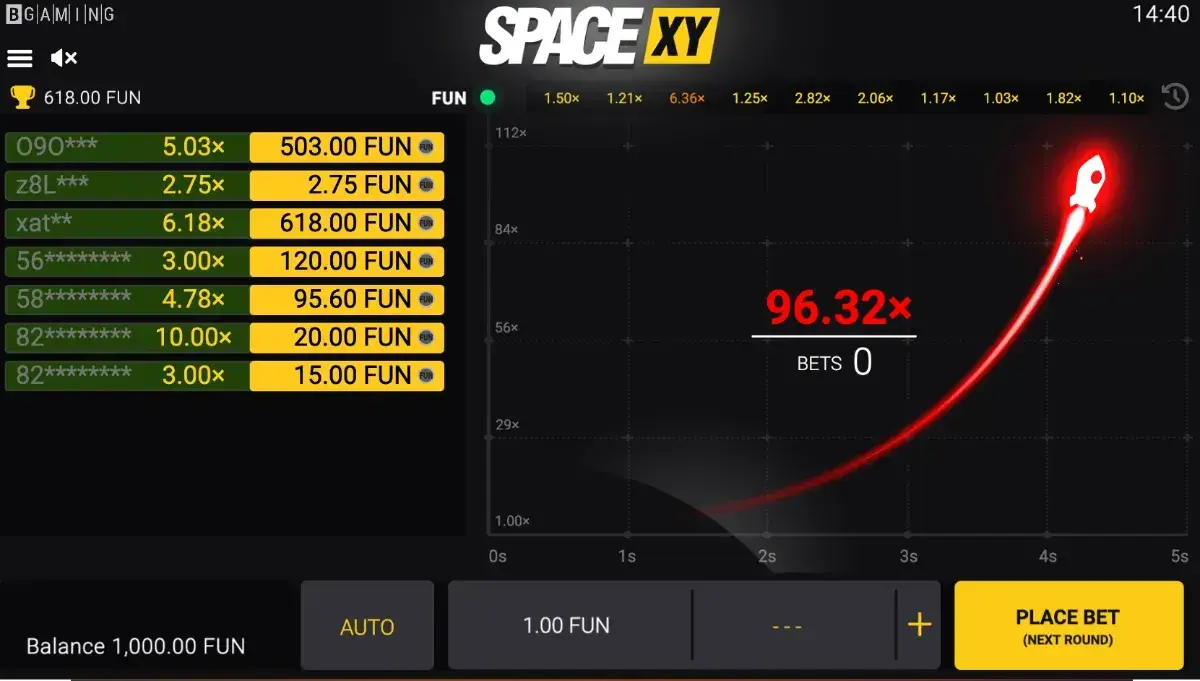
Each round starts with a betting window — a few seconds during which you place your wager. Once the round begins, a rocket launches from the bottom-left corner of the screen and travels upward along the graph. As it climbs, a multiplier in the centre of the screen rises with it: 1.10x, 1.50x, 2.00x, 5.00x, and so on.
At some point, without warning, the rocket crashes. Anyone who has not cashed out by that moment loses their entire bet. Anyone who cashed out before the crash keeps their bet amount multiplied by whatever figure was showing at the moment they hit the button.
The crash point is determined by a certified random number generator before each round begins. It can happen at 1.01x — almost immediately after launch — or it can keep climbing into the hundreds. In theory, the multiplier can reach 10,000x, though rounds that high are rare.
The name Space XY refers directly to the coordinate axes. The X-axis represents time (how long the rocket has been flying), and the Y-axis represents the multiplier value (how high it has gone). When you watch the rocket trace its path across the screen, you are watching a point move along both axes simultaneously.
The pace of play is fast. Most rounds last only a few seconds from launch to crash. Between rounds, there is a brief window — a matter of seconds — during which you place your bet for the next round. If you miss that window, you sit out the current round and bet on the following one. There is no slow build-up, no wait for reels to stop spinning. The game moves quickly, and your attention has to move with it.
The multiplier does not climb at a fixed rate. It can rise slowly at first and then accelerate, or it can jump fast from the start. There is no pattern you can read to predict when a crash will happen — each round’s outcome is generated independently before launch. The visual behaviour of the rocket is a representation of the multiplier value, not a real-time signal you can interpret in advance.
Visually, the game is minimal. The rocket glows in shades of orange and yellow as it rises, leaving a bright trail behind it. The background is a plain black field with a faint suggestion of Earth below the launch point. There are no planets, no stars, no animated elements beyond the rocket itself. It looks clean, but it is sparse — something a number of players have noted as a drawback compared to other crash titles. A small counter beneath the multiplier shows how many bets are currently active in the round, so you can see that other players are in the same game, but their individual bet amounts and cashout points are not visible to you.
Key Features
Dual Bet
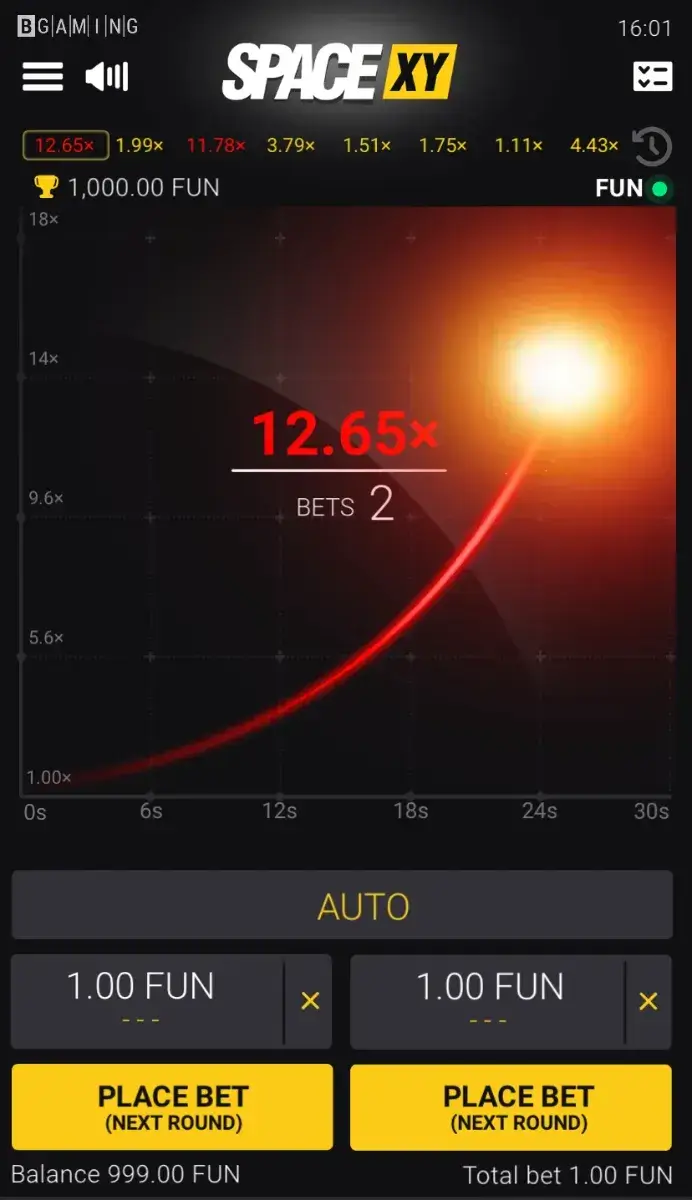
This is Space XY’s most practical differentiator from basic crash games. The game gives you two separate betting panels, and you can use them independently within the same round.
The most common way to use this is to split your strategy. For example, you place ৳500 on Panel 1 with auto cashout set to 2.00x — a conservative exit that locks in a return. At the same time, you place ৳200 on Panel 2 and hold it manually, aiming for a higher multiplier.
If the rocket crashes at 1.80x, you lose both bets. If it reaches 2.10x before crashing, Panel 1 has already cashed out automatically, giving you a return on that portion, while Panel 2 is gone. If the round runs longer — say, 6.00x — you can cash out Panel 2 manually at that point.
The dual bet panel does not let you place unlimited amounts. There is a maximum total bet per round, and the two panels share that cap. If you put a large amount on Panel 1, the available limit for Panel 2 adjusts downward accordingly.
Auto Cashout
You set a target multiplier before the round starts. When the rocket reaches that value, the game cashes out your bet automatically — you do not need to touch the screen.
This matters a lot if you are playing on a mobile browser in Bangladesh. On a Grameenphone or Banglalink 4G connection, there is always a small risk of a brief lag at exactly the wrong moment. Auto cashout removes the manual timing element and hands that decision to the server. If you have a target in mind, set it before launch rather than watching the screen and hoping to hit the button in time.
Autoplay
Autoplay lets the game place bets on your behalf for a set number of rounds. You can configure it to run for anywhere between 5 and 1,000 rounds, or set it to run indefinitely until you switch it off.
Autoplay works alongside auto cashout — you define your bet amount, set your cashout target, and the system repeats that combination automatically. It does not adjust your bet based on wins or losses; it simply repeats the same parameters until the round count runs out.
One practical note: if you use autoplay with auto cashout during a session on a slower mobile connection, the game handles execution server-side, which reduces the chance of a missed cashout due to a momentary drop in signal.
Bet History
A bar above the main playing area shows the crash results from the last ten rounds — the multiplier at which the rocket went down each time. That is all you get. There is no extended history, no frequency chart, no session statistics beyond those ten numbers.
Ten results is not much to work with if you want to assess patterns, though in a game driven by RNG, past results do not predict future outcomes anyway. The limited history display is still a functional gap compared to platforms like Aviator that offer more detailed round data.
RTP and Volatility
BGaming lists Space XY’s theoretical RTP as 97%, which is above the average for crash games. The full range, which you can find in the in-game rules section, is 96.88% to 98.92%.
What determines where in that range your actual return lands? BGaming does not specify. The in-game documentation mentions that strategy affects RTP, but gives no breakdown of which approach produces which figure. Based on how crash game mathematics typically works, more conservative exit strategies (lower multiplier targets) tend to produce outcomes closer to the theoretical RTP ceiling, because the probability of reaching a given cashout point decreases as the multiplier rises. Players chasing high multipliers take on more variance and, over a large sample, see returns toward the lower end of the range. But BGaming has not confirmed this explicitly for Space XY, so treat that as a reasonable inference rather than a confirmed fact.
It is also worth noting that RTP figures only become meaningful over a very large number of rounds — thousands, not dozens. In a short session of 20 or 30 rounds, the actual return can deviate significantly from the theoretical figure in either direction. A single round that crashes at 1.01x early in a session can drag your short-term return well below 90%, while a run of moderate multipliers can push it temporarily above 100%. The 97% figure is a long-run average, not a guarantee for any given session.
On volatility, sources disagree. Some reviews describe Space XY as high-volatility, others as low to medium. The confusion likely comes from mixing two different things: session behaviour and theoretical ceiling. In a typical session, the rocket crashes at relatively modest multipliers more often than it reaches extreme heights. That pattern matches a low-to-medium volatility profile. The theoretical ceiling of 10,000x is high, but reaching it requires a level of luck far beyond what most sessions will produce. The low-to-medium label is the more accurate description of day-to-day play.
One figure that often gets overlooked: the maximum payout is capped at $250,000, regardless of the multiplier. At the maximum single-panel bet of $100, you would need to hit 2,500x to reach that cap — not 10,000x. A player betting ৳500 (approximately $4.50 at current exchange rates) faces a much lower effective ceiling in practice. The 10,000x figure represents the maximum possible multiplier, but for most BD players betting in the ৳200–৳1,000 range per round, the payout cap is not a real constraint.
Betting in BDT
Space XY’s bet range per panel is $0.10 to $100. At current exchange rates — which fluctuate, so treat these as approximations — the minimum sits around ৳11 BDT and the maximum around ৳11,000 BDT per panel. With two panels active simultaneously, a player running both at maximum would be placing roughly ৳22,000 per round, subject to the combined panel cap the casino applies.
Most BD players at mid-tier stakes will find the lower end of the range practical. A ৳200–৳500 bet per panel fits comfortably within the game’s structure and gives enough room to split strategies across the two panels.
Deposits at Bangladesh-facing casinos carrying Space XY are typically handled through bKash, Nagad, or Rocket — the same mobile wallet options you would use at a site running Aviator. The deposit and withdrawal process on the casino side is not specific to Space XY; it depends on the platform you are playing on. Space XY itself is just the game — it does not connect directly to any payment system.
If you are depositing for the first time at a casino to play Space XY, the minimum deposit at most BD-facing platforms using bKash or Nagad is ৳200–৳500. Check the casino’s terms directly, as these amounts vary by operator.
One session bankroll note for BD players: because Space XY rounds resolve quickly and the dual bet option can double your exposure per round, it is easy to go through a deposit faster than expected. If you plan to play more than a short session, sizing your per-round bets conservatively relative to your total deposit makes the bankroll last longer and gives you more rounds to work with.
As a rough guide, if you deposit ৳2,000 and bet ৳200 per panel across two panels, you have around five rounds of cover if every round crashes before your auto cashout triggers. If you are running only one panel at ৳200, that same ৳2,000 deposit gives you ten rounds of cushion. Crash games can produce strings of early crashes that deplete a session balance faster than the RTP figure suggests, especially in a short run of rounds. Keeping per-round exposure in proportion to total session balance is more important here than in slot play, where losses tend to accumulate gradually across many spins.
Mobile Performance
Space XY runs in the browser — no download or installation required. On a Redmi Note 12, Redmi Note 11, or Samsung Galaxy A-series device, the game loads without difficulty over a standard 4G connection on Grameenphone or Banglalink. The graphics are minimal enough that the game does not strain mid-range hardware.
Round speed is fast. Each round lasts only a few seconds from launch to crash, with a short interval between rounds for bet placement. The game moves at a pace where manual cashout requires quick reactions, particularly if the rocket is climbing fast through a range you want to exit.
For mobile play on 4G, the auto cashout feature is worth using if you have a specific target in mind. Mobile connections can drop or lag for a fraction of a second, and in a game where timing matters that much, a manual cashout attempt that arrives a moment late due to network lag costs you the round. Setting auto cashout before launch eliminates that risk by moving the execution to the server rather than depending on your button press.
The game interface adapts well to a portrait or landscape screen on a mid-range Android handset. Both betting panels remain visible and accessible without the layout becoming cluttered. The cashout button is large enough to tap without misreading on a standard smartphone screen.
There is no Space XY app in the Google Play Store — the game is accessed through the casino’s mobile browser interface. Most BD-facing casino sites have mobile-optimised layouts that work adequately on a Redmi or Samsung Galaxy A-series device.
Space XY vs. Aviator
Aviator, made by Spribe, is the dominant crash game in Bangladesh. Most players who try Space XY are coming from Aviator, so a direct comparison is useful.
| Feature | Space XY (BGaming) | Aviator (Spribe) |
|---|---|---|
| Developer | BGaming | Spribe |
| Release year | 2022 | 2019 |
| RTP | 96.88%–98.92% (theoretical 97%) | 97% (standard) |
| Provably fair | No (RNG, iTech Labs certified) | Yes |
| Dual bet | Yes | Yes |
| In-game live chat | No | Yes |
| Live bets feed | No | Yes (other players’ bets visible) |
| Stats history | Last 10 results | Extended history available |
| Max multiplier | 10,000x | Theoretically uncapped |
| Max payout cap | $250,000 | Varies by operator |
| Autoplay | Yes (5–1,000 rounds or infinite) | Yes |
| Platform | HTML5, browser-based | HTML5, browser-based |
Where Space XY has a practical edge: The dual bet panel is the main one. While Aviator also offers dual bets, Space XY’s implementation is straightforward and functions reliably on mobile. The slightly wider theoretical RTP ceiling (up to 98.92% versus Aviator’s flat 97%) is a marginal advantage, though whether any given player actually realises that depends on strategy and variance.
Where Aviator is stronger: Provably fair is the biggest gap. Aviator uses a multi-source provably fair system, meaning players can independently verify the outcome of any round using publicly available cryptographic data. Space XY does not offer this. Its RNG is certified by iTech Labs, which is a legitimate independent testing lab, but iTech Labs certification and provably fair are different things. Certification means an independent lab checked the RNG meets fairness standards; provably fair means you can personally verify each outcome after the fact. Players who care about transparency will find Aviator more reassuring on this point.
Aviator also has a live chat window inside the game and a real-time feed of other players’ bets and cashouts. Space XY has neither. The community aspect of Aviator — watching others bail out at different points, seeing what the high-rollers are chasing — is absent in Space XY. For some players this makes no difference; others find it useful for gauging the room.
The stats display in Aviator is also more detailed. Space XY shows the last 10 crash results and nothing more. Aviator shows more rounds of history, which at least gives players a longer visual reference, even if past results do not predict future outcomes.
Which type of BD player might prefer Space XY: Players who want to experiment with the dual bet strategy in a straightforward interface, or who simply want a break from Aviator without learning a completely different game format. The mechanics are close enough that transitioning between the two requires no adjustment period.
Who is better off staying with Aviator: Anyone for whom the provably fair verification matters, anyone who uses the live bets feed as part of how they approach the game, or anyone who wants more historical data visible on screen.
Weaknesses
Space XY has real limitations that most reviews underplay or skip entirely.
Not provably fair. This is the most significant one. BGaming uses a certified RNG, and iTech Labs is a credible testing organisation. But you cannot independently verify a Space XY round after the fact. If you care about being able to check game outcomes yourself, Space XY cannot offer that.
Plain visuals. The background is flat black with minimal detail. The rocket is well-designed, but there is not much else to look at. After a few hours of play, the environment is static. This is a purely aesthetic issue and does not affect gameplay, but it is a gap compared to crash games that have put more work into the visual environment.
Limited statistics. Ten rounds of crash history is not much. There is no way to access a longer history of results within the game, and there are no player statistics or session tracking tools built in.
No in-game live chat. Space XY is a multiplayer game in the sense that multiple players are betting in the same round, but there is no communication layer. You can see how many active bets are in play below the multiplier display, but you cannot see individual bets from other players, and there is no chat.
Minimum bet limitations depending on platform. The game’s own range starts at $0.10 per panel, but some casinos set their own minimum above the developer’s floor. Check the casino’s terms before assuming the minimum will be ৳11.
The max payout cap. $250,000 is the hard ceiling regardless of multiplier. For the vast majority of BD players this is not a practical issue, but it is worth knowing that the 10,000x multiplier only pays out at full value if your bet is small enough that 10,000x does not exceed the cap.
Who Should Play Space XY
Space XY is a reasonable option for BD players who enjoy crash games and want an alternative to Aviator from time to time. The dual bet feature works well in practice, the mobile experience on mid-range Android hardware is fine, and the RTP is competitive.
It is not the right game if provably fair transparency matters to you — Aviator handles that better. It is also not going to give you a rich visual experience or a social element inside the game itself.
The game suits players who prefer a clean, minimal interface and want the dual betting mechanic to run structured strategies across two risk levels per round. If you have been playing Aviator for a while and want to try something mechanically similar without a steep learning curve, Space XY works for a session or two to see if the format suits you.
Start with small amounts — ৳100–৳200 per panel — until you are comfortable with how the auto cashout and dual bet interact. Crash games at any multiplier target can go wrong quickly if you are sizing your bets without accounting for the round speed.
Frequently Asked Questions
Can I deposit with bKash to play Space XY in Bangladesh?
Yes, through Bangladesh-facing casinos that carry BGaming titles and support bKash deposits. Space XY itself does not process payments — the deposit goes through the casino platform. Most BD-facing operators that offer Space XY support bKash, Nagad, and Rocket as standard deposit options. Check the specific casino’s cashier page to confirm minimum deposit amounts and processing times, as these vary by operator.
What is the minimum bet in BDT?
The game’s minimum per betting panel is $0.10, which at current exchange rates is approximately ৳11 BDT. However, individual casinos may apply a higher minimum than the developer’s floor. The effective minimum in Taka depends on both the exchange rate at the time you play and the casino’s own minimum bet policy.
Is Space XY provably fair?
No. Space XY uses a certified random number generator, audited by iTech Labs, an independent testing laboratory. That certification confirms the RNG meets fairness standards. It is not the same as a provably fair system, which would allow you to independently verify each round’s outcome using cryptographic data after the fact. Space XY does not offer that verification mechanism.
How does the dual bet work?
The game provides two separate betting panels. You can activate one or both per round, setting a different bet size and cashout strategy for each. A common approach is to use Panel 1 with auto cashout set at a conservative multiplier as a baseline return, and Panel 2 held manually for a larger potential payout. The two panels share a combined maximum bet cap per round, so the amount you place on Panel 1 affects how much is available on Panel 2.
What RTP can I expect from Space XY?
The theoretical RTP is 97%, with a stated range of 96.88% to 98.92%. BGaming links the variation to strategy but does not specify which approach produces which figure. Over a large number of rounds, conservative cashout strategies tend to produce outcomes closer to the upper end of the stated range, while chasing high multipliers introduces more variance. In practice, short-session results can differ significantly from the theoretical average in either direction.