3 Lucky Idols went live in June 2026, and it arrives with a problem that has nothing to do with its math model: nobody outside Amigo Gaming’s own build sheet knows what that math model actually returns. The official game page lists a grid, a paylines count and a maximum multiplier. It does not list an RTP. That omission is the first thing worth understanding about this release, because it shapes almost everything that follows in this review.
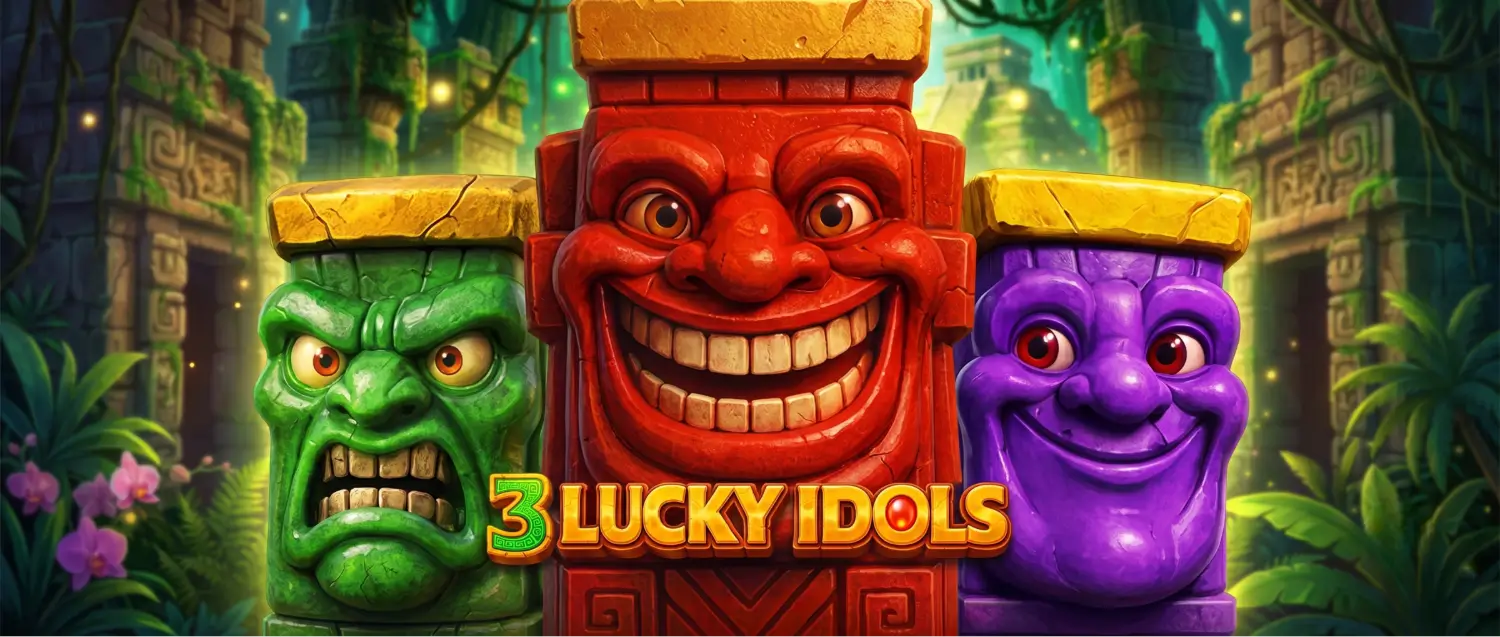
Amigo Gaming is a Cyprus-registered studio (CLOUDBRIDGE LTD) that has built a recognisable identity around one mechanic: the Pin Win bonus, a Hold & Win variant that shows up across dozens of its titles, from Golden Toro to Skull Coins to the studio’s own volcano-themed sibling, 3 Spirit Volcanoes. 3 Lucky Idols is the jungle-temple reskin of that same design language — three coloured guardians instead of three volcanoes, tokens instead of masks, but the same core promise. Three gods watch your reels. One of them, at random, decides whether you get a small Pin Win, a stacked double, or the full triple.
At medium-high volatility and a x6000 max win ceiling on a 30-line, 5×3 grid, the numbers on paper put this somewhere between a serious high-roller title and a mid-tier volatility slot that wants to look bigger than it plays. Whether that ceiling is reachable, and whether the RTP gap should worry you, is what the rest of this review works through.
Math model and mechanics: a slot that won’t show its own numbers
Here’s the fact that has to be stated plainly before anything else: Amigo Gaming has not published an RTP figure for 3 Lucky Idols. Not on the official game page, not in any press material tied to the June 2026 launch, and not yet on SlotCatalog, Casino Guru or any of the major independent aggregators — the game is too recent for third-party testing to have caught up. This is not unique to this title. The studio’s own volcano-themed sibling, 3 Spirit Volcanoes, shipped with the same gap: reviewers noted at launch that RTP and hit frequency data “have not been publicly released by Amigo Gaming.”
That pattern matters. Amigo Gaming’s broader portfolio clusters tightly around 96.0%–96.06%, GLI-certified, according to independent provider audits covering the studio’s confirmed titles. That range is a reasonable expectation for where 3 Lucky Idols will eventually land once an aggregator or a licensed operator publishes the certified figure. It is not a substitute for that figure. Treat the 96% neighbourhood as the studio’s house style, not as this game’s confirmed number, and check the in-game paytable at your casino of choice before you stake anything meaningful — operators can and do configure RTP within the range a certificate allows, and until 3 Lucky Idols has independent test data, you’re relying entirely on whatever the operator’s build displays.
Volatility is listed officially as medium-high, which sits a notch below the “high” or “extreme” label Amigo reserves for its most punishing releases. In practice, medium-high on a Pin Win chassis usually means the base game pays in dribs and drabs — small line hits from the standard symbol set — while almost all of the meaningful money sits behind the token-collection mechanic. You are not grinding out a living on base spins here. You are waiting for one of three gods to wake up.
The grid is a 5-reel, 3-row layout (the official listing calls it “3 x 5,” rows by reels) running 30 fixed paylines. That’s a conservative paylines count for a 2026 release — plenty of competitors in this bracket run 50 lines or move to a ways-pay format for a bigger combination count. Thirty fixed lines keeps the base game simple and the paytable easy to read, but it also means base-game hit frequency has less structural help than it would on a wider-paying grid.
The max win is x6000 the stake. Context matters here more than the number alone. On a £1 spin, that’s a £6,000 ceiling — competitive against the wider mid-market slot field, but well below headline chasers like Book of 99’s five-figure multiplier or even some of Amigo’s own high-volatility Pin Win titles, which have run as high as 1,000x jackpot components stacked into bigger totals. Compared directly to the studio’s own 3 Spirit Volcanoes, which caps at 1,100x, 3 Lucky Idols is a considerably bigger swing — nearly 5.5 times the ceiling on a structurally similar chassis. That’s the clearest signal that this is meant to be the more aggressive release in the pair.
No bet range appears on the official page either. Amigo’s comparable titles typically run somewhere between £0.10–£0.20 at the low end and £50–£100 at the high end, but until an operator build confirms it for this specific title, don’t assume that range applies here. Check the in-game paytable before you commit a stake.
What does the missing RTP actually cost you in practice? Take the studio’s general 96.0%–96.06% neighbourhood as an illustrative baseline, not a confirmed figure for this game. On that basis, £500 wagered across a session at £1 a spin would theoretically return somewhere near £480 over the long run, with the gap widening or narrowing depending on where the operator’s build actually sits within whatever range the certificate allows. A half-point swing either side of that estimate — the kind of gap that shows up constantly between an operator-configured build and a studio’s headline figure — moves that same session’s expected return by £2.50 to £3. That’s not a large number on its own, but it’s the exact kind of detail that should be visible in the paytable and currently isn’t, for this specific title.
Hit frequency hasn’t been published for 3 Lucky Idols either, and the studio doesn’t have a consistent house number to lean on here — Amigo’s wider catalogue runs anywhere from roughly 14% to 27% depending on the title and its paylines count, so there’s no safe assumption to carry across from one game to the next. What can be said with more confidence, based on the 30-line structure and the medium-high volatility label, is that base-game wins should land often enough to keep the reels feeling active, while the money genuinely worth chasing sits almost entirely behind the token-and-idol system. That’s a standard shape for this bonus format, and it’s also exactly why the missing activation-rate data for the idol triggers matters more than the missing base-game hit frequency does.
Feature breakdown: three gods, one random switch
The idol and token system
Trigger: Green, Red and Purple TOKEN symbols land during ordinary base-game spins and are tracked against their matching idol above the reels.
Mechanic: Each idol collects only its own coloured token. When enough tokens accumulate — the exact threshold isn’t published — the matching guardian “awakens” and hands you a Pin Win Bonus tailored to that idol’s personality. The official copy describes three possible attribute types tied to the idols: Collect, Boost, and Payer. What isn’t published anywhere yet, including on the official page, is which idol maps to which attribute, or what the underlying respin values and multiplier bands actually are.
Honest limitation: This is the single biggest transparency gap in the whole release. Amigo’s sister title 3 Spirit Volcanoes at least lets you infer the shape of the Collect/Boost/Payer split by analogy — its Red volcano runs a Pick’em with tiered awards, its Purple volcano runs a Hold & Win Pin Win with fireball multipliers and fixed jackpot tiers, its Green volcano runs a straightforward free spins mode. If 3 Lucky Idols follows the same internal logic — and the shared “PIN WIN Bonus… Collect, Boost, or Payer” language strongly suggests it does — then Collect likely means gathering values across multiple activations, Boost likely means upgrading existing symbol values mid-round, and Payer likely means a straight cash-value collector. That’s an informed inference from the provider’s own pattern library, not a confirmed spec. Don’t build a betting strategy around it.
Single Pin Win Bonus
Trigger: One idol awakens on its own.
Mechanic: Standard Amigo Pin Win structure, based on everything else the studio has shipped: a locked-symbol respin round, most commonly running three respins that reset back to three every time a new qualifying symbol lands. The round ends either when respins run out or the grid fills.
Realistic contribution: In the studio’s other Pin Win titles, a single un-boosted activation of this type typically delivers somewhere in the low tens of stake multiples — a nice top-up, not a headline win. Expect the same shape here until confirmed otherwise.
Honest limitation: A single-idol trigger is, by definition, the weakest outcome of the three possible activations. If you’re chasing the x6000 ceiling, this isn’t the version of the bonus that gets you there.
Double and Triple Pin Win Bonus
Trigger: Two or all three idols awaken simultaneously — described in Amigo’s own launch copy as the idols combining their powers into a Double or Triple PIN WIN variation.
Mechanic: This is presumably where the multiplied ceiling comes from — running two or three of the idol-specific bonus types either sequentially or stacked, similar to how 3 Wonders – Underworld Kingdom (a direct competitor, more on that shortly) allows its own three coin-modifier features to run concurrently rather than one at a time.
Realistic contribution: This is almost certainly the path to anything near the top of the paytable. Whether it happens once every few hundred spins or once every few thousand is exactly the kind of hit-frequency data that hasn’t been published for this title and won’t be reliably known until independent trackers accumulate real spin samples post-launch.
Honest limitation: A random, uncontrollable trigger for the biggest payout mode is a design choice, not a flaw exactly, but it does mean you have zero agency over reaching the game’s best outcomes. Compare that to Pragmatic Play’s 3 Genie Wishes, where the three-wish mechanic is a player pick, not a random idol handshake. One gives you a say in your own bonus. The other doesn’t.
Random Bonus Mini-Game
Trigger: Described as triggering independently of the token system — a spinning wheel that “awards powerful bonuses.”
Mechanic: Wheel-based bonus mini-games in this genre typically award instant cash multipliers, free spins allocations, or direct entry into one of the idol-specific Pin Win variants. Amigo hasn’t published the wheel’s specific segment values for this title.
Realistic contribution: Treat this as a variance smoother — a secondary path that keeps the reels feeling alive between idol activations, rather than a primary route to the max win.
Honest limitation: Without published trigger odds, there’s no way to state how often you’ll actually see this wheel in a normal session. That’s worth knowing going in, not discovering three hundred spins later.
Buy Bonus
Trigger: Purchased directly, at any time, for a fixed multiple of the current stake.
Mechanic: Instant access to the token/idol bonus round without grinding the base game to trigger it naturally.
Realistic contribution: Across Amigo Gaming’s confirmed portfolio, Buy Bonus features on comparable titles have run in the 80x–100x stake range. That figure comes from the studio’s broader catalogue, not a confirmed price for 3 Lucky Idols specifically — the official page confirms the feature exists but doesn’t list a cost. If the studio holds to its own pattern, expect something in that neighbourhood; verify the exact price in the operator’s paytable before buying in.
Honest limitation: Buying into a random-outcome trigger means you’re paying a fixed price for a variable result — you could buy in and land the weakest single-idol outcome just as easily as the triple. That’s true of every Buy Bonus feature in the industry, but it’s worth restating here given how much of this game’s ceiling depends on which idol combination you land.
Wild, Scatter and Instant Pays
Trigger: Standard reel-based landing during ordinary spins — no collection mechanic involved.
Mechanic: The official feature tags list WILD, SCATTER and INSTANT PAYS alongside the bonus-specific mechanics, which tells you the base game isn’t purely a token-delivery vehicle. A Wild substitutes for standard symbols to complete extra combinations, a Scatter presumably pays on scatter positions independent of the fixed paylines (the exact symbol count required hasn’t been published), and Instant Pays is Amigo’s shorthand for direct cash-value symbols that pay out immediately rather than feeding a collector meter.
Realistic contribution: In practice, this trio does the unglamorous job of keeping the base game from feeling completely dead between idol activations. None of the three is likely to be a major swing factor on its own — that job belongs to the Pin Win system — but together they set the base-game rhythm and the small, regular top-ups that make the long stretches between triple activations tolerable.
Honest limitation: No paytable values for any of these three symbols have been published for this title yet. Until an aggregator or operator posts the full symbol paytable, there’s no way to say whether the top standard symbol pays a meaningful multiple of the stake or barely covers the spin cost. That’s a real gap for a slot that’s already asking players to trust an unconfirmed RTP.
The 2026 perspective: familiar bones, no sequel yet, and an honest gap in the data
There’s no Power Reels, Megaways or expanded-grid variant of 3 Lucky Idols — the game is one month old at the time of writing, and Amigo Gaming hasn’t announced one. The closer comparison isn’t a sequel; it’s the studio’s own sibling release, 3 Spirit Volcanoes, which shares the identical bones: a 5×3 grid, three colour-coded guardians (there, volcanoes), a Pile Collector/token mechanic feeding into a Pin Win round, and a Random Bonus path running alongside it. The differences are the theme, the paylines count (25 fixed on the volcano game versus 30 here), and the ceiling — 1,100x on 3 Spirit Volcanoes against 6,000x on 3 Lucky Idols. Neither game has a published RTP. If you’ve played one, you already understand roughly how the other will feel to spin; the jungle version is simply built to swing harder.
Two named competitors show what “three-path bonus” slots look like when the numbers are actually public.
3 Wonders – Underworld Kingdom (Boomerang Studios, distributed via Spin Games) is the closer structural match. It’s built on a jungle/ancient-ruins theme with three idol totems that can each award coin-modifier features — and, crucially, all three can fire at once and stack, the same “Double or Triple” concept 3 Lucky Idols is selling. SlotCatalog lists its RTP at 95.53% on medium volatility, with a confirmed 50-payline, 5×4 grid running stakes from $0.50 to $50. Max win is where sources disagree: SlotCatalog states 9,400x, VegasSlotsOnline states 4,965x — a genuine discrepancy worth flagging rather than picking one figure and moving on, and a reminder that even “confirmed” competitor data isn’t always internally consistent across aggregators. Either number comfortably dwarfs 3 Lucky Idols’ 6,000x ceiling, and Underworld Kingdom has the advantage of an actual published RTP. If you want this exact concept with numbers you can verify today, Underworld Kingdom is the more transparent pick.
3 Genie Wishes (Pragmatic Play) takes the “three magical figures, three outcomes” premise and hands the decision to the player instead of the RNG — you choose which of the three wishes to pursue rather than waiting for an idol to wake up. It’s a much older, much calmer game: 96.53% RTP, medium volatility, and a modest 500x max win most sources agree on (a handful of older listings cite figures as high as 4,000x, which looks like a legacy paytable version rather than the current build — another discrepancy worth naming rather than smoothing over). It’s not really competing for the same player. Genie Wishes is the comfortable, transparent, low-ceiling option; 3 Lucky Idols is chasing the bigger number with a mechanic that offers you no control over how you get there.
That contrast is the honest way to place 3 Lucky Idols in the current market. It has a genuinely higher ceiling than its own studio sibling and a more dramatic random-trigger structure than the Pragmatic comparison, but it’s launching with less public data than either direct competitor. Buy-bonus availability confirms Amigo wants players who’d rather pay than grind; the absence of a progressive jackpot (nothing in the official materials suggests one) confirms this is a fixed-ceiling game, not a network jackpot title. In a 2026 lobby stacked with high-RTP transparency plays — Book of 99, Mega Joker’s legendary payout reputation, and a growing pile of aggregator sites building entire content strategies around checking the RTP before you play — a slot that ships without that number is swimming against the current trend, whatever its mechanics look like on paper.
Mobile matters here too, given how much of 2026’s slot traffic runs through a phone screen rather than a desktop browser. Amigo’s HTML5 build standard across its confirmed catalogue runs at a smooth frame rate on both iOS and Android, and there’s no reason to expect 3 Lucky Idols to break that pattern — the game launched with 30 language options listed on the official page, which points to a wide, mobile-first distribution push across multiple markets rather than a niche desktop release. What that doesn’t tell you is anything about load times or data weight on a budget handset, and Amigo hasn’t published technical specs on that front either.
Buy Bonus pricing is worth one more pass in the competitive context. If 3 Lucky Idols lands in the studio’s usual 80x–100x range, buying straight into the token round on a £1 spin would cost roughly £80–£100 for a shot at an unknown mix of single, double or triple activations. Compare that to a game with a published RTP and a known feature-buy cost, where you can at least calculate the buy’s own effective return. Here, you’d be paying a fixed, still-unconfirmed price for a swing at an unconfirmed range of outcomes — a double layer of uncertainty that a cautious player should weigh before treating the buy-in as a shortcut rather than a gamble on top of a gamble.
Verdict: interesting mechanic, incomplete paperwork
3 Lucky Idols is a competently built extension of Amigo Gaming’s Pin Win formula, wearing a jungle-idol skin over bones that already exist elsewhere in the studio’s catalogue. The three-way random trigger and the Double/Triple stacking concept are the game’s real hook, and a 6,000x ceiling is a legitimate step up from the studio’s own volcano-themed sibling. The number that most limits this review isn’t a mechanic — it’s the missing RTP. Until Amigo Gaming, a licensed operator, or an independent aggregator publishes a certified figure for this specific title, every player is spinning on the studio’s general 96%-neighbourhood reputation rather than a confirmed number for this game.
Play this if you already trust Amigo Gaming’s broader catalogue and you’re drawn to the specific appeal of a random, uncontrollable three-way bonus split — the anticipation of not knowing which god wakes up is a real, if unquantifiable, part of the experience. This is also a reasonable pick for a player who wants a bigger swing than 3 Spirit Volcanoes offers without leaving the same studio’s design language, since the 6,000x ceiling gives the format genuinely more room than its own sibling ever had.
Skip it, for now, if RTP transparency is a hard requirement before you stake real money. A player who wants a documented, third-party-verified return figure has better options this month: 3 Wonders – Underworld Kingdom offers a near-identical three-idol, stacking-bonus concept with a published 95.53% and a bigger confirmed ceiling on top, and 3 Genie Wishes offers a calmer, fully transparent 96.53% for anyone who’d rather know exactly what they’re signing up for before the reels start turning. Neither of those games asks you to take the studio’s word for it.
Check the in-game info panel at whichever operator carries 3 Lucky Idols before you play — if the certified RTP is displayed there, use that figure, not this review’s estimate, as your baseline. Until then, the honest summary is this: an interesting mechanic wrapped around an incomplete spec sheet, from a studio with a track record solid enough to make that gap feel like an oversight rather than a warning sign — but a gap worth knowing about all the same.