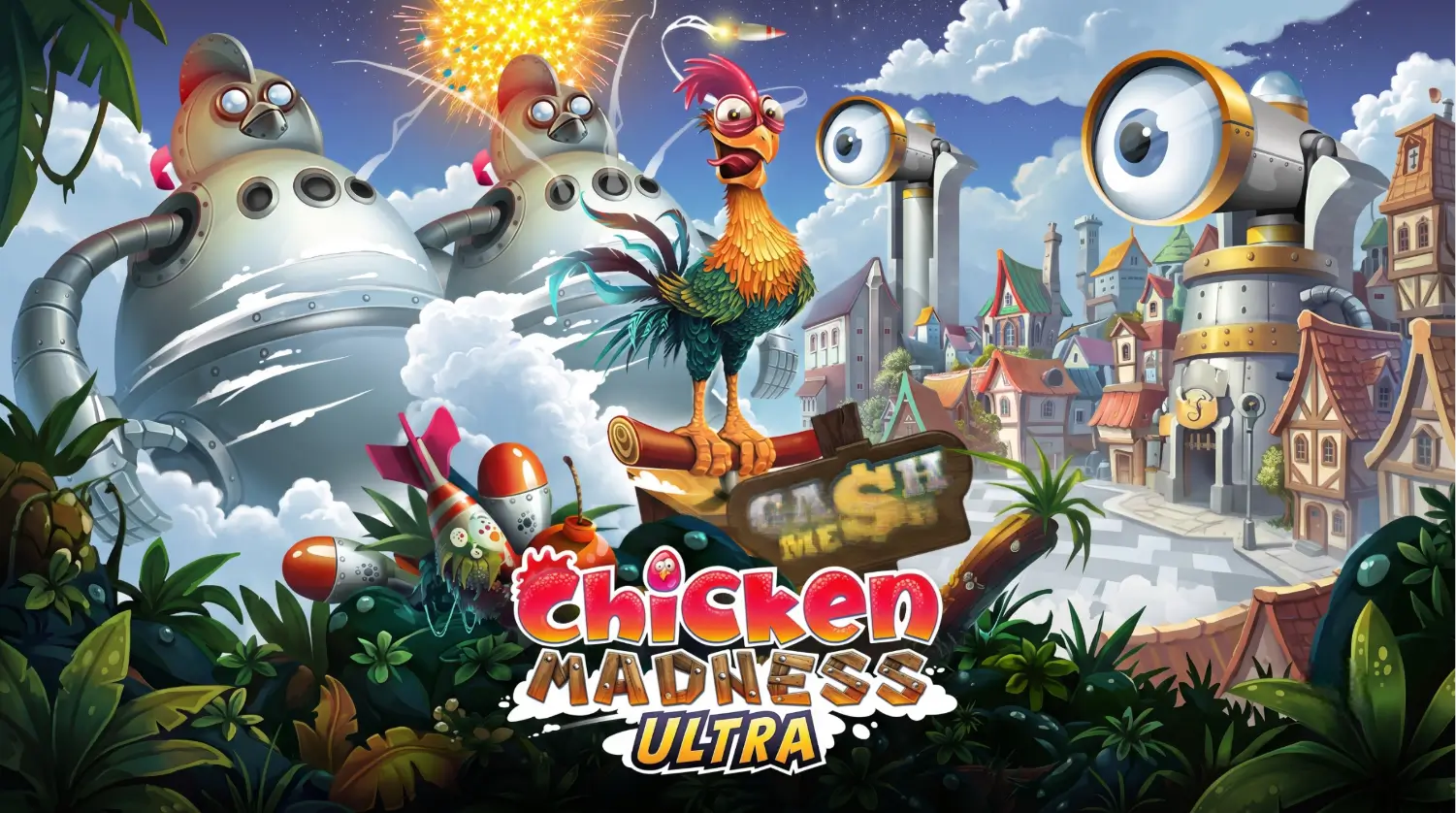
Chicken Madness Ultra has been sitting in BF Games’ library since April 2023, and it is still the studio’s flagship farmyard title three years on. That is a long shelf life for a mid-tier release, and it tells you the math holds up well enough that operators keep it in rotation. The game sits at 96.01% RTP on its top setting, runs high volatility, and builds its entire identity around a Hold and Win round called Cash Mesh. What it does not do, and this is the detail worth sitting with before you load the demo, is publish an official maximum win. Every major aggregator that lists this game leaves that field blank. That single gap shapes almost everything else in this review.
The math model: three RTP numbers and a ceiling nobody will confirm
Start with the return-to-player figure, because in Bangladesh this is the number that decides whether a game is worth your time before you even look at the graphics. RTP tells you how much of every taka wagered comes back to players over a very large number of spins — not on your session, but averaged across millions of spins by everyone who plays the game. Chicken Madness Ultra ships in three configurable versions: 92.05%, 94.06%, and 96.01%. Operators choose which one to run, and the choice is not visible on the reels. You have to check the in-game paytable or the operator’s RTP disclosure page to know which version you are actually playing.
That 4-point spread matters more than it looks. On a ৳1,000 session at 20 spins a minute for an hour, the difference between the 96.01% build and the 92.05% build works out to roughly ৳240 in expected long-run return — not something you will feel on any single spin, but it compounds over months of play. One aggregator lists a slightly higher top figure of 96.06% for this game; SlotCatalog and the majority of other trackers confirm 96.01% as the highest published setting. Treat 96.01% as the number to look for, and if your casino’s info panel shows something lower, you are on a weaker build than the game is capable of running.
Why do RTP ranges exist at all? Because BF Games, like most studios, builds several math models into the same game code and lets each operator pick which one to switch on server-side. Nothing on the reels tells you which build you’re on — the graphics, the paytable multipliers, and the feature triggers all look identical across all three versions. The only place the difference shows up is in the actual long-run return, and the only way to check it before you deposit is the in-game “i” or rules icon, which should list the exact RTP your operator is running. If that panel doesn’t show a number, or shows something outside the 92.05–96.01% range, that’s worth a support ticket before you commit real money.
Put the spread in concrete terms. Deposit ৳2,000 and play it down at an average ৳10 stake across roughly 200 spins. At 96.01% RTP, the theoretical long-run return on that action is around ৳1,920. At 92.05%, it drops to around ৳1,841 — a difference of roughly ৳79 on that single session, and one that scales up the longer and more often you play. Neither figure tells you what actually happens on 200 spins of a high-volatility game (short sessions on high-variance titles swing hard in both directions), but it does tell you which build rewards patience better over the months.
Volatility is rated high across every source that lists it, and the practical description matters more than the label. High volatility on a 5×3, 10-payline game with a hold-and-win bonus means the base game will feed you small, frequent nudges from the wild and the card-royal symbols, while the real money sits behind the Cash Mesh trigger — which does not show up often. Hit frequency is listed at 25%, meaning roughly one spin in four lands some kind of win, but most of those wins are small enough that they barely dent your balance before the next bet. You are not playing this for base-game consistency. You are playing it for the bonus round, and the bonus round makes you wait.
Here is the part that actually needs saying plainly: Chicken Madness Ultra has no confirmed maximum win multiplier. SlotCatalog — the industry’s most reliable spec tracker — lists the Max Win field as N/A. No official BF Games page states a ceiling either. A handful of low-authority aggregator sites throw out numbers like “$50” or “$2,500,” but those figures don’t hold up: $50 matches the game’s max bet, not a win multiplier, and $2,500 has no sourcing behind it at all. Rather than repeat a number that cannot be verified, the honest position is this: the top end of this game is defined by its uncapped progressive Grand Jackpot, not by a fixed multiplier. That is a fundamentally different math model from most 2026 farm slots, and it is worth understanding before you compare Chicken Madness Ultra to anything else in this niche.
Grid structure is straightforward: 5 reels, 3 rows, 10 fixed paylines running left to right. Betting range runs from €0.10 to €50 per spin (roughly ৳12 to ৳6,000 at typical conversion, though your operator sets the exact BDT figures). There is no Megaways engine here, no cluster-pays grid, no expanding reel set — the whole game leans on two mechanics doing the heavy lifting, which the next section breaks down properly.
Release dating carries a small discrepancy worth flagging rather than hiding: SlotCatalog’s attribute table lists 2023-04-06 as the release date, while several review sites cite 24 April 2023. Neither figure changes anything about how the game plays, but if you’re cross-referencing sources yourself, expect to see both dates in circulation. The game runs on JS/HTML5, weighs in at roughly 33.6 MB, and is built for both desktop and mobile browsers — a reasonable file size for a mid-range Android phone on a Grameenphone or Banglalink 4G connection, without the loading delays that heavier 3D-engine titles sometimes bring on slower mobile data.
Feature breakdown: two systems, one doing more work than the other
The progressive win multiplier
This is the mechanic BF Games actually built the base game around, and it’s simple enough to explain in one line: every consecutive winning spin bumps a global multiplier upward, starting at x2 on your second straight win and capping at x5 on your fifth. The multiplier applies to your spin win, not to your stake directly, and — this is the part that makes it interesting — it does not reset while you keep winning. It only drops back to x1 the moment a spin returns nothing.
In practice this rewards streaks rather than single lucky spins. A x1 win followed by four more consecutive hits turns your fifth win into a x5 payout on that specific spin’s result. The catch, and there is always a catch with high-volatility math, is that 25% hit frequency makes a five-spin winning streak a genuinely rare event. You’ll see the multiplier climb to x2 or x3 reasonably often. Getting it to x5 before a dry spin resets it back down is the kind of thing that happens maybe once in an extended session, not every session.
Chicken Wild
One of the roosters on the reels acts as a wild, substituting for every regular paying symbol except the Coin bonus symbol that triggers Cash Mesh. Card royals (J through A) pay between x0.5 and x5 of your stake for a five-symbol line — these are the fillers that keep the 25% hit frequency ticking over, and individually they barely register against your balance. The premium set — farmer, chef, fox, rooster — pays x10 to x25 of stake, a meaningful step up that’s still nowhere near enough on its own to justify the game’s high-volatility label.
The wild itself carries the strongest base-game payout in the game: land a five-symbol wild combination and you’re looking at up to x50 stake, the ceiling for anything outside the bonus round. That’s a solid top-line base-game hit for a mid-tier symbol set, though landing five wilds on one spin across just 10 fixed paylines is exactly as rare as it sounds — in practical terms, this is closer to a bonus-level event than something you should plan a session around. Where the wild earns its keep more often is in completing partial lines with the premium symbols, nudging what would have been a three-of-a-kind farmer combination into a four- or five-symbol payout instead.
Cash Mesh — the Hold and Win round
This is where the game’s identity actually lives. Drop 5, 6, 7, 8, 9, or 10 Coin symbols anywhere on the 5×3 grid in a single base-game spin, and you trigger Cash Mesh with a matching number of respins — land 7 coins, get 7 respins. Every coin that’s already locked stays locked; the remaining empty positions respin individually, and any new coin that lands resets your respin count back up, the way Hold and Win rounds generally work across the industry.
Each locked coin carries either a fixed cash value or one of four jackpot labels. Two are fixed multipliers of your stake: Mini pays x10, Minor pays x20. Two are progressive and pool across the network: Major starts at a base value of £500, Grand starts at a base value of £1000, and both climb with every real-money spin placed on the game anywhere it’s live, until someone hits them. If your respins run out before you’ve filled the entire grid, you’re sometimes handed 1, 2, or 3 extra bonus spins at random to keep the round alive a little longer — a small mercy mechanic that stops the bonus dying too early too often.
Fill the entire 5×3 grid — all 15 positions covered with coins — and a Full House multiplier doubles every collected cash prize (the jackpot values are excluded from this doubling; they pay at their locked value). A full house is genuinely rare. Most Cash Mesh rounds end with a partial grid and a payout built from whatever mix of fixed coins and jackpot hits landed during the respins, not the doubled full-house outcome the marketing screenshots like to show.
Realistically, most triggers land closer to the 5-coin minimum than the 10-coin maximum, which means most Cash Mesh rounds start with 5 respins and a grid that’s already two-thirds empty. The round can still stretch out if new coins keep landing during those respins — every fresh coin resets your remaining-respin count, so a lucky run can turn a 5-respin trigger into a genuinely long bonus round — but the baseline expectation should be a short round that closes with two or three coins collected, most of them fixed-value rather than jackpot-labelled. The jackpot symbols exist, and they do get hit, but they’re the minority outcome inside a minority feature, which is the honest way to frame a bonus round that only fires on a 25%-hit-frequency base game in the first place.
The honest limitation to flag here: because Major and Grand pull from a shared progressive pool, their actual value at the moment you trigger Cash Mesh depends entirely on how long it’s been since someone last won them. You could hit the round and find Grand sitting at its £1000 floor, or you could hit it after months of accumulation and find a genuinely large number attached. There’s no way to know in advance, and the game gives you no visibility into the current pool size before you commit a spin.
The 2026 perspective: how this holds up against its own family and the wider market
Chicken Madness vs. Chicken Madness Ultra
BF Games released the original Chicken Madness in April 2022, a full year before Ultra. The base numbers are close cousins: same 5×3 grid, same 10 fixed paylines, same high volatility rating, and RTP configured across three tiers — sources give slightly different exact figures here (SlotCatalog lists 92.03% / 94.08% / 96.06%, while BF Games’ own product page shows 92.13% / 94.13% / 96.15% for the original), but both land the top setting a hair above Ultra’s 96.01%. Hit frequency on the original comes in at 27%, marginally more forgiving than Ultra’s 25%.
The structural difference is the progressive win multiplier. The original Chicken Madness doesn’t have it — it runs a “Mighty Cash” feature built around the same two-fixed, two-progressive jackpot skeleton, but without the streak-reward layer BF Games bolted onto Ultra. That’s the actual upgrade the sequel offers: a reason to keep spinning through a cold base game beyond just chasing the coin trigger. What it didn’t fix is the transparency gap — neither game publishes a maximum win, and neither has for the three-plus years both titles have been live.
BF Games has since released a third entry, Chicken Madness Ultra Dice, in mid-2025. It runs the same RTP configuration (92.05% / 94.06% / 96.01%) and the same Cash Mesh trigger logic, but the fixed jackpot multipliers are noticeably smaller — Mini pays x2 stake and Minor pays x3 stake, against Ultra’s x10 and x20. That’s not a minor tweak; it roughly halves the guaranteed floor value of a Cash Mesh round that doesn’t hit a progressive. If you’re choosing between the two newer titles, Ultra’s fixed payouts are the stronger baseline even before you factor in jackpot variance.
Where it sits against named competitors
Pragmatic Play’s The Great Chicken Escape (2019) is the obvious comparison point — same farmyard-chicken theme, similar 5×3 layout, though it runs 20 paylines against Ultra’s 10. It ships at 96.50% default RTP (with 95.51% and 94.53% alternate builds), medium-high volatility, and — this is the number that actually matters — a confirmed, published 5,000x maximum win, reachable through a five-tier Feature Gamble bonus ladder rather than a hold-and-win mechanic. That’s a completely different bonus structure, built around risking a triggered feature for a bigger one, but it gives the player a hard number to plan around. Chicken Madness Ultra does not.
Pragmatic Play’s Chicken Drop (2021) makes the gap wider still. It’s a 7×7 cluster-pays engine rather than a payline slot, so the mechanics aren’t directly comparable, but the numbers are: 96.50% default RTP, high volatility rated 5 out of 5, and a confirmed 5,000x max win built around an Egg Drop multiplier system that climbs from x2 to x11 and persists through free spins, with Golden Eggs that can grow to cover a 6×6 section of the grid. Both Pragmatic titles beat Ultra on default RTP by roughly half a percentage point, and both hand the player a transparent ceiling that BF Games simply doesn’t.
It’s worth being fair to Ultra here: neither Pragmatic title runs an uncapped progressive jackpot the way Cash Mesh does. Their 5,000x figures are hard ceilings, which cuts both ways — you know exactly what the biggest possible win looks like, but you also know that’s the absolute limit, no matter how long the network has been running without a major hit. Chicken Madness Ultra’s Grand jackpot has no such ceiling. If it’s been building for months, the true top-end payout on Ultra could, in theory, exceed what either Pragmatic title can ever pay. The problem is you have no way to check that pool size before you spin, which is a different kind of opacity than simply not publishing a number — it’s a number that exists, updates in real time, and just isn’t shown to the player anywhere in the client.
You might ask why that gap matters if you’re only playing with a modest bankroll anyway. It matters because a published max win lets you size your bankroll against a known worst-and-best case. Without one, you’re playing a Hold and Win game on faith that the progressive jackpots are doing the heavy lifting the marketing implies — and there’s no way to verify that from the outside.
Neither BF Games nor any aggregator lists a bonus-buy option for Chicken Madness Ultra, and none of the major review sites mention one either, so treat this as a natural-trigger-only game: no feature-buy shortcut into Cash Mesh. That matters in 2026, where bonus-buy has become close to a standard expectation on high-volatility slots from most major studios — its absence here means every Cash Mesh round has to arrive the slow way, through the 25% hit frequency base game.
Relevance for a Bangladesh audience
Worth being upfront about this: BF Games is not a major presence in the Bangladeshi casino market. JILI dominates the local slot scene — by some market estimates, JILI titles alone account for roughly 70% of slot plays across BD platforms, with PG Soft around 18% and Pragmatic Play near 8%. Everything else, BF Games included, splits a small remainder. That doesn’t make Chicken Madness Ultra a bad game; it makes it a niche pick rather than a lobby staple you’ll find promoted on every bKash-friendly casino site. If you’re specifically hunting for it, you’ll likely need to search a broader slot library rather than expect it on the homepage carousel — try the search bar and the provider filter under BF Games rather than scrolling the trending row.
The currency math is also worth flagging for BD players specifically. BF Games lists min and max bet in euros (€0.10 to €50), and most licensed operators serving Bangladesh convert that range into BDT automatically at their own displayed rate rather than a fixed peg — so the taka figure you see at the table can shift slightly day to day. Check the actual stake shown before you spin rather than assuming a round-number conversion. On the deposit side, this is a standard slot with no bKash- or Nagad-specific mechanics built in — funding works the same way it does for any other title in your casino’s lobby, through whichever local wallet your operator supports.
Is this a high roller’s game, a recreational spin-through, or dead weight in a 2026 lobby? It’s a recreational high-volatility pick for players who specifically want the Hold and Win format and don’t mind a jackpot that pays out on network timing rather than a predictable ceiling. It is not a high roller’s game — there’s no published max win to justify big stakes chasing it, and the €50 max bet caps you well below what serious progressive-hunters typically want. And it isn’t dead weight either — a game with a genuine multi-year shelf life and a functioning progressive system still has a place, just not a prominent one.
Verdict
Chicken Madness Ultra is a solidly built Hold and Win slot let down by one specific, fixable transparency gap: no operator or tracker has ever published a maximum win figure for it, and the game’s own math model — an uncapped progressive Grand Jackpot instead of a fixed ceiling — makes that gap harder to work around than usual. The number that most limits this game isn’t the RTP (96.01% top setting is respectable, if not table-topping) or the volatility (high, as advertised, and honestly delivered). It’s the absence of a published max win where every direct competitor names one.
Play it if you specifically want a Hold and Win farmyard slot, you’re comfortable with a jackpot ceiling that depends on network pool size rather than a fixed number, and you’re playing for the Cash Mesh round itself rather than chasing a headline multiplier. The x5 progressive multiplier and the two fixed jackpots inside Cash Mesh give you enough to work with on a modest, patient bankroll.
Skip it if you want a number to plan your session around before you start. Players who like knowing the theoretical ceiling going in — the way a 5,000x published max win lets you do on The Great Chicken Escape or Chicken Drop — will find Ultra’s silence on this point a genuine dealbreaker, not a minor omission. For that player, either Pragmatic Play title covers the same farmyard theme with a transparent number attached, and that’s worth more than a few tenths of a percent of RTP difference either way.
For a Bangladeshi player weighing this against the JILI and PG Soft titles that dominate most local lobbies: Chicken Madness Ultra won’t out-earn the market leaders on brand recognition or table presence, and you’ll likely have to go looking for it rather than find it pushed on you. But if the Hold and Win format specifically is what you’re after — locking coins, chasing a fill, watching a progressive tick upward in the background — it’s a competently built, honestly volatile example of the genre, run by a studio that’s kept it live and largely unchanged for three years. Set your stake to the low end of the €0.10–€50 range, confirm the 96.01% build is what your operator is running before you commit, and treat every Cash Mesh trigger as a bonus, not an expectation.