Every once in a while a game arrives that forces you to stop and actually think. Not think about which bonus round to trigger, or how many paylines to activate — just think about one question: do I take the next step, or do I take the money?
That is the whole game. One question, repeating until you either cash out or lose everything. Chicken vs Zombies, released in October 2025 by InOut Games, is built on that premise, and it works better than it has any right to.
This is not a slot. There are no reels, no paylines, no scatter symbols, no free spin bonus. What you get instead is a crash-style game dressed in graveyard humour — a brave, crown-wearing chicken walking through rows of zombies while a multiplier ticks upward on each tombstone. Your job is to decide when the chicken stops walking. InOut has been refining this format since Chicken Road, and Chicken vs Zombies is the most polished version of that formula so far.
Here is a full breakdown of how it plays, what the numbers actually mean, and why it holds up particularly well for players in Bangladesh who want something fast, mobile-friendly, and transparent.
What Is Chicken vs Zombies?
InOut Games built their reputation on a specific type of game — the “road-crossing” crash format — where a character moves forward one step at a time and the player decides how far to push. Chicken Road started it. Chicken Road 2, Fish Road, and Rabbit Road followed. Chicken vs Zombies is the latest, released in October 2025, and it is visually the most ambitious entry in the series.
The studio has been consistent about what they are building: games that strip away every convention of traditional slot design and focus the entire experience on a single decision repeated under increasing pressure. No wild symbols, no bonus features, no cinematic intro sequences. Just a character, a path, and the choice to continue or stop. The formula works because it maps directly onto the way risk-taking actually feels — each step is small, each commitment feels manageable, and the cumulative exposure builds up faster than you expect.
InOut spent over ten months developing Chicken vs Zombies, with a team of eighteen developers, illustrators, and engineers. The result is noticeably more polished than earlier entries in the series. The animation is smoother, the zombie character designs are more varied, and the audio design does meaningful work in building tension. Whether you are coming to this game fresh or already familiar with Chicken Road, the production quality is visible from the first round.
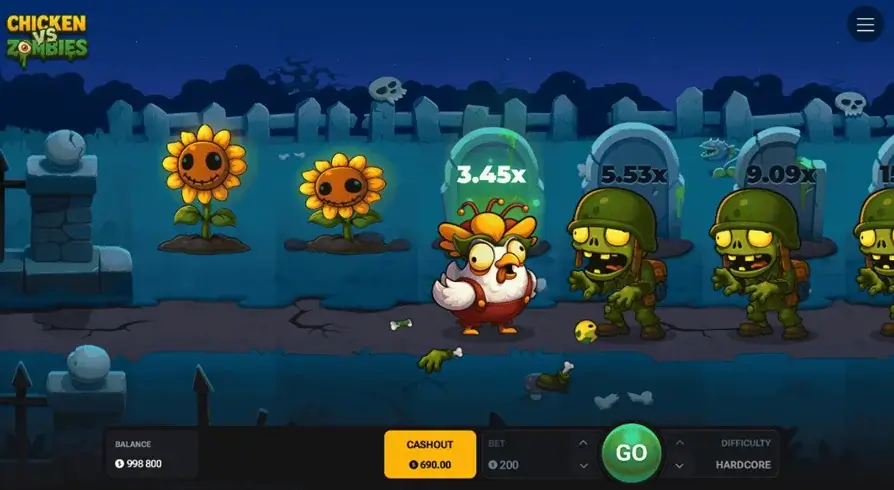
The setting is a moonlit graveyard. Rows of tombstones stretch across the screen, each one marked with a multiplier value. Between those tombstones stand zombies. The character — a white chicken wearing a small golden crown — moves left to right, fighting each zombie in sequence. Defeat the zombie, and the tombstone transforms: it glows green, a smiling sunflower sprouts up, and your potential payout ticks higher. Let the zombie win, and the round ends. You lose the bet.
The visual design takes clear inspiration from Plants vs. Zombies — the sunflowers appearing after each successful step are an intentional reference, functioning as a positive visual reward. The zombie designs themselves escalate with difficulty: slow, shuffling walkers on Easy; armoured military zombies on Hardcore. The cartoon aesthetic keeps things light enough that the underlying tension does not feel oppressive, which is exactly the balance InOut was aiming for.
Sound design follows the same logic. The background music is calm and atmospheric at the start of each round and builds in intensity as the chicken advances. By the time you are five or six steps in, the audio is doing real psychological work — nudging you toward one more step. Recognising that pressure is part of playing the game well.
There are no bonus rounds, no progressive jackpot, no auto-play. The entire game is one mechanic repeated cleanly, and that simplicity is a deliberate choice, not a limitation.
How to Play: The Core Loop
The gameplay loop takes about thirty seconds to learn and a considerably longer time to master.
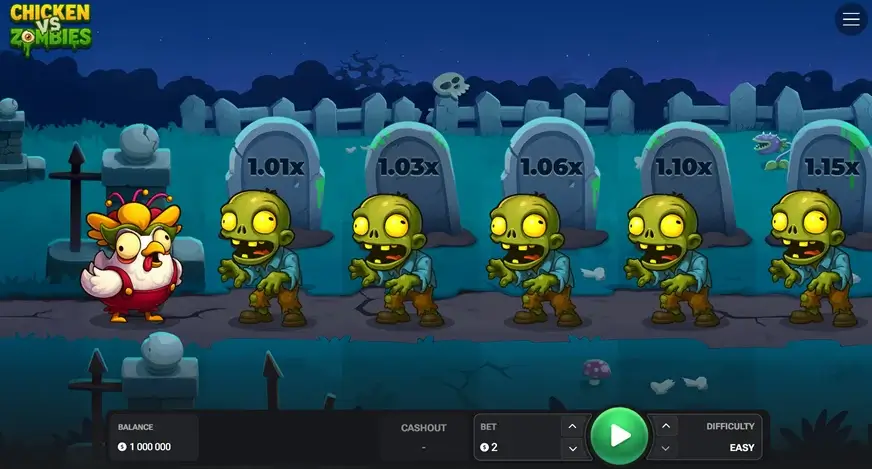
Before each round, you set two things: your bet amount and your difficulty level. Bet sizes run from $0.01 to $200 per round. Once those are confirmed, you press the green Play button and the round begins.
The chicken moves to the first zombie. If it wins — which is determined by the game’s RNG — a sunflower appears, the multiplier on the next tombstone is now your potential cashout value, and a bright orange Cashout button shows exactly how much you would receive if you stopped right now. Alternatively, you press Go to advance to the next zombie.
That is the entire decision: Cashout or Go. The multiplier on the next tombstone is always visible before you commit, so you always know what you are risking and what you stand to gain. This is different from a traditional crash game where a single line climbs automatically and you have to react — here, each step is a deliberate choice with a pause built in.
If a zombie defeats the chicken at any point, the round ends immediately and the bet is lost. There is no partial payout, no consolation prize. All or nothing, right up until the moment you choose to cash out.
A spacebar shortcut is available for players who want to run rounds quickly without reaching for the mouse between steps. On mobile, the Cashout and Go buttons are large enough that mistaps are not a serious concern — the interface was clearly tested for touchscreen use.
Difficulty Modes: Your Real Bankroll Tool
This is the part of the game that most casual write-ups miss. The difficulty setting in Chicken vs Zombies is not just a cosmetic choice — it is the primary way you control variance, and understanding it properly changes how you approach the game entirely.
There are four modes:
Easy — 30 zombies on the path. Multipliers grow in small increments from 1.01x upward. The first five steps show values of approximately 1.01x, 1.03x, 1.06x, 1.10x, and 1.15x. The longer path means more cashout opportunities and a lower chance of losing any single step, but reaching a meaningful multiplier requires staying in the round for a while. This mode suits players who prefer frequent small wins and want to learn the game’s pacing before risking more.
Medium — 25 zombies. The gaps between multiplier values widen. Risk increases, reward per step increases proportionally. A solid middle ground for players who have spent time on Easy and want more from each run without jumping straight to the higher modes.
Hard — 22 zombies. Multiplier acceleration picks up noticeably. The zombie designs change too — you start encountering football zombies in helmets and protective gear, which serves as a clear visual signal that the odds have shifted. Getting past the first five or six steps on Hard produces payouts that would require twelve or more steps on Easy.
Hardcore — 18 zombies, starting multiplier of 1.44x. The path is short, the multipliers climb fast, and the bust risk on any individual step is significantly higher than the other modes. Getting stopped by the very first zombie happens with some regularity on Hardcore. But when a run goes deep — even to five or six steps — the multipliers reach values that the other modes cannot match at equivalent depth. The theoretical maximum multiplier on Hardcore is 3,608,855x. That figure is not realistic, but meaningful payouts do appear within normal session lengths.
The practical implication: if you want low variance and longer sessions, Easy or Medium is your game. If you want to chase larger multipliers and accept that most rounds will end early, Hardcore is where that happens. The RTP of 95.5% applies across all modes — InOut achieves different volatility profiles not by changing the house edge but by restructuring the zombie count and multiplier distribution.
For players managing a fixed session budget, treating difficulty as your volatility dial is more useful than any betting strategy. A smaller bet on Hardcore gives you access to the same multiplier potential as a larger bet on Easy, with the trade-off being shorter average runs.
RTP, Max Win, and What the Numbers Mean
The Return to Player for Chicken vs Zombies is 95.5%, confirmed by independent review sources including SlotCatalog. This is a competitive figure for crash-style games, sitting above many instant-win titles that cluster around 94% or lower.
What 95.5% means in practice: for every $100 wagered across a large enough sample of rounds, the game returns $95.50 in winnings. This is a statistical average across all players and all sessions, not a per-session guarantee. In any individual session — particularly on higher difficulty modes — results can deviate significantly in either direction. A run of early losses on Hardcore is not a sign that the RTP has changed; it is normal variance at work.
One important detail confirmed by multiple independent sources: the RTP in demo mode is identical to real-money mode. The same 95.5%, the same RNG, the same multiplier distribution. Demo is a genuine practice environment, not a version rigged to feel more generous. Players who use the free demo to calibrate their cashout targets are working with accurate data.
The maximum win per round is capped at $20,000, regardless of mode. This ceiling exists independently of the theoretical maximum multiplier — if you were somehow to reach 3,608,855x in Hardcore, the round would still pay out $20,000 maximum. The hard cap is visible in game rules before you play. For players planning sessions around max-win potential, the ceiling is $20,000.
Bet range is $0.01 to $200 per round. At the minimum bet of $0.01, even a genuinely impressive Hardcore run is unlikely to produce a meaningful cash return — the floor is designed for practice and very low-risk play. The $200 maximum bet with a $20,000 payout cap means a 100x return is the practical ceiling for anyone playing at maximum stake.
Provably Fair: What It Actually Means
Provably Fair is a term that gets used loosely across the industry. In Chicken vs Zombies, it has a specific, verifiable meaning.
Each round’s outcome is generated using a combination of a server seed (provided by InOut) and a client seed (generated on the player’s side). Both seeds are hashed using SHA-256 cryptography before the round begins. After the round ends, you can access your bet history, retrieve both seed values, and independently verify — using any SHA-256 calculator — that the hash matches what was displayed before play. If the hashes match, the round outcome was not altered after the fact. If they do not match, you have concrete evidence of manipulation.
This is not just a marketing claim. The verification process is accessible to anyone who wants to use it, no technical background required. For players in markets where regulatory oversight is limited or unclear, this kind of player-side verification provides a level of assurance that standard licensed games cannot offer in the same way.
The game operates under IOGr B.V., licensed by the Anjouan Gambling Authority.
Mobile Performance
Chicken vs Zombies runs on HTML5. There is no app to download, no APK to sideload — the game launches directly in a mobile browser and loads in under three seconds on a stable connection.
The interface scales cleanly to portrait and landscape orientations. The Cashout and Go buttons are large and well-positioned for one-handed play. The 60FPS animation stays smooth on mid-range Android hardware — the game was reportedly tested across over 100 devices before release.
For players in Bangladesh using a Samsung Galaxy A-series or Redmi Note device, the game performs well on Chrome for Android. The touch controls respond accurately, which matters specifically because a mistimed tap on the Cashout button during a multiplier climb is a costly error. InOut made the button placement a priority.
Data consumption is reasonable for a game with this level of animation. A typical session runs lighter than a streaming video at comparable quality. On a Grameenphone or Banglalink 4G connection, the experience is consistent. On a slower or congested connection, the HTML5 format is more forgiving than a native app would be — there is no persistent connection requirement, and the game does not require constant data throughput between steps.
The browser-based format also means no account is required to access the demo version. Players who want to try the game before depositing can do so immediately, on any device, without registration.
One more thing worth mentioning for mobile players specifically: the spacebar shortcut that speeds up desktop play obviously does not apply on mobile, but the button layout compensates well. Rounds that a desktop player might run in ten seconds take perhaps three or four more seconds on mobile, which is a negligible difference. The game never feels sluggish on a phone.
Playing from Bangladesh: Practical Notes
Bangladesh players accessing Chicken vs Zombies through a licensed casino platform will typically fund accounts through intermediary wallet services. bKash and Nagad are the most widely used options for this type of transaction. The deposit flow varies by platform, but the general process — transferring to a casino wallet via a local payment method — is consistent across most operators that accept Bangladeshi users.
At the minimum bet of $0.01 per round, a session cost of $1 runs to roughly ৳110 at approximate current exchange, though conversion rates vary by platform and timing. The minimum stake makes it genuinely accessible for low-budget testing before committing to higher amounts.
Evening and late-night sessions are practical on this game because rounds are short — typically between five and thirty seconds — and the game does not require sustained concentration over long periods. A thirty-minute session on Easy or Medium at low stakes is a reasonable way to learn the cashout timing before moving to higher difficulty or higher bets.
One thing worth knowing for players using mobile data: because there is no auto-play and each step requires a manual tap, there is a natural pause between rounds. You are not going to accidentally burn through a session budget by looking away from the screen. The manual design that reviewers sometimes flag as a missing feature is, from a session management perspective, actually useful.
How It Compares to Other InOut Games
If you have already played Chicken Road or Chicken Road 2, the mechanics here will be immediately familiar. The step-based format is identical. The difference is execution: Chicken vs Zombies has better visuals, more distinct zombie character designs across difficulty levels, and a setting that gives the tension a more fitting frame. A graveyard full of zombies suits a game about risk and survival in a way that a busy road simply does not.
Fish Road, another title in InOut’s lineup, adds fixed jackpots up to 500x and free spins to the same basic format. It is a more complex game. Chicken vs Zombies is not trying to compete on feature count — it is leaner by design. Whether that is a drawback depends entirely on what you want from a session. If you want the purest version of the one-decision crash mechanic, Chicken vs Zombies is the cleaner experience. If you want extra layers of potential reward attached to the same base format, Fish Road is the better fit.
Rabbit Road exists in the same series and is essentially a palette swap. The road-crossing formula with different character artwork. There is no meaningful mechanical difference.
Against crash games from other providers, Chicken vs Zombies is unusual in two specific ways. First, the step-based format creates natural pause points that continuous multiplier games lack. In Aviator or similar titles, the multiplier climbs without pause and the decision to cash out happens against a continuously running clock. In Chicken vs Zombies, each step stops the action briefly and invites a deliberate choice. That is a genuinely different psychological experience — slower, in a way that gives you a moment to think, but potentially more dangerous because it also gives you a moment to second-guess a sensible cashout.
Second, the visibility of upcoming multipliers is uncommon. On most crash games, you can see the current multiplier but not what the next value would be if you continued. In Chicken vs Zombies, the tombstones ahead show you exactly what the next multiplier will be before you commit to the step. This is a meaningful difference for strategic play — you are always making a decision with complete information about the immediate next payoff, even if you cannot see beyond it.
The Psychology of Manual Cash-Out
It is worth spending a paragraph on why InOut made the decision to exclude auto cash-out entirely, because it matters to how you approach the game.
In most crash games, auto cash-out lets you set a target multiplier before the round and the game cashes out automatically when that level is reached. It removes the real-time decision. InOut chose not to include this feature, and the reviews that call it a missing feature are missing the point. The manual decision is the game. The experience InOut is creating depends on you sitting there, watching the multiplier climb, and having to choose. If the game cashed out automatically at your preset target, that experience evaporates. You would be watching a spinner, not playing a game.
The consequence is that this game rewards self-awareness more than most. Players who know their own tendencies — specifically, whether they tend to hold too long or cash out too early — and who can apply that knowledge under the pressure of a climbing multiplier, will get more from the game than players who rely on instinct. Running demo rounds with a specific cashout target and tracking whether you actually hit that target, or whether you override it in both directions, is genuinely useful information about how you play.
There is no betting system that changes the underlying odds. The RTP is fixed, the RNG is certified, and no pattern of past rounds influences future outcomes. That said, how you play affects how long your session lasts, how often you realise wins, and how large those wins are relative to your stake.
The most consistently useful approach is to decide your target multiplier before the round begins, not during it. Pick a number — say, 2x on Medium, or 5x on Hard — commit to it, and cash out when you hit it. The psychological pull to push one more step is the central mechanic of the game. The designers know it, you know it, and the best defence against it is a pre-set rule rather than in-the-moment judgement.
Difficulty should match your session budget and risk tolerance, not your ambition. If you have a fixed amount you want to play with and want to maximise session length, Easy with early cashouts gives you the most rounds for your money. If you have the same budget but want the chance of a larger single win, Hardcore with an early cashout target gives you occasional meaningful multipliers on the rounds that survive the first few steps.
Running the demo version first is not just for beginners. Experienced players who switch to a new difficulty mode benefit from a few demo rounds to calibrate their cashout instinct before putting real money behind it. The demo RNG is the same as the real-money version, so the practice is meaningful.
Two patterns that tend to create problems: chasing after a run of losses by increasing stakes or moving to a harder difficulty, and abandoning a pre-set cashout target mid-round because the multiplier is still climbing. Both are natural impulses and both work against session profitability. Setting a loss limit before the session starts — and stopping when it is reached — is more effective than any bet sizing strategy.
If a session is going badly and focus is slipping, stepping out is the right call. This is a game that punishes distracted play specifically because the cashout decision happens fast and under pressure. A tired or frustrated player will almost always hold too long.
What the Game Does Well
The visual design is genuinely good. The graveyard setting, the crowned chicken, the sunflowers appearing after each win — it is funny, it is well-executed, and it gives the game a personality that most crash titles lack. The Plants vs. Zombies reference is affectionate rather than derivative.
The four difficulty modes are a meaningful design choice. Giving players direct control over variance — not just bet size — makes the game more adaptable to different playstyles and session types than most crash games manage.
The “no auto cash-out” design is worth highlighting specifically. Several reviewers have listed it as a missing feature. It is not. Auto cash-out removes the tension that makes the game what it is. The decision to stop or continue is the entire point. Taking that decision away would turn Chicken vs Zombies into a different and less interesting game.
Provably Fair implementation that is actually verifiable is rarer than the marketing would suggest. InOut’s implementation here is genuine and accessible.
Mobile performance is solid across mid-range Android hardware — a practical priority for the majority of players in Bangladesh and similar markets.
What the Game Does Not Offer
There are no bonus rounds, no free spins, no multiplier features triggered by special symbols. The game is the game: place bet, advance, cash out or lose. Players looking for feature depth will need to look elsewhere. InOut’s Fish Road offers fixed jackpots and free spins within the same road-crossing format if that is the kind of variety you want.
The maximum win cap of $20,000 per round is a real ceiling. At high bet sizes, the cap limits upside in a way that affects the risk-reward calculation. For most players at most bet sizes this ceiling is irrelevant, but it is worth knowing before planning a session around large bets on Hardcore.
There is no social component. No leaderboard, no shared multiplier, no chat. The game is a solo experience. For players who enjoy the community element of crash games like Aviator, Chicken vs Zombies does not replicate that.
Verdict
Chicken vs Zombies is exactly what it looks like: a clean, well-executed crash game with a good theme, a verified 95.5% RTP, and a design that respects the player’s ability to manage their own risk.
It is not trying to be complicated. It is trying to create a specific feeling — that edge between cashing out safely and pushing one step too far — and it creates that feeling reliably, round after round. For what it is, it is very good at it.
For players in Bangladesh looking for a mobile-friendly game that is fast, transparent about its math, and playable in short sessions without a large minimum stake, Chicken vs Zombies is worth the time it takes to run through a few demo rounds. Start on Easy, get comfortable with the cashout timing, and move up from there.
Just decide where you are cashing out before you press Go. The game will do the rest.
Chicken vs Zombies was developed by InOut Games and released in October 2025. RTP: 95.5%. Bet range: $0.01–$200 per round. Max win per round: $20,000 USD. Difficulty modes: Easy (30 zombies), Medium (25), Hard (22), Hardcore (18). Provably Fair: SHA-256 verified. Platform: HTML5, browser-based, no download required.