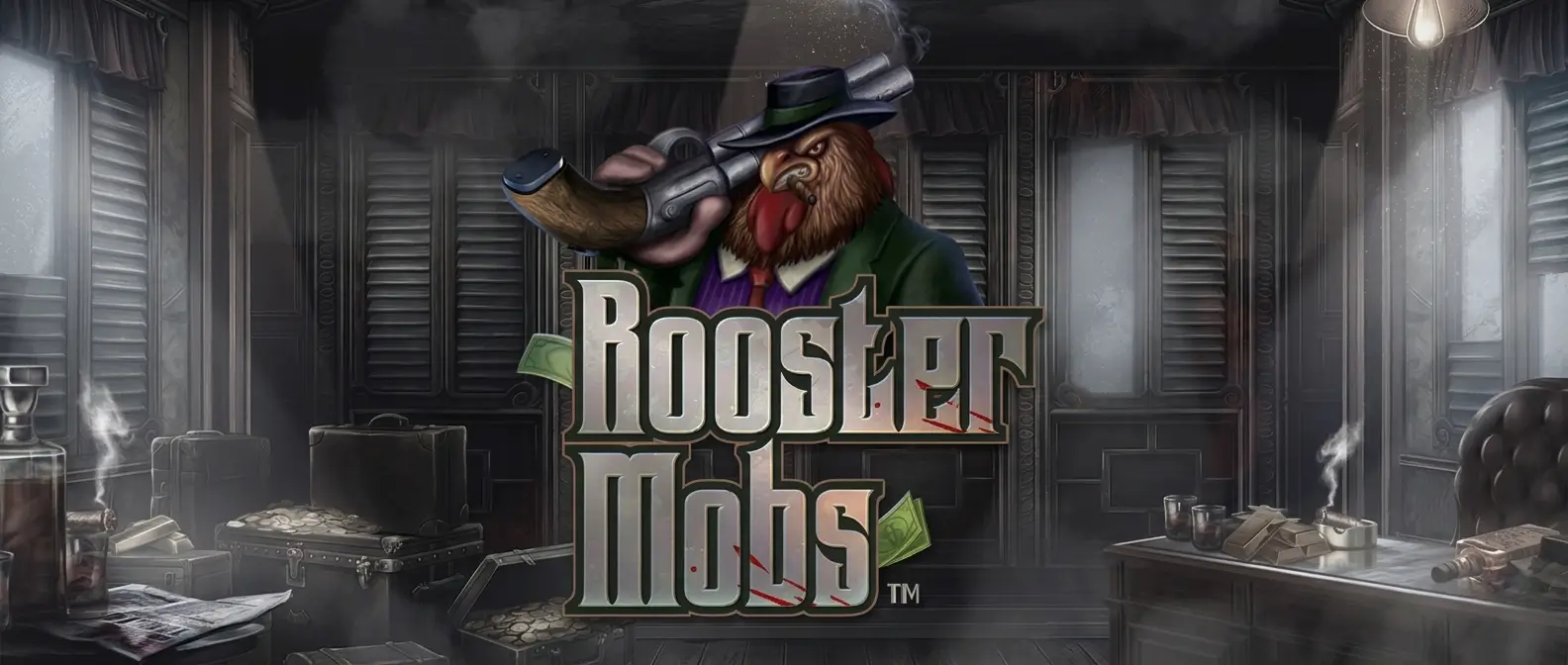
Rooster Mobs came out in late 2023. Two and a half years later, it’s still sitting in lobbies across Asia, and you’ll find it at most casinos that carry StakeLogic titles. That staying power tells you something — but it doesn’t tell you the full story. This is a slot where the bonus round genuinely delivers and the base game genuinely doesn’t. If you play it not knowing that, you’ll burn through your balance waiting for something to happen.
RTP: 96.00% (Stakelogic official listing). A separate source — a compiled RTP index — lists it at 96.02%. StakeLogic has also confirmed publicly that the game operates with multiple RTP models, meaning the version at your specific casino may be lower. That’s the honest starting point. Before you spin, it’s worth checking whether your casino displays the live RTP for this title. If it doesn’t, assume the lower end.
The max win is 10,000x your stake. At a BDT 20 spin, that’s BDT 200,000. Realistic? In exceptional sessions. Likely? No. But the maths are there, and the features exist to reach it.
What Rooster Mobs actually is
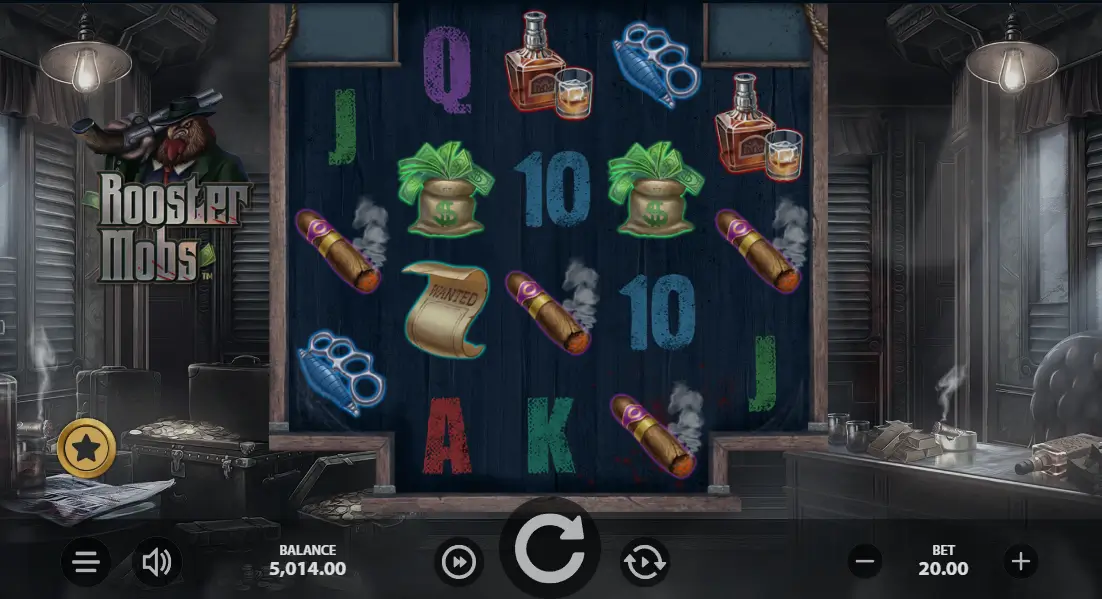
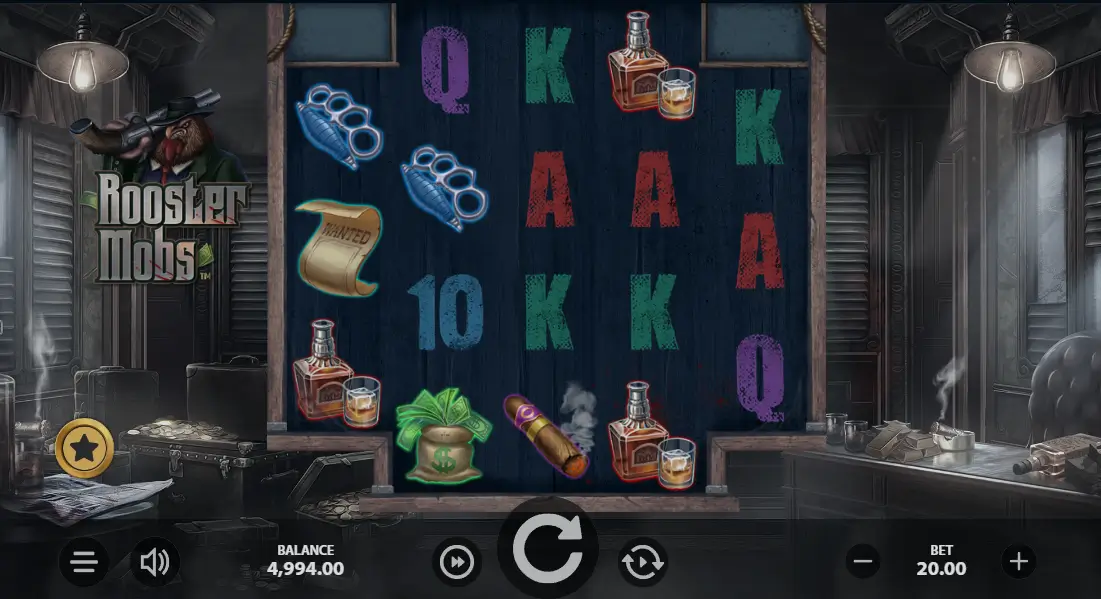
It’s a 5-reel slot running a 3-4-4-4-3 grid with 576 ways to win. Wins pay from left to right across adjacent reels, starting from reel 1. The theme is gangster roosters — think The Godfather but with feathers. Roosters in suits, smoking cigars, holding wanted posters. It sounds absurd. The execution is actually well done.
There is no Super Stake option on this title, which is unusual for StakeLogic. Most of their 2023–2024 releases include it. Rooster Mobs doesn’t. Whether that’s a design decision or a market configuration, the absence means you can’t double your bet to increase modifier frequency in the base game.
The bet range is BDT 16 to BDT 8,000 per spin (converted from the listed €0.20 to €100 range at approximate exchange rates — confirm with your casino for the exact BDT denomination). On a budget of BDT 500, you’re looking at roughly 30 spins at the minimum. That’s not a lot with high volatility, and I’d recommend starting at or near the minimum until you’ve seen the free spins bonus at least once.
StakeLogic is a Dutch studio founded in 2014, now part of Sega Sammy Holdings following a 2024 acquisition. They operate under Malta Gaming Authority and UKGC licences, and their games are distributed across over 950 online casinos. Rooster Mobs is one of their higher-ceiling releases — the 10,000x max win puts it above the majority of the StakeLogic catalogue.
The math model: what the numbers actually mean for a Bangladesh player
RTP stands for Return to Player. It means that over millions of spins, the game returns around 96% of all money bet. For every BDT 100 you stake over time, BDT 96 comes back on average. The remaining BDT 4 is the casino’s edge.
Here is the important thing about RTP: it is a long-run average. In one session of 100 spins, you might get back BDT 200 or BDT 20. The RTP only makes practical sense across hundreds of hours of play. For a single session, it tells you very little about what will happen.
Volatility is more useful for session planning. Rooster Mobs is rated high volatility — 5 out of 5 stars on StakeLogic’s own site. High volatility means the game pays infrequently but tends to pay larger amounts when it does. You will have sessions with 20–30 spins in a row without a meaningful win. That’s normal for this math model, not a sign the game is broken.
The 576 ways to win grid helps with hit frequency compared to fixed paylines. Winning combinations can form in hundreds of different patterns rather than a fixed set of lines. Even so, StakeLogic built this as a bonus-driven game. The real money is in the free spins — the base game hit rate is moderate at best.
Max win of 10,000x — how does that compare? StakeLogic’s own Money Track 2 (also 2023) hits up to 50,000x. Deadwood by Nolimit City, which uses a similar nudging wild mechanic on a 3-4-4-4-3 grid, reaches 13,950x at 96.02% RTP. Rooster Mobs at 10,000x is below both. For a high volatility release, 10,000x is functional but not outstanding in 2026. It was more competitive at launch.
The paytable pays modestly in the base game. Five matching low-pay card symbols (9 through Ace) return 0.9x your bet. Five matching high-pays return 1.75x to 3.5x. At a BDT 20 stake, a full line of the best symbol pays BDT 70. These numbers are not what you’re playing for. You’re playing for the free spins and the multiplier system.
A practical example of what high volatility means in one session. Imagine you deposit BDT 500 and play at BDT 20 per spin. That gives you 25 spins before your balance runs out. On a high volatility game, 25 spins is not a large sample. You might hit the bonus round once, you might not hit it at all. You might also hit it twice. This variance is what high volatility means in practice — not a label, but a real experience of inconsistency within short sessions.
If you play at BDT 10 per spin, you get 50 spins. That’s better odds of seeing the bonus at least once. The trade-off is that a 10,000x win at BDT 10 returns BDT 100,000 rather than BDT 200,000. Position size matters for both bankroll survival and potential payout. Decide before you load the game: are you playing for the experience of the bonus, or are you positioning for the ceiling? The answer changes your optimal bet level.
Hit frequency in the base game. The base game produces wins on roughly 30–40% of spins — a moderate rate for a ways-to-win grid. What it doesn’t produce consistently are meaningful wins above 5x your bet without a modifier involved. Most base game wins in the 1x–3x range. The modifiers change this, but modifiers don’t land every spin. In a 20-spin base game stretch, you might see 2–3 modifier appearances. Each one triggers a respin and a feature effect. The respins and effects are where the base game can occasionally produce something worthwhile — but never consistently.
Feature breakdown
Reel modifiers: the three roosters
This is the mechanical heart of the game. Three rooster characters can appear as full-reel wilds on reels 2, 3, and 4. They always land partially — that’s intentional. When they land, they nudge to fill the entire reel, becoming a full wild, and then award a respin.
Each of the three roosters carries a different modifier, which activates on the respin:
Modifier 1 — the Doubler. This rooster doubles all winning ways on the respin. If you have 48 winning combinations formed, they all count twice. It’s the most straightforward of the three modifiers and delivers the most predictable boost. In the base game, this is the modifier that most commonly produces a decent win.
Modifier 2 — the Mystery Stack collector. When this modifier lands, mystery symbols appear on the reels — at least one is guaranteed. The modifier then collects all values shown on those mystery symbols and pays them out as a combined total. The catch: mystery symbol values are not shown in the paytable and are generated dynamically. You have no way to know in advance how high they can go. From watching sessions, they tend to land modest values in the base game but can be more significant in the free spins.
Modifier 3 — the Symbol Splitter. A random number of winning symbols are split into two. So if you have a reel showing three of the same high-pay symbol, the splitter can duplicate them, effectively expanding the number of matching symbols in the win. It draws comparisons to No Limit City’s xSplit mechanic — the concept is similar, the execution is StakeLogic’s own.
One modifier can land on any spin, on any of the three middle reels. Multiple modifiers on the same spin are possible. When that happens, all their effects apply.
In the base game, modifier frequency is acceptable — you’ll see them every 15–25 spins on average in extended play. The issue is that base game wins without the multiplier system are limited. The modifiers deliver respins and additional ways, but without an accumulating multiplier behind them, the payouts stay modest most of the time.
Wild scatters
If 1 or 2 scatter symbols land anywhere on the reels without triggering the bonus, they convert to wild symbols rather than disappearing. They only land on reels 2, 3, and 4. This is a clever design decision — it means even a failed scatter attempt doesn’t waste entirely. These scatter-wilds can substitute for any regular symbol in a winning combination.
Three or more scatters on reels 2, 3, and 4 simultaneously trigger the free spins bonus.
Free spins bonus and the gamble wheel
Landing 3 scatters awards 8 free spins. Before the bonus begins, you face the Gamble Wheel — a 10-sector wheel with 7 winning sectors and 3 losing ones.
First spin of the wheel: win and your 8 free spins become 12. Lose and the bonus is cancelled entirely — you receive nothing.
Second spin (optional, only available if you won the first): win again and your 12 free spins become 16. Lose and you drop back to 8.
The odds on that first wheel spin are 70% win / 30% loss. It’s not a bad bet mathematically — if the expected value of the bonus is positive, gambling for more spins should increase your long-run return. But the 30% chance of losing the bonus entirely is a real risk for players with small sessions. My recommendation: if you’re on a limited budget in one session, collect the 8 spins. The guaranteed bonus is worth more than the chance of 16.
During free spins, the win multiplier starts at 1x and increases by 1 for each reel displaying an active modifier. If all three middle reels show a modifier simultaneously, the multiplier jumps by 3 in one go — and this happens before wins are paid. There is no cap on the multiplier. It can theoretically grow to very large values with repeated modifier landings.
Extra scatters during the bonus award additional spins: 1 scatter = +1 spin, 2 scatters = +2 spins, 3 scatters = +8 spins (effectively a retrigger).
This is where the 10,000x ceiling lives. A long free spins run with multiple modifier activations across all three reels can push the multiplier into double or triple digits. Combined with strong symbol combinations on a 576-ways grid, the numbers stack. In extended testing, multipliers above 20x in a single bonus are achievable — beyond 50x they’re rare but documented.
Bonus Buy
Two buy options are available (not in all markets — the UK restricts bonus buys, and availability varies by operator):
- Free spins buy: 100x your stake. At BDT 20 per spin, that’s BDT 2,000 to go straight to the bonus (before the gamble wheel).
- Modifier spin buy: 50x your stake (BDT 1,000 at minimum bet). This buys a single spin with a guaranteed modifier on reels 2, 3, and 4.
The modifier spin buy at 50x is interesting. It doesn’t give you the full bonus, but it guarantees a respin and a feature activation. For players who want to experience the modifiers without waiting for the base game to deliver them, this is the cheaper entry point.
Whether bonus buys are worth it mathematically depends on whether the bonus RTP matches the base game RTP. StakeLogic hasn’t published this breakdown publicly for Rooster Mobs. Given that Stakelogic offers multiple RTP configurations, the bonus buy may carry a different effective RTP than the standard game at your specific casino. Treat this as a fair cost of access, not a guaranteed advantage.
2026 perspective: where does it stand?
Rooster Mobs launched in a competitive 2023 market and holds up reasonably well. But context matters.
The max win question. 10,000x was a solid ceiling in 2022. By late 2023, slots like Money Track 2 (StakeLogic’s own release, also 2023) were already reaching 50,000x. Deadwood by Nolimit City sits at 13,950x with a 96.02% RTP and a similar nudging wild mechanic. In 2026, 10,000x on a high volatility slot is functional, not exceptional. Players who are specifically seeking ceiling potential will find more at other titles.
The mechanic comparison. BigWinBoard drew comparisons between Rooster Mobs and Deadwood and Sakura Fortune 2 at launch. That’s a fair observation — the nudging full-reel wild structure is similar to Nolimit City’s xNudge mechanic. StakeLogic’s implementation is slightly simpler: no multiplier embedded in the wild itself during nudges, but instead modifiers that activate separately. It’s a different balance point. Some players will prefer StakeLogic’s version because the effects are more varied (doubler, mystery collector, splitter) rather than a single escalating multiplier.
There is also a creative argument for the rooster theme. Most crime or gangster slots use primates, dogs, or human characters. Roosters are unusual. The design team committed to it — each rooster character is dressed and armed distinctly, the gloomy office setting actually works, and the soundtrack (percussive, heist-film style) is better than the genre average. These things don’t affect the math, but they do affect whether you enjoy 50 spins of waiting for the free spins.
StakeLogic’s broader 2023–2024 output for context. The same year as Rooster Mobs, StakeLogic released Money Track 2, which went to 50,000x and became one of their most talked-about titles. In 2024, Candyways Bonanza 3 followed with a 20,000x ceiling. Compared to these, Rooster Mobs’ 10,000x looks conservative. That’s partly because it’s a different mechanic family — modifier-based respins rather than cascading wins — and partly because StakeLogic’s ceiling targets have increased year-on-year since 2022.
No progressive jackpot. Rooster Mobs has no jackpot layer. If you play at casinos that run jackpot network overlays (Drops & Wins, etc.), you may benefit from that separately — but the base game has no progressive component.
Buy bonus availability. The buy feature exists but is restricted in certain markets. For Bangladesh players, availability depends on your specific casino’s market configuration for StakeLogic titles. Most international casinos serving the Bangladesh market carry the bonus buy option. Check the in-game settings before assuming it’s there.
StakeLogic in 2026. The Sega Sammy acquisition in 2024 has accelerated their output. Their 2024–2025 catalogue includes stronger max-win titles and more refined mechanics. Rooster Mobs is now a middle-tier title in their portfolio — not their flagship, but not abandoned either. It remains available at most StakeLogic partner casinos.
Is there a sequel or variant? As of 2026, there is no Rooster Mobs Power Reels, Megaways, or sequel release from StakeLogic. The original remains the only version. This is worth noting — some of StakeLogic’s best titles have received upgraded variants. Their Megaways conversions often improve on the originals significantly. Rooster Mobs has not received this treatment. Two and a half years without a sequel is a telling signal: either the studio has more planned and is working on it, or the commercial performance didn’t justify the investment. From the outside, there is no way to know which.
For Bangladesh players specifically. The game runs well on mobile — StakeLogic’s HTML5 titles are optimised for mid-range Android devices including Redmi Note and Samsung Galaxy A-series. On Grameenphone and Banglalink 4G connections, load times are acceptable. The 576-ways grid doesn’t require the processing power that some heavy Megaways titles demand. It’s a stable play experience on a phone.
StakeLogic titles appear at most major international casinos that accept Bangladesh players, including platforms supporting bKash and Nagad deposits. Rooster Mobs doesn’t carry any Bangladesh-specific restrictions in the markets commonly used here. Bonus buy availability should be confirmed at your specific casino — not every operator enables it for all regions.
One practical note on session planning: the free spins trigger rate isn’t published officially. From aggregated player data, a 576-ways high-volatility game with this scatter setup typically triggers the bonus around once per 100–150 spins on average. At BDT 20 per spin, that means you may need BDT 2,000–3,000 in stakes before seeing the bonus round once. That’s the honest expectation for session budgeting. Some players will trigger it on spin 15; others will go 200 spins without it. High volatility means exactly this kind of inconsistency.
If you’re playing at a casino with a welcome bonus tied to slot wagering, Rooster Mobs contributes to wagering requirements normally in most cases — though confirm this with your casino’s bonus terms before loading the game with bonus funds active.
Verdict
For recreational players in Bangladesh on a BDT 200–500 session budget: Rooster Mobs is a reasonable choice if you understand that you’re paying for the free spins experience, not the base game. Set a session limit before you start. Use the minimum bet until you trigger the bonus once and see what the free spins actually produce. High volatility on a small bankroll means you can exhaust your budget without hitting a significant spin. That’s not a design flaw — it’s the math model working as intended. Go in knowing that.
The gamble wheel before free spins is the decision that catches players out most often. The 30% chance of losing the whole bonus is real. If your session budget is BDT 300 or under, collect the 8 spins rather than risking the wheel. At larger bankrolls where one cancelled bonus doesn’t end your session, gambling for 12 or 16 makes sense — the expected value of extra spins is positive, but only if you can afford to lose one bonus without ending your session.
For experienced players chasing ceiling potential: Rooster Mobs is a second-tier choice in 2026. The 10,000x max win is real but not competitive against the current high-ceiling market. If you want StakeLogic specifically, Money Track 2 at 50,000x or Candyways Bonanza Megaways at 20,000x offer stronger ceilings. If you want a similar mechanic with a higher ceiling, Deadwood by Nolimit City at 13,950x and 96.02% RTP is the more developed version of the same nudging-wild concept.
Where Rooster Mobs wins is in the modifier variety. Three distinct effects, each doing something different, gives the bonus round a more unpredictable character than a straightforward multiplier escalation. Some sessions will hinge entirely on the mystery collector; others on the symbol splitter. The doubler produces the most consistent results; the mystery stack has the widest range. That variety keeps things interesting across multiple sessions in a way that a single-mechanic slot often doesn’t manage.
The game has been on the market for two-and-a-half years and still earns its place in lobbies. It’s not StakeLogic’s best work from 2023, but it’s not filler either. If Rooster Mobs is available at your casino and you have BDT 500 to spend on a session, there are worse ways to spend it. Just go in knowing the base game is the price of admission, not the main event.
Quick answers for Bangladesh players
Can I play Rooster Mobs for free before using real money? Most international casinos that carry StakeLogic games offer a demo version. Playing demo first is a good idea with high volatility slots — you get a feel for the modifier frequency and bonus round before committing real money. The demo doesn’t pay out, but it lets you experience the mechanics without risk.
What is the minimum I need to start playing? The game’s minimum bet is BDT 16 per spin (approximately €0.20 at current exchange rates — confirm with your casino for the exact BDT figure). For a realistic session on a high volatility game, BDT 300–500 is a workable starting point at minimum bet. Less than BDT 200 is risky — you may not see the bonus round before your balance runs out.
Does Rooster Mobs work with bKash or Nagad? The game itself has no payment method restrictions — it’s a slot, not a payment system. Whether bKash or Nagad works depends on your casino. Most international casinos serving Bangladesh players accept bKash as a deposit method. Check your casino’s cashier section to confirm before registering.
What is the best bet size for this game? There is no single correct answer, but a general rule for high volatility slots: bet no more than 1–2% of your total session budget per spin. On BDT 500, that means BDT 5–10 per spin. The game’s minimum is BDT 16, which is slightly higher. Play at the minimum until you’ve hit the bonus round at least once. If you’re up after the bonus, you can decide whether to increase your stake.
How long does one session typically last? On 25 spins at BDT 20, a session could end in under 10 minutes if you hit bad variance. On 50 spins at BDT 10, you have more runway. Rooster Mobs isn’t a game designed for quick casual sessions — the base game needs time to produce the bonus. If you only have 15 minutes and BDT 200, this might not be the right game for that specific session.