BGaming’s original Fishing Club launched in June 2024 and became one of the studio’s most-played casual titles — enough that a Winter variant followed in January 2025, and a full sequel arrived in April 2026. That’s a two-year lifecycle for a game with no reels, no paylines, and a deliberately stripped-back feature set, which says something about how much appetite there is for casual instant-win formats right now. Fishing Club 2 keeps the reel-free, first-person casting mechanic that made the original stand out, but it bolts on two Buy Bonus options and a third scenic location. The question worth asking two years into the “casual instant-win” boom: does adding Buy Bonus and more scenery actually move the needle, or is this the same 97.16% RTP game with a fresh coat of paint? The x3,000 max multiplier is unchanged from 2024, which tells you a lot about where BGaming decided to spend its development budget this time round — control and convenience, not ceiling.
Math model and mechanics
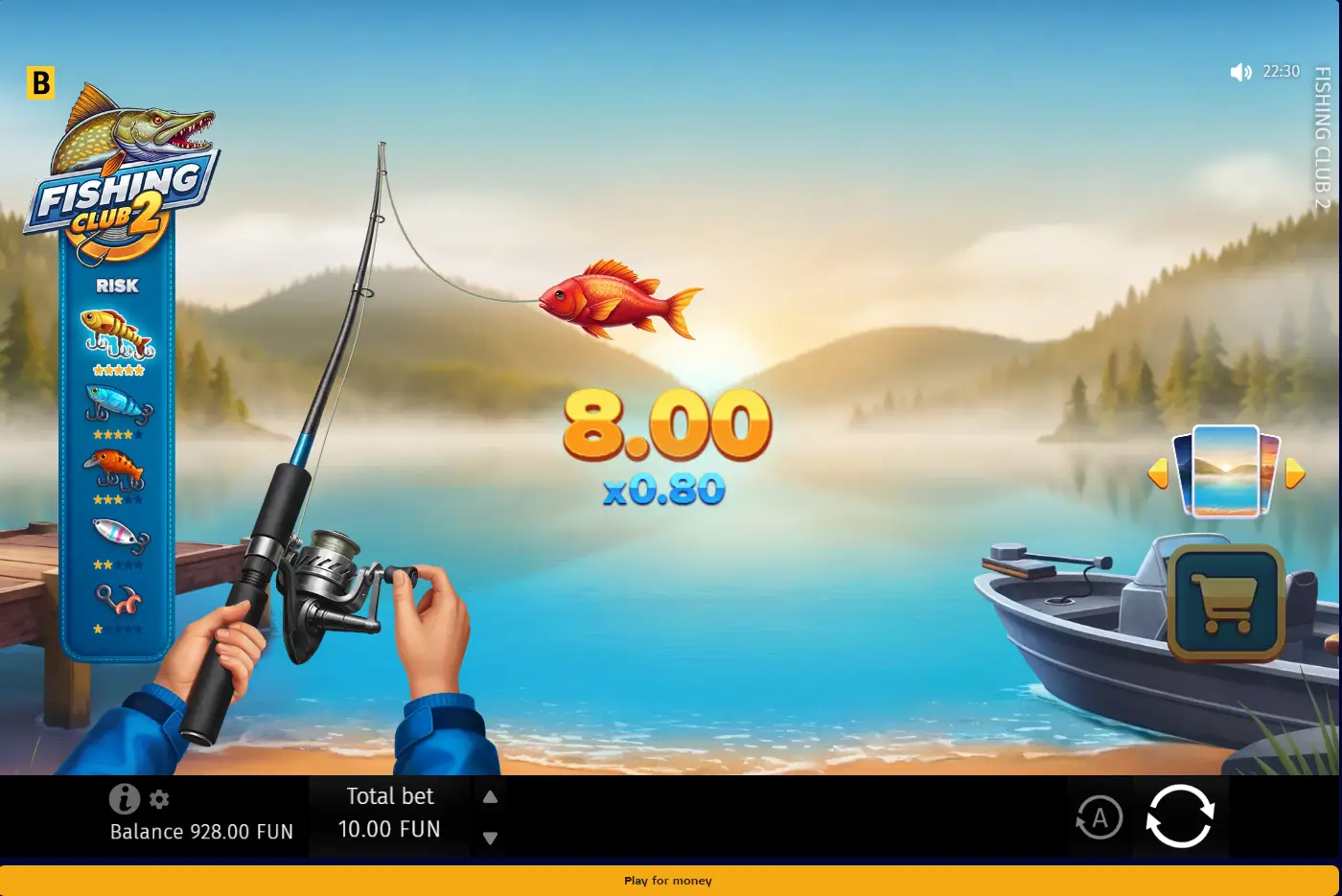
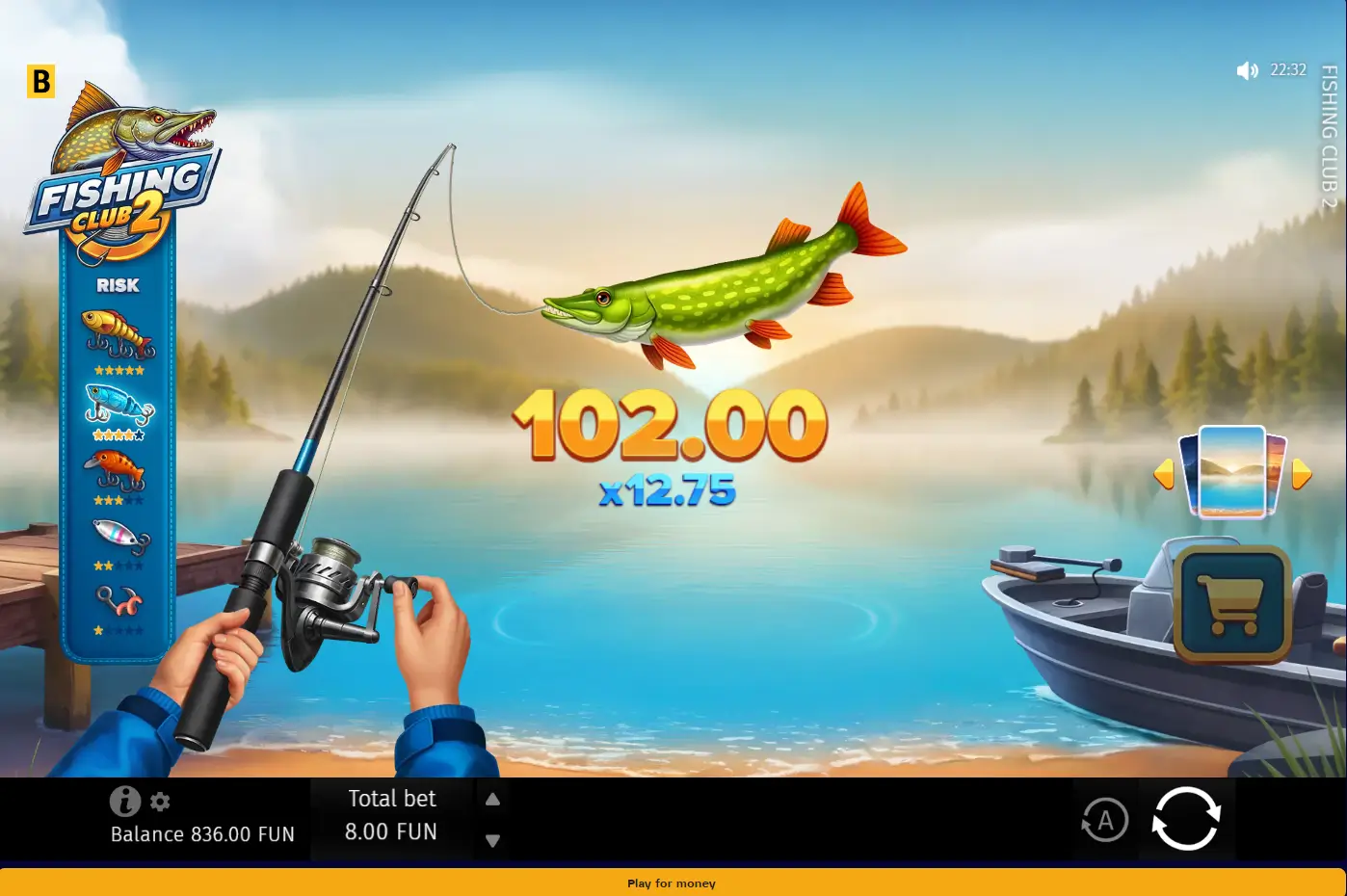
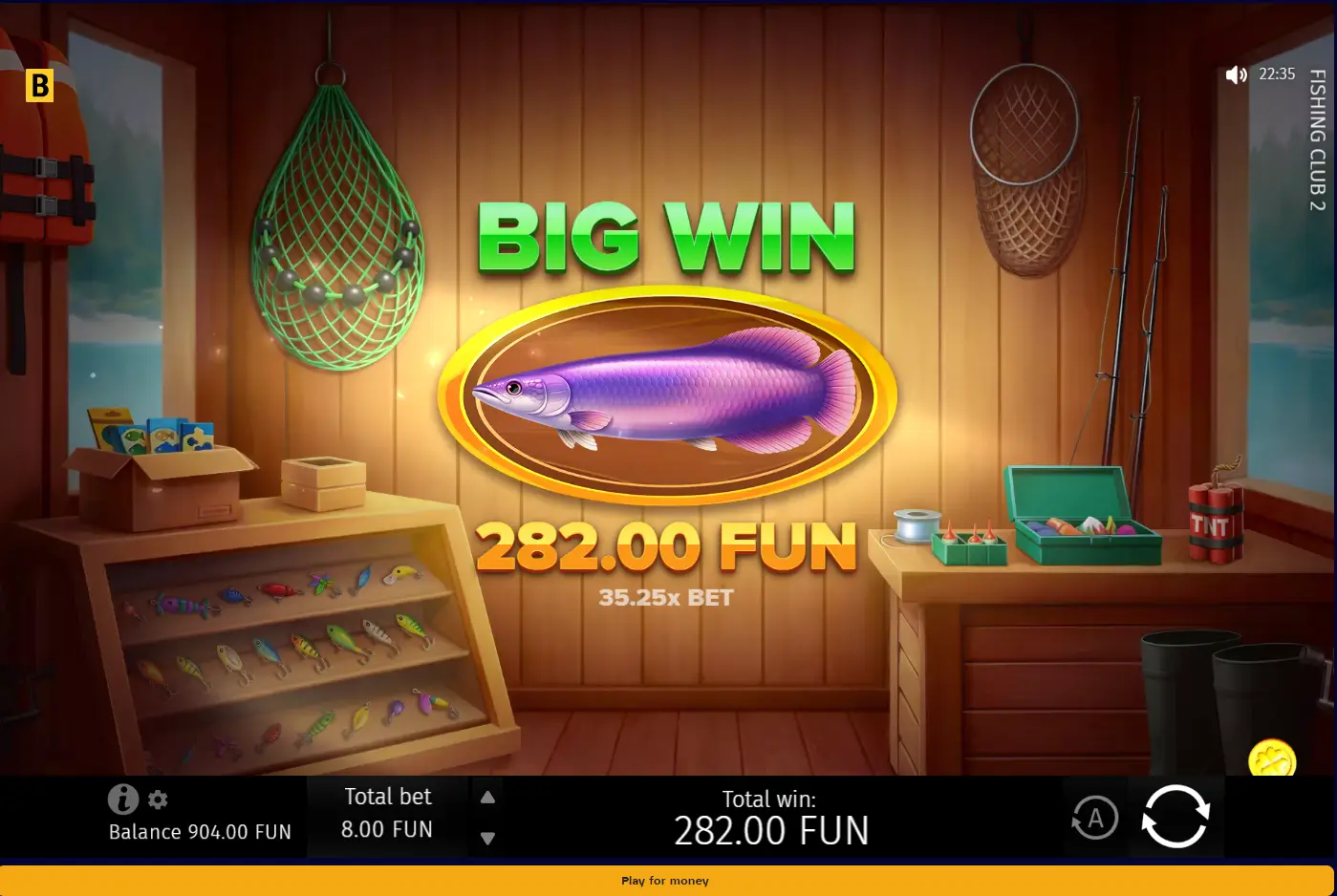
Fishing Club 2 drops reels and paylines entirely. Each bet is a single cast, and what you reel in — or don’t — decides the payout. There’s no 5×3 grid to read, no line count to configure, just a stake, a risk level, and a cast button.
The RTP is published at 97.16% across the game’s official listing and independent trackers including SlotCatalog, which sits well above the roughly 96% average for the fishing-slot category generally. That figure is consistent almost everywhere it’s checked — with one exception. BitStarz’s own game page lists Fishing Club 2 at a flat 96%, a full 1.16 points below every other source. Operators can and do run games at reduced RTP configurations, so this isn’t proof of an error, but it’s also the kind of gap that matters at volume: on a $100 wagered session, that’s roughly a dollar’s difference in expected return. Check the in-game info panel before you commit real money, because the number on the tin genuinely varies by operator here.
Volatility sits at medium-low, and BGaming’s own risk-level system is the mechanism that actually controls it. There are five risk levels, and — this is the detail that matters — the headline RTP doesn’t move between them. What changes is hit frequency and catch size. At Level 1, you’re hooking something on roughly 45% of casts, mostly small fry. At Level 5, that drops to somewhere around 20%, but the fish pool skews toward the bigger multipliers. A separate operator listing (BitStarz) clocks the base hit rate at 1 in 5.87 spins, which is a plausible blended figure across levels rather than a contradiction — just be aware these numbers describe different slices of the same game.
Bet range is reported as 0.60 to 51 by SlotCatalog and $0.60 to $60 by BitStarz — a discrepancy almost certainly explained by currency conversion and by the fact that the ceiling shifts with risk level. Either way, the entry point is higher than the 0.10–0.20 floor you’ll find on most video slots, which matters if you’re used to stretching a small bankroll across hundreds of spins.
Here’s the number that actually defines this game: x3,000 max win, unchanged from the original Fishing Club. Multiplied against the reported bet ceiling, that produces a headline win somewhere between $180,000 (BitStarz) and roughly €255,000 (SlotCatalog) depending on currency and operator bet limits — another figure that varies by source, so treat any specific cash amount as operator-dependent rather than fixed. In a market where Pragmatic Play’s Big Bass Splash tops out at 5,000x and plenty of crash-style casual titles clear five figures in multiplier terms, 3,000x is respectable but no longer exceptional. That’s the ceiling this entire review keeps circling back to.
Put that in session terms. At a $1 stake and Level 5’s roughly 20% hit frequency, you’d expect a catch on around one in every five casts. Most of those catches sit well below the 3,000x ceiling — the fish paytable is weighted so the top multiplier is a rare outcome, not a typical one, which is exactly what “medium-low volatility” describes in practice. A $100 session at $1 a cast buys roughly 100 casts, and at that hit rate you’d land somewhere around 20 catches. If even one of those lands near the top of the table you’re well ahead; if the session runs cold, the empty casts between wins are where medium-low volatility actually shows up. That’s a different rhythm to a high-volatility payline slot, where a single free spins trigger can swing an entire session in one direction.
Hit rate is also where the sourcing gets messiest. BitStarz’s 1-in-5.87 figure, the roughly 45%-to-20% range spanning Levels 1 through 5, and the base RTP all describe the same underlying math from different angles, and none of them are necessarily wrong — they’re measuring different slices of it. If an operator or aggregator quotes a single hit-rate number for Fishing Club 2 without specifying which risk level it applies to, treat that number as incomplete rather than authoritative.
Feature breakdown
The five risk levels
Risk level is the primary control a player has over how a session feels, and it’s genuinely more granular than most competitors’ single fixed volatility profile. Selecting a level adjusts both the minimum and maximum bet and reshuffles the odds of landing a big fish versus a small one. It doesn’t change the long-run RTP — 97.16% holds at every level according to the game’s own FAQ data — so this is a variance dial, not an edge dial. Pick Level 1 if you want your balance to move in small, steady increments. Pick Level 5 if you’d rather sit through longer dry spells for a shot at the trophy catch. One limitation worth flagging honestly: climbing to Level 5 pushes the minimum stake up with it, which can price out players running a tight bankroll from the exact mode that offers the biggest wins.
That’s worth sitting with for a second, because it’s a genuine design tension. The feature that’s supposed to give players more control — five distinct risk settings instead of one fixed profile — also gates the highest-multiplier mode behind a higher minimum bet. A player with a $20 bankroll can technically select Level 5, but the bet floor at that setting eats through a small balance far faster than the same player would burn through it at Level 1. Practically, that means the risk-level system rewards players who already have a bankroll big enough to absorb the variance it introduces, rather than opening high-risk play up to everyone.
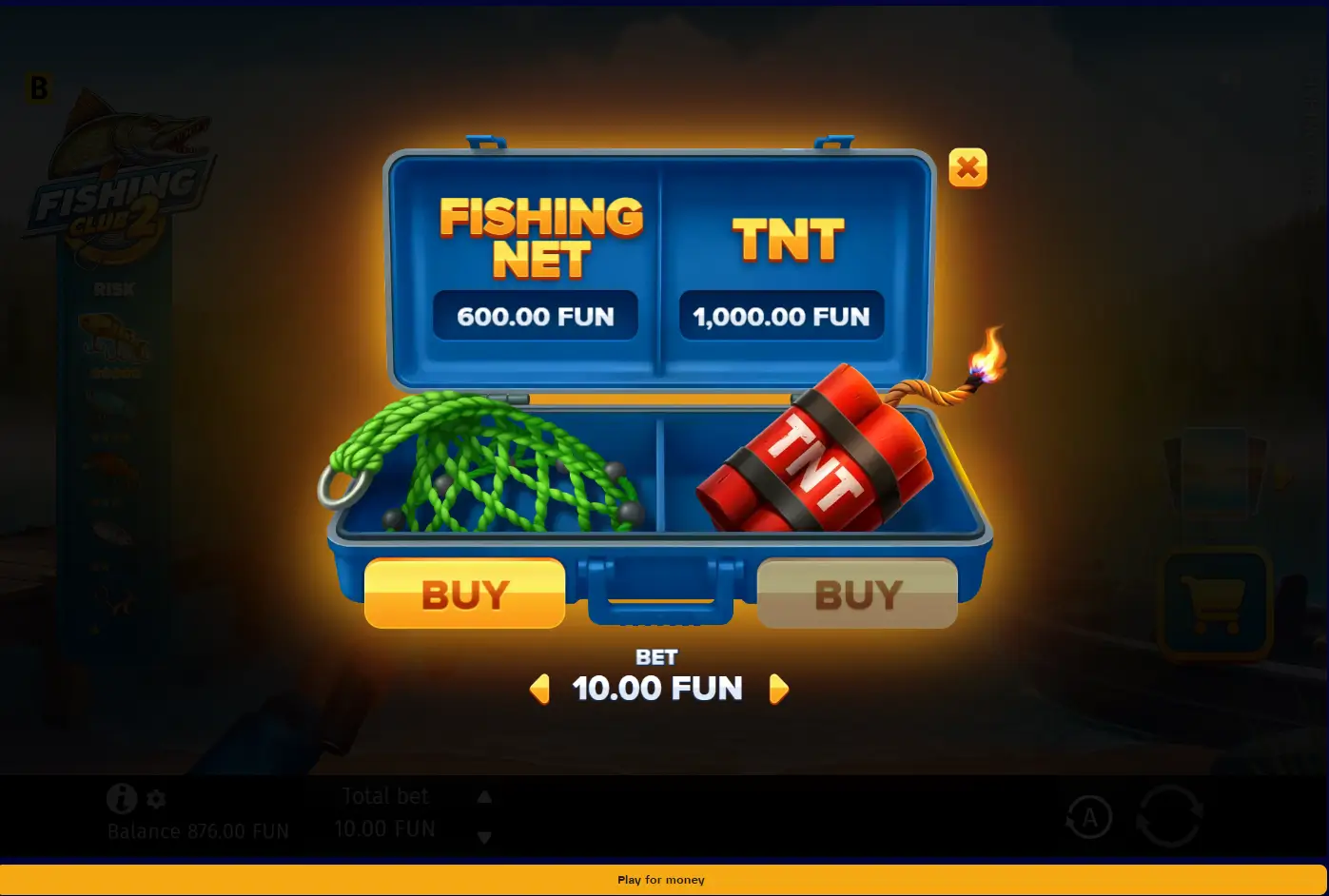
Buy Bonus: Fishing Net (60x stake)
This is the headline addition over the original Fishing Club, which had no buy-in mechanic at all. Fishing Net triggers a guaranteed catch for 60 times your current stake — the price adjusts automatically if you change your bet first. You watch a short net-cast animation, then the game reveals what’s inside. One operator’s testing describes the payout on this feature as mechanically similar to a normal high-value catch, just guaranteed rather than random, with an average return cited around 80x by one independent aggregator — worth treating as directional rather than confirmed, since BGaming’s own materials don’t publish a separate feature RTP breakdown. The honest catch here: at medium-low base volatility, spending 60x your stake to skip to a guaranteed win is a real bankroll commitment, not a minor top-up.
Buy Bonus: TNT (100x stake)
TNT costs more — 100x your stake — and delivers a bigger, louder reveal: an explosion animation before the catch is shown, rather than the net’s quieter reel-in. According to one operator review that tested both features directly, the two are functionally close in terms of what actually lands in your balance; the extra 40x you pay for TNT buys a longer, flashier animation rather than a materially different payout distribution. If that’s accurate, the pragmatic move is obvious: Fishing Net is the better value pick unless the cinematic reveal itself is what you’re paying for. I’d treat that claim as one tester’s read rather than an audited fact, but it’s a reasonable prior given BGaming hasn’t published feature-specific math that contradicts it. One unofficial aggregator lists a Fishing Net RTP of 97.10% and a TNT RTP of 97.12%, both close enough to the base game’s 97.16% that neither feature looks like a meaningfully better or worse deal on paper — the difference, if it exists at all, comes down to what you’re willing to spend for the reveal, not what you can expect back over time. These aren’t figures published directly by BGaming, so file them as aggregator-sourced rather than confirmed.
Three locations: dawn, dusk, twilight
Fishing Club 2’s other headline addition is a choice of three lighting settings to fish under. According to the most detailed technical breakdown available, this is purely visual — same RNG, same payout table, different scenery. That’s worth stating plainly because at least one review site frames the locations as “lake, river, ocean” with different fish density and payout structures, which conflicts with the more granular source. Until BGaming publishes location-specific math that says otherwise, treat the three settings as atmosphere, not strategy. Pick whichever one you find least fatiguing to stare at for an hour.
Best Win and Best Catch tracking
A simple session-length record system: Best Win logs your highest single cash payout, Best Catch logs your highest multiplier landed. Both display as snapshots and reset at the start of a new session rather than persisting long-term. It adds a light gamification layer without cluttering the core loop, but don’t mistake it for a leaderboard or a loyalty mechanic — it’s a personal scoreboard, nothing more.
Manual and Auto play, and mobile handling
Two bet modes are available: Manual, where you cast one line at a time, and Auto, which repeats the cast at a set stake until you stop it or hit a preset limit. Neither mode changes the underlying math — Auto is a convenience layer, not a different game. BGaming built Fishing Club 2 mobile-first, and one independent reviewer who ran it across an iPhone 15, a Samsung Galaxy S24, and an iPad reported it loading in under three seconds with stable frame rates on all three devices during testing earlier this year. That’s a third-party observation rather than something verified in-house, but it’s consistent with BGaming’s stated design priority and with the HTML5 build the game runs on, which typically travels well across device types.
What’s absent, and why it matters
No free spins round. No pick-and-click bonus game. No progressive jackpot. No expanding wilds. This is by design — BGaming built Fishing Club 2 around one clean mechanic and two buy-in shortcuts rather than a layered feature set, and the original Fishing Club worked the same way. If you want a slot that builds toward a climactic bonus round, this isn’t it. If you want a clean, repeatable loop you can dip in and out of, the simplicity is the appeal rather than a shortfall.
Bankroll approach, given the two buy-in prices
With two Buy Bonus options priced 40x apart, the practical strategy question is which one actually fits a given bankroll. Spending 60x on Fishing Net repeatedly requires a stack that can absorb several purchases without a hit landing — treat it as a way to skip a run of dead casts, not as a guaranteed profit engine, since the RTP baked into these features still sits in the high-90s rather than above 100%. The same logic applies to TNT at 100x, just with a steeper cost per attempt. A rough guideline: don’t lean on either buy-in unless your session bankroll is comfortably above 20 times the feature’s price, because a couple of buys back-to-back without a strong return can hollow out a small balance fast. This isn’t specific guidance from BGaming — it’s a general bankroll-management principle that applies to any fixed-price feature buy, and it’s worth applying here specifically because neither feature is described anywhere as improving the underlying RTP.
The 2026 perspective
Set next to the original Fishing Club, the sequel’s upgrades are narrow but deliberate. The 2024 original ran on five risk levels, a single visual setting, and no Buy Bonus at all — you cast, you either caught something or you didn’t, and that was the entire feature set. Fishing Club 2 keeps the risk-level system intact, adds the three lighting locations, and — the actual structural change — introduces the Fishing Net and TNT Buy Bonus options. Everything else, including the headline 97.16% RTP and the 3,000x ceiling, carries over unchanged. BGaming’s own game producer described the sequel as a response to player feedback asking for more control, and the Buy Bonus addition is the clearest evidence of that: it’s the one thing the original genuinely lacked. The 2025 Winter Fishing Club variant, by comparison, actually trimmed the risk-level count down to three, which makes Fishing Club 2 the more feature-complete entry in the mini-series rather than a simple reskin. It’s a reasonable question why BGaming would ship a seasonal variant with fewer risk options between the original and the sequel — the most plausible explanation is that Winter Fishing Club was built as a limited-run reskin for a holiday promotional window rather than a permanent addition to the lineup, and its “available on limited servers” listing on BGaming’s own site supports that reading. Fishing Club 2, by contrast, reads as the mainline successor: it inherits everything from 2024 and adds to it rather than trimming it down.
None of this changes the core math, and that’s worth being blunt about. A sequel that adds a Buy Bonus option but keeps the same RTP and the same win ceiling is a quality-of-life release, not a mathematical one. If your interest in a “sequel” is a genuinely different risk-reward profile — a bigger jackpot, a higher RTP, a materially different max win — Fishing Club 2 won’t deliver that. If your interest is being able to skip dead casts on demand, it delivers exactly that, and only that.
Stack it against the fishing-slot category more broadly and the picture gets less flattering on the win-ceiling side. Pragmatic Play’s Big Bass Bonanza runs a published 96.71% RTP with high volatility and a free spins round where the fisherman wild collects multiplier values off the fish symbols — a materially different math engine that trades RTP for bigger variance. Its 2022 stablemate Big Bass Splash keeps the same 96.71% RTP but pushes the ceiling to 5,000x, nearly double Fishing Club 2’s cap. Blueprint Gaming’s Fishin’ Frenzy, the title credited with starting the fishing-slot genre back in 2014, sits lower still at 96.12% RTP with medium volatility. Fishing Club 2 beats all three on RTP — a genuinely above-average number for the category — but it can’t match Big Bass Splash’s win potential, and it has no free spins engine to build anticipation the way its payline-based competitors do. That’s the trade-off in one sentence: better math, lower ceiling, simpler loop.
Worth a mention alongside the direct fishing-theme competitors: Push Gaming’s Razor Shark trades the fish for a shark but competes on the same “high RTP, disciplined players welcome” pitch, using a Mystery Stacks mechanic that lets wins snowball across a spin rather than resetting after each feature. It’s a genuinely different math model — momentum-based rather than session-based — and it’s the title most often cited when players specifically search for the highest-RTP options in this broader aquatic category. Fishing Club 2 doesn’t compete with Razor Shark on complexity or on that stacking mechanic, but it undercuts it on accessibility: there’s no stack-reading or momentum-tracking required, just a stake and a cast.
Buy-bonus availability puts Fishing Club 2 in step with where casual and instant-win games sit in 2026 — most players now expect the option to skip to a feature round for a set price, and BGaming delivers that with two price points rather than one. Progressive jackpot support remains absent, which keeps this firmly out of the conversation for players chasing life-changing sums; the ceiling is fixed at 3,000x and nothing accumulates behind the scenes. That absence is consistent with the rest of BGaming’s casual catalogue, where jackpot mechanics are rare, so it’s not a Fishing Club-specific gap so much as a category norm.
Who is this actually for? The math — above-average RTP, medium-low volatility, a hard cap well short of five figures — points squarely at recreational players who want steady, low-drama sessions rather than high rollers chasing a single life-changing spin. A player with a 500x-stake bankroll aiming for gradual growth is better served here, and specifically better served by the cheaper Fishing Net buy-in, than someone with 2,000x+ looking to hunt the 3,000x cap through TNT purchases. High-volatility thrill-seekers have faster, bigger-swinging options elsewhere in the category, and this game was never built to compete with them.
Verdict
Fishing Club (2024, the original): still functional, still carrying the same 97.16% RTP and 3,000x ceiling that made it popular in the first place, but it’s now the objectively lesser version of its own concept — no Buy Bonus, one visual setting, and five risk levels that Fishing Club 2 replicates in full while adding features on top. There’s no longer a strong reason to choose the original over the sequel unless a specific casino simply doesn’t carry the newer title yet. Play it if it’s what’s available; otherwise, the sequel does everything it did and more.
Fishing Club 2 (2026): a genuine, if modest, upgrade — the Buy Bonus options are the one addition that actually changes how the game can be played, letting you skip dead casts for a fixed 60x or 100x price. The number that limits it most is still the 3,000x max win, which sat mid-pack in 2024 and now trails Big Bass Splash’s 5,000x by a wide margin. Recommended for recreational players who value a clean, low-jargon loop and an RTP that’s genuinely above category average; not recommended for high-volatility players chasing five-figure multipliers or anyone who wants a free spins climax to build toward, because that mechanic simply doesn’t exist here. If you’re choosing a buy-in, Fishing Net’s lower 60x price point is the sensible default over TNT’s 100x — the extra spend appears to buy a bigger animation rather than a bigger edge.
Put plainly: this is a low-stress, mobile-friendly session game with better-than-average long-run math and a genuinely useful convenience feature bolted onto it. It’s not a game built to chase a life-changing win, and it never claims to be. Judge it against that stated ambition rather than against high-volatility payline slots with ten-times the ceiling, and it holds up. Judge it as a competitor to Big Bass Splash on raw win potential, and it doesn’t.
FAQ
Is Fishing Club 2’s RTP the same across all five risk levels? Yes, according to the game’s own published data — 97.16% holds regardless of which risk level you select. What changes between levels is hit frequency and catch size, not the long-run return percentage.
Does Fishing Club 2 have a progressive jackpot? No. The maximum win is capped at 3,000x your stake with no accumulating prize pool, consistent with the rest of BGaming’s casual game catalogue.
Is Fishing Net or TNT the better Buy Bonus to purchase? Fishing Net, priced at 60x your stake, is the lower-cost option. One independent test found both features deliver mechanically similar outcomes, meaning TNT’s extra 40x cost buys a longer animation rather than a materially different payout — treat that as a reasonable working assumption rather than an audited fact.
Do the three locations in Fishing Club 2 affect the odds? The most detailed technical source available states no — dawn, dusk, and twilight use the same RNG model and payout tables, and the choice is purely visual. At least one other review frames the locations as functionally different, so this hasn’t been universally confirmed by BGaming directly.
How does Fishing Club 2 compare to Big Bass Bonanza? Fishing Club 2’s 97.16% RTP is meaningfully higher than Big Bass Bonanza’s 96.71%, but Big Bass Bonanza’s free spins round and higher volatility give it a different risk profile entirely, along with a free spins climax Fishing Club 2 doesn’t offer.
Can I play Fishing Club 2 for free before betting real money? Yes. BGaming provides a demo mode running on virtual credits, using the same certified RNG as the real-money version, so the odds and behaviour you see in demo play should match live play.
Is Fishing Club 2 available on mobile? Yes — it’s built on HTML5 and designed mobile-first, running in a standard mobile browser without a separate app download.