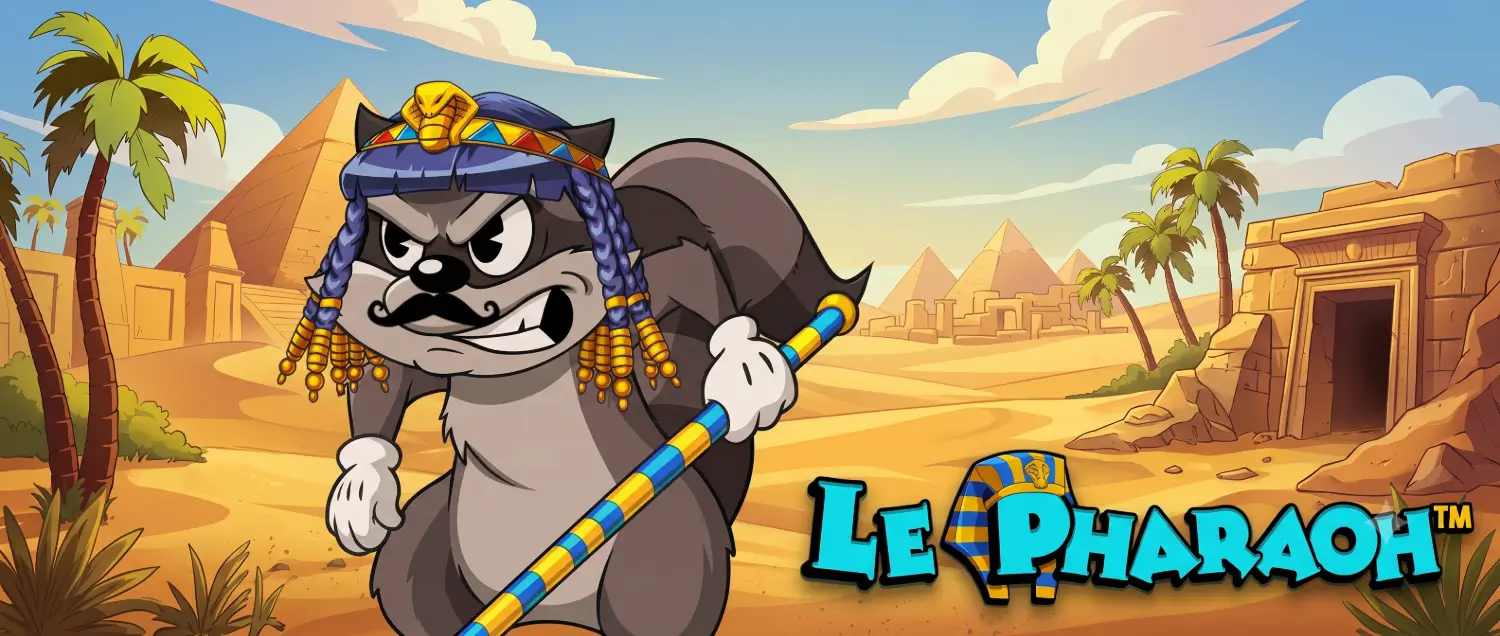
Le Pharaoh has been live since 26 September 2024, which in slot years makes it a veteran rather than a novelty. It arrived as the second entry in Hacksaw Gaming’s “Le” series, the one that took Smokey the raccoon out of Paris and dropped him into a cartoon Egypt full of pyramids and easy marks. The series hasn’t slowed down since: Le Viking, Le King and Le Zeus have all followed, each one nudging the win ceiling higher. That puts Le Pharaoh in an odd spot. It’s still a competent, above-average slot on paper, with a 96.18% RTP and a 15,000x max win, but it’s now sandwiched between an older sibling it clearly outclasses and a newer one that has already outclassed it. The question this review answers isn’t whether Le Pharaoh is good. It’s whether it’s still worth your time when Hacksaw itself has moved on.
Math model and mechanics
Start with the number that actually matters: RTP. Le Pharaoh ships in four configurations — 96.18%, 94.33%, 92.26% and 88.24% — and it’s the operator, not the player, who decides which one goes live on a given site. That’s a wider spread than most 2026 releases bother with, and the gap at the bottom is the one to worry about. An 88.24% RTP is a genuinely weak return, closer to a fruit machine at a motorway service station than a modern video slot. Always check the paytable’s info screen before committing real money, because the difference between the top and bottom configuration isn’t cosmetic.
Here’s what that gap means in practice. Over a realistic 1,000-spin session at £1 a spin, a 96.18% configuration returns roughly £961 of your £1,000 in theoretical long-run value, while the 88.24% version returns around £882. That’s an £80 difference from the exact same game, decided entirely by which casino you happened to click into. Some independent trackers also cite slightly different top-end figures — 96.21%, 96.24% and even 96.29% depending on which bonus mode is measured — which suggests the RTP shifts marginally depending on player choice inside the bonus round rather than being a single fixed number. Either way, 96.18% is the figure to hold operators to, and anything below it is a compromise you’re making on the operator’s behalf, not yours.
Volatility is where sources start disagreeing outright. Hacksaw officially rates Le Pharaoh medium, a 3 out of 5 on its own internal scale. Several independent reviewers, including demo aggregator sites, describe it as high volatility in practice. Both can be true at once, because Le Pharaoh’s base game and its bonus game behave like two different slots. The base game hits often: a 29.21% hit frequency means a winning combination lands roughly once every 3.4 spins, and the Sticky Re-Drop mechanic (more on that below) means those small wins regularly chain into slightly bigger ones. That’s medium-volatility behaviour. The bonus game is a different animal entirely — Lost Treasures in particular can swing from a break-even round to several hundred times your stake with nothing in between. If you only judge the game by its base spins, you’ll call it forgiving. If you judge it by what happens when the bonus lands, high volatility is the more honest label.
The grid itself is straightforward: 6 reels, 5 rows, 19 fixed paylines, paying left to right from the leftmost reel only. That’s a deliberate departure from Le Bandit, which used Cluster Pays. Paylines are more old-fashioned than clusters, but they’re also more transparent — you can look at the paytable and know exactly what a winning line requires, rather than parsing zone-based cluster rules. Bet range runs from £0.10 to £100 per spin, which covers everyone from cautious low-stakes players to the high rollers Lost Treasures is really designed for.
The symbol paytable itself is unremarkable, and it’s worth saying so directly rather than dressing it up. Low-value symbols are the standard 10 through Ace, and the Egyptian icon tier — Scarabs, an Eye of Horus, a Staff, an Hourglass — caps out at a flat 6x the stake for six of a kind on the highest regular symbol. That’s a thin ceiling for a top-paying line symbol by 2026 standards, and it means ordinary base-game wins, even good ones, rarely feel substantial on their own. The entire weight of the game’s payout potential sits behind the bonus mechanics, not the paytable, which is a deliberate design choice but one that shifts almost all of the excitement into a handful of trigger moments rather than spreading it across regular play.
It’s worth being specific about what a 29.21% hit frequency actually buys you at the table. Across 100 spins at a consistent stake, you should expect roughly 29 winning spins, most of them well below break-even value on their own, occasionally chained into something bigger through a Sticky Re-Drop run. That’s a materially different rhythm to something like Legacy of Dead, where independent 200-spin tracking has recorded hit rates closer to 15 to 24%, with long dry stretches between wins. Le Pharaoh’s base game is built to keep the reels moving and the balance ticking over in small increments, which suits players who find long droughts frustrating, even if the ceiling on those small wins is genuinely modest.
On the max win: 15,000x is a 50% jump over Le Bandit’s 10,000x ceiling, and Hacksaw clearly wanted that number to read as an upgrade. In isolation, it’s a solid ceiling — comfortably ahead of Book of Dead and Legacy of Dead, two of the genre’s benchmark titles, both capped at 5,000x. But 15,000x has already been beaten by Le Zeus, which came out a year later with a 20,000x ceiling and a higher hit frequency to go with it. Le Pharaoh’s number was competitive at launch. It isn’t the best number in its own family anymore, and that’s the theme running through the rest of this review.
Feature breakdown
Sticky Re-Drops
This is the mechanic the entire base game is built around, and it replaces the cascading cluster system from Le Bandit outright. Whenever a payline win lands, the winning symbols stick in place and turn into Golden Squares, while new symbols drop in from above to refill the empty positions. If the new symbols create another winning combination, the process repeats, and it keeps going for as long as new wins keep forming. In one extended session, a run started with three Hourglass symbols worth 0.6x the stake and, over three consecutive re-drops, grew into a full set of six for 3x the stake. That’s the mechanic doing its job: turning a small starting win into something worth waiting for, without needing a separate bonus trigger. The catch is that most re-drop chains die out after one or two extra drops. The three-drop chain described above is closer to the upper end of what you should expect than the average.
Golden Riches
Golden Riches is the feature that actually pays the big numbers, and it only activates if a Rainbow symbol is present on the grid at the moment a Sticky Re-Drop sequence ends. When it triggers, the positions marked with Golden Squares convert into Coin, Pot of Gold, or Clover symbols, and their values are totalled and multiplied by the stake. There are two Clover variants worth knowing about: one boosts only the symbols immediately adjacent to it, the other — rarer, and the one worth actually hoping for — boosts every marked symbol on the grid at once. That distinction alone can be the difference between a mediocre Golden Riches trigger and a genuinely good one. It’s the mechanical link between the base game’s steady, modest re-drop wins and the bonus round’s much larger numbers, which is why the paytable leans on it so heavily in its own marketing. Realistically, Golden Riches triggering during ordinary base-game play is uncommon — you need a Rainbow symbol to survive to the exact right moment — so treat it as the occasional bonus on top of base-game spins rather than something to chase spin after spin.
Wild symbol
The Wild substitutes for every paying symbol on the grid and pays a flat 3x the stake for six of a kind, which is a modest but reliable top-tier payout by the game’s own standards. It also plays a role in triggering Golden Riches, since a Wild forming part of a winning combination when a Rainbow symbol is present can help set off the feature. It’s not a flashy inclusion, but it does its job without adding unnecessary complexity to an already feature-dense game.
Bonus Choice: Luck of the Pharaoh and Super Luck of the Pharaoh
Landing 3 or 4 FS scatter symbols simultaneously opens the Bonus Choice menu, and this is where Le Pharaoh earns its reputation for player agency — an unusual amount of it for a slot in this category. With 3 scatters, you can pick Luck of the Pharaoh: 10 free spins in which Golden Squares stay highlighted for the entire round, even after a Rainbow symbol has activated them, letting value stack up across multiple spins rather than resetting after each trigger. Landing 2 extra scatters during the round adds 2 more spins, and 3 extra scatters adds 4. With 4 scatters at trigger, Super Luck of the Pharaoh replaces it: 12 spins instead of 10, better odds of landing high-value Coin and Pot of Gold symbols, and a guaranteed Clover reveal every time Golden Riches fires. This is the calmer of the two bonus paths. It’s built for sustained accumulation rather than a single explosive hit, which makes it the better choice if the goal is clearing a wagering requirement or extending a session rather than chasing the 15,000x ceiling. Put plainly: if you’re weighing up a bonus wagering requirement against your bankroll, Luck of the Pharaoh’s held Golden Squares give you a more predictable path to a moderate, repeatable win than the all-or-nothing structure sitting one menu choice away.
Lost Treasures and Super Lost Treasures
The higher-variance option, and the one that actually threatens the max win. Choosing Lost Treasures drops the normal paying symbols entirely and enters a Hold & Win structure with 3 refilling lives. Coin and Pot of Gold symbols stick to the grid once they land, along with two types of Stone Tablet symbol: the Adding Stone Tablet, which adds a value between 1x and 500x to a random Coin on each spin, and the Multiplying Stone Tablet, which multiplies a random Coin’s value by 2x, 3x, 4x, 5x, 10x or 20x. The round ends either when your lives run out or when the grid fills completely with Coins, Pots of Gold, or Stone Tablets, at which point every Coin and Pot of Gold value is added together and multiplied by your stake. Super Lost Treasures, unlocked with 4 scatters, guarantees an Adding Stone Tablet on the very first spin and improves the odds of higher-value symbols throughout. This is where the 15,000x ceiling actually lives — a Multiplying Stone Tablet landing late in a round, after several Adding Tablets have already stacked value onto the grid, is the realistic path to a five-figure multiplier. It’s also the mode most likely to end in a whimper: plenty of Lost Treasures rounds burn through all three lives with barely enough value on the grid to cover the stake back. One documented Rainbow FeatureSpins purchase into this mode returned close to €450 against a bonus buy cost that nearly matched it — not a loss, not a headline win, and a fairly typical outcome for the mode once you strip away the highlight-reel numbers. Treat any specific multiplier you read about Lost Treasures as the exception being reported precisely because it’s exceptional, not the baseline.
Rainbow Over the Pyramids
The rarest trigger in the game: land 5 scatter symbols at once in the base game, and you skip the choice menu entirely for a guaranteed 12-spin Epic Bonus. Every mechanical benefit from the other modes is stacked into one: Golden Squares remain highlighted for the full round, and a Rainbow symbol is guaranteed on every single spin, meaning Golden Riches has a chance to fire on every spin rather than depending on a Rainbow landing naturally. In practice this is the feature you’ll read about far more often than you’ll trigger — landing 5 scatters simultaneously in the base game is a genuinely rare event, and Hacksaw doesn’t sell direct access to it through the buy menu, which keeps it feeling earned rather than purchased.
Feature Buy
Le Pharaoh’s Feature Buy panel offers four tiers, priced in stake multiples: BonusHunt FeatureSpins at 3x the bet gives a fivefold increase in the chance of triggering a bonus naturally rather than buying straight in; Rainbow FeatureSpins at 60x guarantees a Rainbow symbol lands with a winning combination on the very next qualifying spin; You Must Choose at 100x drops you straight into the standard Bonus Choice menu (Luck of the Pharaoh or Lost Treasures); and But Choose Wisely at 250x does the same for the Super versions. None of these buy directly into Rainbow Over the Pyramids, which stays an organic-only trigger. Worth flagging clearly: Feature Buy is disabled in several regulated markets, the UK among them, so check availability before assuming it’s an option at your casino of choice. Where it is available, the pricing structure is honest about what it’s selling: 3x for better odds, 60x for a guaranteed ingredient, and 100x or 250x for guaranteed entry into a specific bonus tier. None of these buys guarantee a profitable outcome — they guarantee access to a mode, and what that mode then pays is exactly as variable as triggering it for free.
The 2026 perspective
Le Pharaoh doesn’t exist in isolation, and Hacksaw has made sure of that by building an entire family around it. Its direct predecessor, Le Bandit, launched in August 2023 with Cluster Pays instead of paylines, a 96.34% RTP, and a 10,000x max win. Le Pharaoh improved the ceiling by 50% and swapped clusters for a more transparent payline structure, but it also inherited a slightly lower top RTP configuration in the process. If you’re choosing purely between the two, Le Bandit remains the friendlier entry point for newcomers to the series, while Le Pharaoh is the more mechanically ambitious of the pair, with a genuinely bigger bonus ceiling to chase.
The more uncomfortable comparison is with Le Zeus, released in September 2025 and built on the exact same 6-reel, 5-row, 19-payline skeleton as Le Pharaoh. Hacksaw replaced Golden Squares with a Mystery Reveal mechanic, kept the same Coin-and-collect structure underneath, and pushed the numbers up across the board: a 96.26% top RTP configuration, a 36.6% hit frequency (well above Le Pharaoh’s 29.21%), and a 20,000x max win, a third higher than Le Pharaoh’s ceiling. Le Zeus isn’t a Power Reels or Megaways spin-off — Le Pharaoh doesn’t have one of those, and no credible source suggests one is coming — but it functions as the closest thing to a sequel this game has. It plays the same, hits more often, and pays out further. There’s no honest way to recommend Le Pharaoh over Le Zeus on the numbers alone.
Against the wider Egyptian-slot field, Le Pharaoh actually holds up better than it does against its own siblings. Book of Dead, still the genre’s reference point, offers a 96.21% RTP but caps out at just 5,000x — a third of Le Pharaoh’s ceiling, on a simpler 5×3, 10-payline grid with a single Free Spins feature and no re-drop mechanic to extend base-game wins. Legacy of Dead pushes RTP slightly higher at 96.58% but keeps the same 5,000x ceiling as its predecessor, and independent hit-rate tracking on that title has recorded figures well below Le Pharaoh’s 29.21%, with long dry stretches described as part of the intended design rather than a flaw. Eye of Horus Megaways widens the format to 15,625 ways to win but settles for a 96.1% RTP and, again, nothing close to Le Pharaoh’s top-end potential. On raw win ceiling, hit frequency, and feature density combined, Le Pharaoh is comfortably the more ambitious game in this specific comparison set. The trade-off is complexity: newcomers who want the simple, book-and-expanding-symbol format that made Book of Dead a classic will find Le Pharaoh’s five-tier bonus menu genuinely more to learn before it makes sense.
Fairness infrastructure is one area where Le Pharaoh doesn’t cut corners. The game’s RNG is certified by independent testing labs including eCOGRA and iTech Labs, and Hacksaw’s server-side architecture means a dropped connection mid-spin doesn’t cost you the round — it completes server-side and any win is credited automatically. Neither of those things differentiates Le Pharaoh from most licensed 2026-era slots, but they’re worth confirming rather than assuming, particularly given how much of this game’s value depends on trusting a Lost Treasures round through to its actual conclusion.
Two structural absences are worth stating plainly. There’s no progressive jackpot on Le Pharaoh, and there never has been — every win, including the 15,000x ceiling, is a fixed multiplier of your own stake, not a shared pool. That matters if you’re specifically hunting jackpot-style wins rather than high-multiplier bonus rounds; the two aren’t the same thing, and Le Pharaoh only offers the second. Feature Buy, as covered above, is present but regionally restricted, so its availability shouldn’t be assumed as a given the way it might be with older, less-regulated titles.
So who is this actually for in 2026? It’s a high roller’s game more than a recreational one, but with an important caveat: the base game’s 29.21% hit frequency keeps a low-stakes, drawn-out session viable in a way that pure high-volatility titles like Legacy of Dead don’t allow. The player who gets the most out of Le Pharaoh is someone who wants steady base-game turnover with an occasional genuine shot at a five-figure multiplier through Lost Treasures, and who’s willing to accept that the game they’re playing has already been quietly superseded by its own developer.
Verdict
Le Pharaoh is a solid, above-average slot that has aged into an awkward middle position. A 96.18% top RTP, a 29.21% hit frequency, and a 15,000x max win are all genuinely competitive numbers against the Book of Dead and Legacy of Dead generation of Egyptian slots, and the five-way Bonus Choice structure gives it more player agency than most titles in the category bother to offer. What limits it isn’t a flaw in the math model — it’s Le Zeus, released a year later on the identical grid, with a higher hit frequency and a 20,000x ceiling that makes Le Pharaoh’s numbers look dated by comparison.
Play it if you want the payline-based, paytable-transparent version of Hacksaw’s Coin-collect formula, if you’re specifically drawn to the choice between Luck of the Pharaoh’s steady accumulation and Lost Treasures’ higher-risk Hold & Win structure, or if you’re working through the “Le” series in release order and want to understand where the format came from before it got bigger numbers. It also remains a reasonable pick for players who value a genuinely frequent base game over a single headline multiplier, since a 29.21% hit frequency is still doing real work in keeping sessions engaging between bonus triggers.
Skip it if your only criterion is the highest available ceiling in this specific mechanic family — that’s Le Zeus now, not this one — or if an 88.24% RTP configuration is genuinely on offer at your casino of choice, in which case no feature set makes up for that number. And skip Lost Treasures specifically, even within Le Pharaoh, if your bankroll can’t absorb a run of rounds that end well below their purchase cost; that mode’s headline numbers are the exception, not the expectation. For everyone else, Le Pharaoh is a genuinely well-built slot that simply arrived a year too early to be Hacksaw’s best answer to its own question.