Provider: Turbo Games | RTP: 97% | Max Win: 717.27x | Min Bet: ৳12 (~$0.10) | Provably Fair: Yes
Let’s be straight with each other. You’ve probably seen a dozen crash games in the past year alone. Aviator made everyone go crazy. JetX had its moment. Every platform from KheliBet to Nagad88 is stuffed with games that go up — and then explode right before you cash out. You know the drill. Half the time you cash out at 1.4x because you blinked, and the other half you hold on for 8x while it crashes at 1.7x. The cycle is real and it never stops being annoying.
So when someone tells you to check out a game where a tiny red character climbs a staircase while fireballs try to murder him, your first reaction is probably okay, sure, I’ll give it two minutes. Fair enough. That’s exactly how I approached it, and two minutes turned into considerably longer once the mechanics clicked.
Here’s the thing: Fury Stairs isn’t trying to be Aviator. It’s not even trying to be the flashiest game on the lobby. What it’s trying to do — and mostly succeeds at — is something genuinely different. It’s part crash game, part mines game, part retro arcade, and it somehow holds together without collapsing under the weight of its own weirdness. This review covers everything you actually need to know — the mechanics, the numbers, the honest pros and cons — for players in Bangladesh looking at this game in 2026. No fluff, no cheerleading, and no inventing features that don’t exist.
What Is Fury Stairs, Actually?
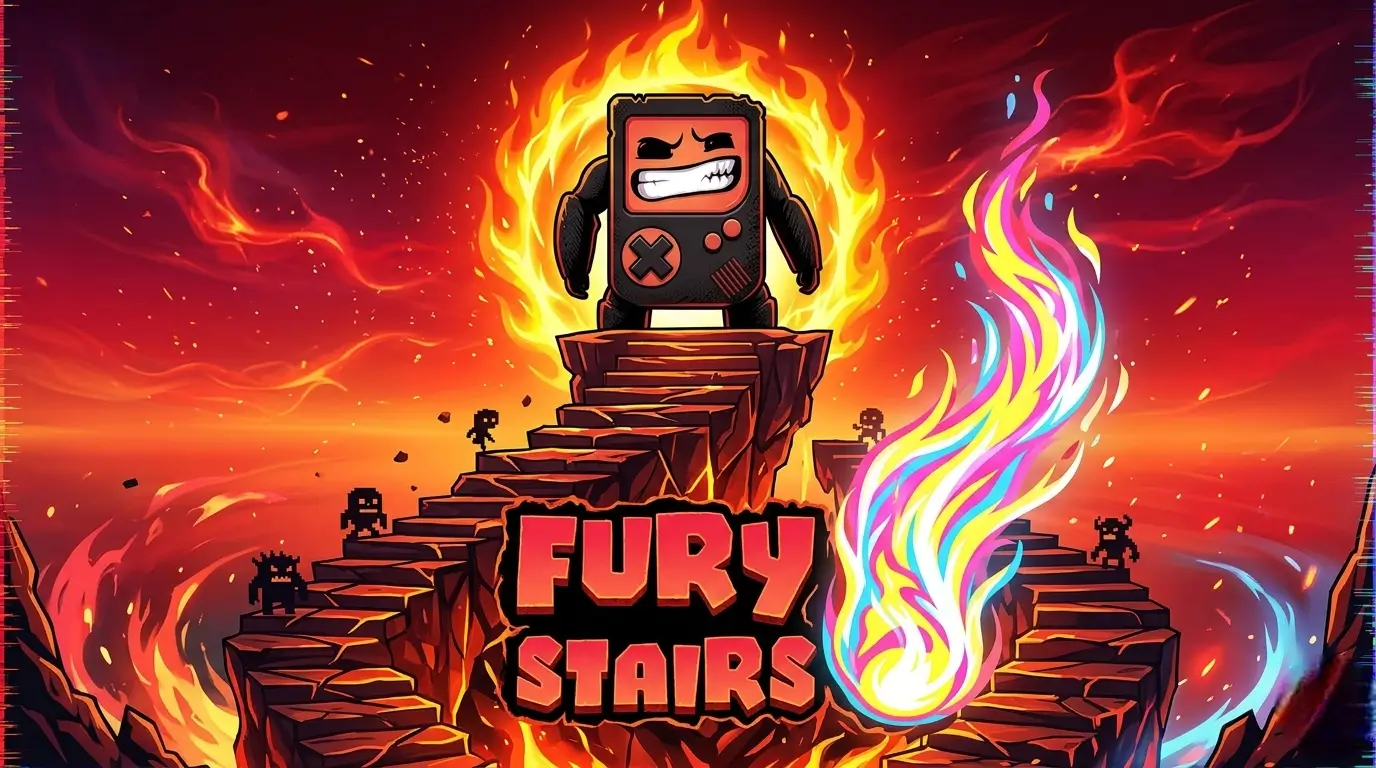
Fury Stairs launched on Christmas Day 2021 — yes, really, December 25 — from Turbo Games, the same studio behind Crash X, Mines, Bayraktar, Limbo Rider, and a handful of other titles you’ve probably seen on the same platforms. The game is built around a simple concept: a 13-row staircase, a red character, and hidden fireballs. Your job is to keep climbing without stepping on one.
If you’ve played Mines before, some of this will feel familiar. If you’ve played any crash game, the cash-out pressure will feel familiar. But the combination creates something that sits in its own corner, and that’s actually kind of rare in a genre where everything looks the same after a while.
The best way to describe it: imagine Donkey Kong got mashed with a crash game and someone stripped out all the animations, the storyline, and the budget. What’s left is the raw decision-making loop, running hot, every single round.
How the Game Actually Works
You start each round by doing two things: picking your bet size and choosing your difficulty level. Those two choices determine everything that follows, and neither one can be changed mid-round, so you’d better make them intentionally.
Bet size runs from $0.10 to $100 per round. For Bangladesh players depositing via bKash or Nagad, that bottom end is roughly ৳12 — low enough to genuinely test the game without feeling it in your weekly budget. The top end at $100 puts you in the range where a single bad row costs real money, so understand what you’re getting into before you start throwing big numbers at it.
Difficulty is where Fury Stairs separates itself from most games in this category. You’re not spinning a reel and hoping for the best. You’re actively deciding how many fireballs hide on each row — anywhere from 1 to 5. Pick 1 fireball and the game becomes a slow, relatively safe grind where you’re chipping away at small multipliers like a patient accountant. Pick 5 and you’re basically sprinting through a minefield in flip-flops, hoping the ground doesn’t explode under you every single step.
Once those two decisions are locked in, you hit Start. The 13-row staircase appears on the right side of the screen, each row displaying available blocks and the multiplier you’d collect if you cashed out there. Your little red character — who looks like he escaped from a mid-2000s indie game and nobody told him he was now in a casino — is standing at the bottom, waiting for your orders.
You click a block. He climbs. One of two things happens:
- The block is safe. The multiplier ticks up. The game asks you, silently but very loudly: keep going, or take the money?
- The block has a fireball. Your guy gets absolutely torched. Round over. Bet gone. Better luck next time, friend.
That’s it. That’s the whole loop. Simple enough that you can explain it to anyone in 30 seconds, but the tension during an active round — when you’re on row 9 out of 13, sitting on a 40x multiplier, and you’re deciding whether to push to row 10 — is very real. The game doesn’t rush you. It just sits there with your winnings on the screen while the next block waits. That pause is where the whole psychology of the game lives.
One thing worth knowing that the game doesn’t announce prominently: the number of blocks per row is not constant. The higher you climb, the fewer options you have on each row. So your odds of picking the safe block actually get worse the deeper you go, not better. You’re climbing into tighter and tighter corridors, with a fireball taking up more and more of the available space. The pressure is baked into the structure.
Also: whatever difficulty you pick at the start stays locked for the whole round. You cannot change it mid-climb. Once you cash out or get blown up, you start fresh and can pick a different number of fireballs for the next round. This sounds like a limitation but it’s actually smart design — it forces you to commit to a risk level rather than adjusting on the fly after you’ve already seen which blocks are safe.
The Multiplier Table — What You’re Actually Playing For
This is where things get concrete. The multiplier you can reach depends entirely on how many fireballs you chose. Here’s the full breakdown:
| Fireballs Per Row | Minimum Multiplier | Maximum Multiplier |
|---|---|---|
| 1 | 1.02x | 2.77x |
| 2 | 1.08x | 8.60x |
| 3 | 1.14x | 31.71x |
| 4 | 1.21x | 134.85x |
| 5 | 1.29x | 717.27x |
A few things to note here.
First, at 1 fireball per row, you’re capped at 2.77x even if you clear all 13 rows without a scratch. That’s not nothing — it’s about triple your money — but you need a clean sweep to get there, and the lower rows barely move the needle. You’ll often find yourself at row 6 looking at a 1.3x multiplier and wondering why you bothered.
Second, at 5 fireballs per row, that 717.27x ceiling is technically reachable — but the game has a hard cap of $10,000 on total payouts. So even if you’re betting $100 and you somehow hit the theoretical maximum, you’d collect $10,000 rather than $71,727. That’s a significant limitation that many reviewers mention once and then move past. Worth remembering if you’re thinking about big bets.
Third, for Bangladesh players on smaller budgets — say ৳1,200 bets, which is roughly $10 — the 3 or 4 fireball rows offer a decent middle ground. You can realistically hit 15x to 30x on a good run without needing to go full madman mode, and if the round goes badly, the loss is manageable.
Risk Control: The Thing That Actually Sets This Game Apart
Most crash games give you one lever: when to cash out. Fury Stairs gives you two levers. The fireball count is a pre-round risk dial that most games in this genre don’t have at all, and it genuinely changes how you approach sessions. It’s the difference between a game that happens to you and a game you’re actually making decisions in.
The conservative line: Play 1 fireball per row. You’ll die less often. Each safe row gives a small multiplier bump. You’re essentially farming tiny wins — cash out at row 4 or 5, collect a 1.1x or 1.15x, repeat. It’s not glamorous. It’s not going to fund a lifestyle change or even pay for dinner. But for someone who wants to stay in the game longer, learn the feel of the mechanics, and not burn through a bKash top-up in four rounds, it’s a reasonable starting point. Think of it as the tutorial difficulty with a cash prize for finishing.
The middle road: 2 or 3 fireballs per row. This is where most experienced players seem to land for regular sessions, and it’s where the game starts to feel genuinely interesting rather than just mechanically functional. The multipliers are meaningful — you can collect a real 5x to 10x on a solid run — and the risk level isn’t heart attack territory. Three fireballs with a max of 31.71x is a genuinely playable range: you won’t hit it often, but it happens often enough to be worth chasing occasionally. For Bangladesh players with a session budget around ৳2,000 to ৳5,000, this is probably the sweet spot. A bet of ৳500 at 3 fireballs that reaches row 7 or 8 pays out a few hundred taka in profit — nothing life-changing, but a decent result for a few minutes of play.
The high-variance grind: 4 or 5 fireballs per row. Here you’re playing a game of probability with steep odds against you every single row. The upside exists — 134.85x and 717.27x are real numbers attached to real payouts — but your expected session at 5 fireballs is heavy losses punctuated by occasional big hits that might or might not cover what you spent getting there. For a Bangladeshi player using bKash with a session budget of ৳5,000 or ৳10,000, this mode will drain that budget fast on a bad run. Only go here if you’re genuinely comfortable losing the whole amount in a handful of rounds, and if you have the discipline to walk away after a big win instead of immediately feeding it back into the next round.
The crucial point — and this is worth saying clearly — is that there is no strategy that beats the house edge. The RTP is 97%, meaning 3% goes to the house over time across every session from every player. No amount of pattern reading, fireball counting, gut feeling, or superstition changes those underlying odds. The fireballs are placed randomly at the start of each round. Provably fair means you can verify this after the fact using the round’s hash value. There’s no hot streak to ride and no cold streak to dodge. The game doesn’t have memory. It doesn’t know you just lost five rounds in a row and owe you a win. It just runs the odds fresh every time.
What good risk management actually looks like in practice: decide your fireball count before you start based on your session goal and your budget, set a mental stop-loss amount before you open the game, and actually stick to it when you hit it. That’s it. That’s the entire strategy section of every honest Fury Stairs guide ever written. The rest is noise.
Visual Design and Sound: Bare Bones, No Apologies
Fury Stairs is not going to win any awards for presentation. The studio clearly poured its energy into the mechanics rather than the visuals, and the end result is something that looks more like a 2009 browser game than a 2021 casino release. If you’re the kind of player who needs sweeping animations, cinematic intros, and an orchestral soundtrack to feel like you’re in a proper game — Fury Stairs will feel like it was made on a lunch break.
The main character — that blocky little red figure — has a lot of personality packed into very few pixels, which is genuinely impressive given how little the developers had to work with. He runs, he climbs, he occasionally gets detonated by a fireball in a way that’s almost cartoonishly violent. It’s charming in a lo-fi way, and it fits the overall retro arcade aesthetic the game is going for. The character design clearly draws from classic platformers — multiple reviewers compare him to Meat Boy, the masochistic hero of the 2010 indie game that also reveled in killing its protagonist repeatedly. If you know, you know. If you don’t, just think “small red blob that dies a lot.”
The background is static. The staircase is just a grid of blocks. There’s no ambient animation, no particle effects beyond the fireball explosion when your character dies, and the color palette is deliberately minimal. If you came from playing something like Gates of Olympus right before opening Fury Stairs, the visual downgrade is noticeable. It’s the difference between watching a film and reading a text file of the script. The information is all there; it just looks very different.
Audio is equally spartan: two sound effects and no background music whatsoever. One sound when you successfully climb a row, one when you get blown up. That’s your entire audio experience for every session, every round, every day you play this game. The silence between those two sounds is where the tension actually lives, which you could argue is smart psychological design — or you could argue it’s a budget call. Probably both.
For players on Grameenphone or Banglalink data connections — where streaming audio just burns MB for no reason — this spartan audio approach is honestly a feature rather than a limitation. The game is lightweight, loads fast, and doesn’t keep your phone’s speaker cooking the whole time.
The UI layout is clean and sensible. Bet controls and fireball selector sit on the left side of the screen. The staircase grid fills the right, with multipliers clearly attached to each row so you always know exactly what cashing out at that moment would pay. In the top right corner you’ve got your balance display, a mute button, and a small settings gear that opens a panel for nickname changes, bet value adjustments, and the game rules. At the bottom of the screen there’s a live ticker of results from other Turbo Games titles — a minor social element that adds a little ambient sense of activity without actually being useful for anything.
For mobile players on Samsung Galaxy A-series or Redmi Note devices — which covers a significant chunk of the Bangladesh audience — the game loads cleanly in a mobile browser. No app download, no registration for the demo, no heavy assets sitting in your cache. You open it, tap a block, watch the result, and the next round is ready within seconds. That turnaround speed matters when you’re playing on mobile data during a commute or a break. Fury Stairs is genuinely built for mobile-first play in a way that many visually richer games aren’t.
Provably Fair: Does It Matter?
Yes, it matters, and it matters more in markets like Bangladesh where there’s limited regulatory oversight and players are right to be cautious about whether outcomes are genuinely random.
Fury Stairs uses a provably fair system, which means the result of each round is cryptographically committed to before you make your choice. The fireball positions are determined and locked in before you pick your block — not after. After the round ends, you can verify using the hash value that the placement was set before your click, not generated in response to it. This is real, verifiable transparency, not a marketing term someone slapped on a press release.
Most mainstream slot games and even many crash games cannot offer this. A traditional RNG slot generates results and you have to trust the operator’s license, their auditing certificates, and ultimately their word. With provably fair, you don’t have to trust anyone — you can independently confirm every single round if you have the inclination. Most players never do the verification, but the option being there is a meaningful trust signal. It’s the difference between a restaurant that says “we use fresh ingredients” and one that lets you walk into the kitchen and check.
For Bangladesh players depositing real money via bKash or Nagad into a platform, knowing the game cannot be manipulated against you at the round level is worth something. The operator still has a house edge — that’s how the business works — but the provably fair system means that edge comes from probability, not from tilting individual results.
If you want to verify a round: after it ends, the game shows you the server seed hash and client seed used to generate the fireball positions. You can run those through the verification function yourself. The Turbo Games documentation on their site explains the process. You’re unlikely to do this every round, but knowing you could is the point.
Who Will Actually Enjoy This Game
Let’s be direct about who Fury Stairs is and isn’t for.
It works well for players who:
- Like decision-making during each round, not just passive watching
- Want short, fast rounds without spinning animations or feature build-up
- Prefer to control their own risk level rather than having it baked in by a developer
- Play primarily on mobile and want something light and responsive
- Appreciate genuine provably fair transparency
- Are used to crash game or mines mechanics and want something that blends both
It’s probably not the right fit for players who:
- Want a big max win ceiling — $10,000 capped payouts rule out the true high-roller territory
- Need visual spectacle, sound design, or any kind of narrative context to stay engaged
- Want bonus rounds, free spins, jackpot pools, or any feature beyond the core climbing mechanic
- Are looking for a social multiplayer experience or shared crash graph
The game’s biggest limitation is that it doesn’t grow with you. After a few dozen sessions, you’ve seen everything Fury Stairs has to show. The mechanics don’t evolve, there are no unlockables, no seasonal events, no special modes. You’re playing the same grid climb every time. For some players that’s a feature — pure, uncluttered repetition. For others, it gets old.
How It Compares to Similar Games
vs. Aviator (Spribe): Aviator has a multiplying plane, a shared social feed where you can watch other players cash out in real time, and autobet/auto-cashout options that let you set a target and walk away. Fury Stairs has none of that social layer, no auto-cashout, and no shared experience. You’re climbing alone while Aviator lets you feel like you’re at a table with other people. RTP is similar — Aviator also runs at 97%. The key mechanical difference is that Fury Stairs gives you the fireball slider as a pre-round risk control; Aviator’s risk is entirely in your cashout timing, which means Fury Stairs offers a slightly different type of decision-making. Neither is objectively better; they scratch different itches.
vs. Mines (BGaming / Turbo Games own version): The closest mechanical relative in the game library. Both involve hidden bombs on a grid, and both require you to select tiles while managing how much risk you’ve taken on. The key structural difference is that Mines lets you pick any tile in any order across a single flat grid and collect whenever you want; Fury Stairs is a linear vertical climb where row order is fixed and the number of available blocks shrinks as you ascend. Fury Stairs forces you forward in one direction; Mines lets you work the grid however you like. If you’ve played Mines and you like the format but want more defined progression and clearer multiplier markers at each stage, Fury Stairs is worth 20 minutes of your time.
vs. Space XY (BGaming): Space XY is a proper crash game with trajectory mechanics, multiple spacecrafts, and significantly higher max win potential than Fury Stairs’s $10,000 cap. More visual, more complex, more upside. Fury Stairs is simpler and faster but doesn’t come close to Space XY’s ceiling for big sessions.
vs. JetX (SmartSoft Gaming): JetX is another crash-format game with a jet that flies until it crashes. Auto-cashout options, shared lobby feel, faster round cadence. Fury Stairs is slower and more deliberate — each block pick is a conscious choice, whereas in JetX you’re mostly watching and timing. Different tempo, different kind of attention required.
The honest comparison landscape: Fury Stairs is not the top dog in any single category. It’s not the most visually impressive, not the highest max win, not the most socially engaging. What it has that most competitors don’t is the explicit difficulty slider that gives you real pre-round control. That one feature keeps it relevant in a crowded field.
The Honest Bottom Line
Fury Stairs is a solid, unpretentious instant game that does exactly what it promises. It’s not going to become your main game unless you have a very specific taste for bare-bones mechanics and fast rounds. But as a secondary title — something to cycle through between longer sessions on other games — it punches well above its weight.
The 97% RTP is genuinely good. The provably fair system is real and verifiable. The fireball difficulty control gives you actual input into your risk profile, which is more than most games in this category offer. The $10,000 payout cap is a real limitation, and the lack of any bonus features means what you see is absolutely everything you’re going to get.
For Bangladesh players on bKash or Nagad with moderate session budgets and a preference for fast, mobile-friendly play: this game belongs on your tried list. Whether it stays on your regular list depends on how much you value simplicity versus variety.
Start in demo mode. Get comfortable with the mechanics. Find your preferred fireball count — most players land on 2 or 3 for regular sessions. Set a budget before you start, and decide your cashout target in advance. Then play through it without chasing. That’s about as much guidance as anyone can honestly give you on this one.
The staircase is waiting. Your guy is ready to climb. Just try not to get him killed in the first row.