By a veteran slot reviewer with 12+ years in the trenches
Let me be straight with you from the jump: Rome: The Golden Age is the kind of slot that will either carve your bankroll to pieces like an unlucky gladiator meeting Rome’s finest — or hand you a payout so large you’ll be staring at your screen wondering if it actually happened. There’s almost no middle ground with this one. NetEnt built something genuinely ambitious here, and while it has a few frustrating quirks that keep it from being a true masterpiece, the raw potential packed into this game puts it comfortably in the upper tier of anything the Swedish studio has ever produced.
Released on February 9, 2021, Rome: The Golden Age arrived with the kind of hype you’d expect from a developer that has Gonzo’s Quest and Dead or Alive 2 in its back catalogue. Does it live up to the billing? After logging serious session time on this title, the answer is: mostly yes — with some important caveats you need to know before you fund your account and start spinning.
The Setup: Marble Columns, Diamond Grid, and a View from the VIP Box
Before we talk numbers and mechanics, let’s talk about what you actually see when you load the game. NetEnt placed you on a marble-floored, column-flanked terrace — essentially the ancient world’s equivalent of a luxury corporate box — with a gladiatorial arena spreading out below you. The visual presentation is polished and clean: full HD rendering, crisp symbol animations, atmospheric sound design with crowd noise that swells when things get interesting.
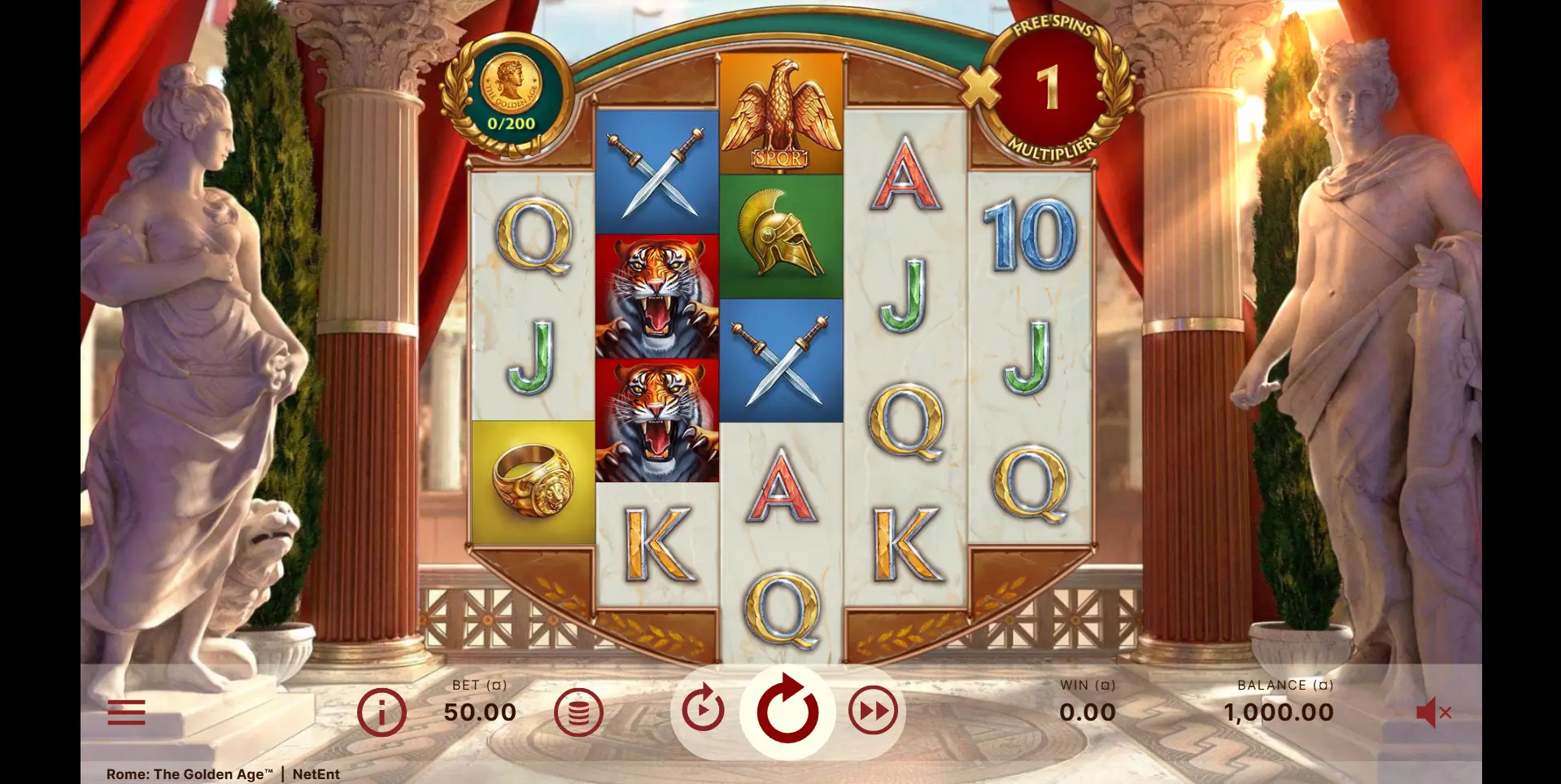
The reel layout is where things get immediately unusual. Instead of the standard rectangular grid you’d find in 90% of online slots, Rome: The Golden Age uses a diamond-shaped 3-4-5-4-3 format. That gives you 20 fixed paylines across five reels, with the middle reel offering the most symbol positions at five. If this layout looks familiar, that’s because NetEnt used the same structure in their branded Jumanji slot — but the similarity ends at the grid shape. Where Jumanji was a relatively gentle ride, Rome: The Golden Age has teeth.
The symbol set covers the usual range. Low-value royals (10 through Ace) fill out the bottom of the paytable. Move up and you’ve got Roman-themed premiums: crossed swords, golden helmets, signet rings, eagles, and tigers. The wild symbol and the tiger both sit at the top of the regular pay table, worth 5x your total bet for five of a kind. Here’s where many reviewers stop and sound an alarm — and rightly so. These individual symbol values are genuinely low. A full-screen landing of the top symbol pays just 5x your bet through normal line wins. On paper, that sounds underwhelming. In practice, the game’s feature mechanics more than compensate — but only when they fire properly, which isn’t guaranteed.
There’s also the Golden Age coin symbol and the Rome symbol, which don’t belong to the standard pay table at all. These are the engine that makes the whole machine run.
A word on the aesthetics while we’re here. The marble-columned backdrop is genuinely one of the nicer looking base environments in NetEnt’s recent catalogue. The background renders in full HD, and the column statues flanking the grid are detailed without being distracting. Where the presentation takes a slight knock is in the reel symbols themselves, which look noticeably more cartoonish against the richly rendered background — a mismatch that more than a few reviewers have flagged. It doesn’t ruin the experience, but it’s a visible inconsistency in what is otherwise a visually polished title. The audio design, on the other hand, is consistently strong throughout: crowd ambiance, cinematic music that builds during big moments, and satisfying sound effects when the wild chain activates all combine to create an atmosphere that keeps you engaged during sessions.
How the Frame System Actually Works (Read This Carefully)
This is the part where most casual players either zone out or misunderstand what’s happening — and then wonder why their session drained their balance without any fireworks. Understanding the Frame Collection mechanic isn’t optional; it’s the entire foundation of the game.
Every time a Golden Age coin symbol lands on the grid, two things happen simultaneously. First, that position on the grid gets marked with a golden frame — a visual indicator that sticks around across subsequent spins. Second, between one and four points get added to the progress bar located in the top-left corner of the screen. If the Golden Age symbol lands on a position that already has a frame, it can randomly transform into a Rome symbol, and that position’s frame becomes “active.”
On the very next spin after a Rome symbol appears, the mechanics get dramatic. The Rome symbol’s position converts to a wild, and then — crucially — every adjacent position that also carries a frame converts to a wild as well. Those new wilds don’t stop there. They then spread again to their adjacent framed positions, cascading outward up to five times. When the dust settles and those wilds have contributed to a win, the frames on those positions get cleared.
The visual of this spreading wild chain, when it’s running hot and covers a significant portion of the grid, is genuinely one of the more satisfying animations you’ll see in a NetEnt game. The tension builds as each position flips — you’re watching a chain reaction in real time, never quite sure how far it’ll reach or how much of the grid it’ll engulf.
But — and this is a big but — the base game hit frequency sits at around 17.6%, meaning wins hit roughly once every five or six spins. The spreading wilds help bridge the dry spells, but you will have sessions where the frame coverage never gets particularly dense and the Rome symbol just doesn’t cooperate. This is a game that asks for patience and a healthy enough bankroll to absorb variance.
The Progress Bar and Free Spins Multiplier: Where the Real Money Hides
Now we get to the mechanism that separates Rome: The Golden Age from almost every other high-volatility slot in the market. The progress bar in the top-left corner tracks points accumulated through Golden Age symbol landings. You need 200 points to fill it. Each time it fills, the Free Spins multiplier advances by one step.
The multiplier ladder runs as follows: ×1 (starting point), ×2, ×3, ×5, ×7, ×10, ×12, ×15, ×20, ×30, ×40, ×50, ×75, ×100, ×200, ×300, ×500, ×750, and finally ×1,000. That’s 18 full cycles of the progress bar needed to reach the maximum. The multiplier is stored, waiting for the next Free Spins trigger — and it only resets after Free Spins have been played.
Let that sink in. The multiplier doesn’t disappear just because you’ve been spinning for a long time. It survives until Free Spins finally fire. This creates a fascinating strategic situation: experienced players often deliberately try to delay triggering Free Spins by avoiding scatter-prone configurations, preferring to build the multiplier as high as possible first. The higher the multiplier you carry into the bonus, the more explosive the potential payout.
To trigger Free Spins, you need three scatter symbols — gold wreath icons — landing simultaneously on reels 2, 3, and 4. At that point, any positions already carrying frames or active frames (that didn’t convert to wilds on the triggering spin) get locked immediately. These locked positions will award a random prize between 0.5× and 50× your total bet at the end of the feature.
During Free Spins, the mechanics shift. Each reel position spins independently, and only Rome symbols can appear — no regular pay symbols, no royals, nothing else. If a Rome symbol lands on any unlocked position, it locks that position, resets the counter back to three free spins, and awards a prize of between 0.5× and 50× your bet. The round continues until you run out of spins or all positions are locked. Fill every single position with Rome symbols and you get a bonus ×2 multiplier applied to all prizes on top of whatever your accumulated multiplier was.
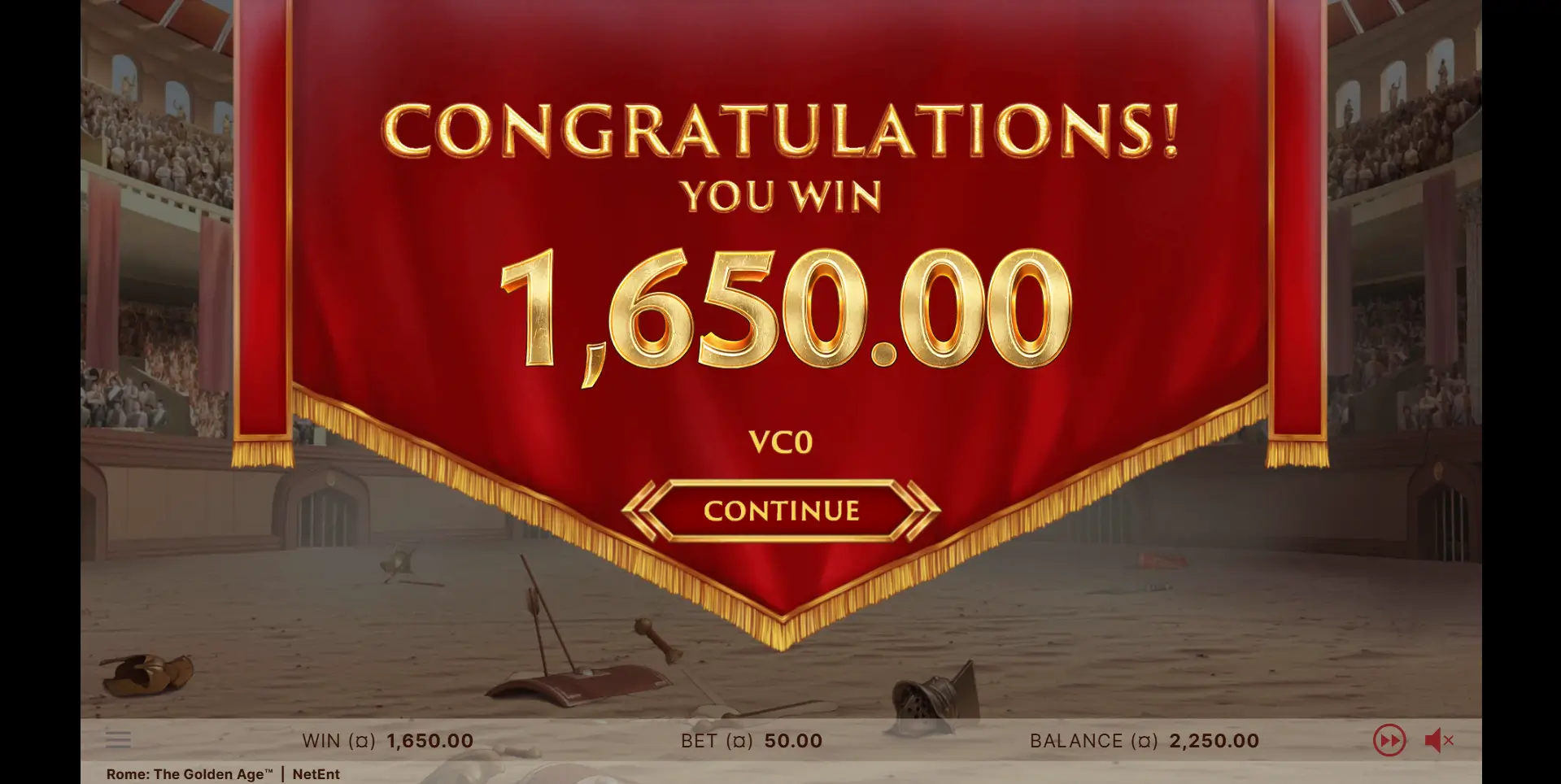
At the end of Free Spins, all Rome symbol prizes are totalled, then multiplied by the current Free Spins multiplier. That total is your payout. With a ×1,000 multiplier and a full grid of Rome symbols each paying up to 50×, the theoretical 100,000× maximum comes into view — though NetEnt’s own simulation data puts hitting that ceiling at roughly once per 166 billion spins. More realistically, you’re hunting for wins in the 1,000× to 20,000× range, which is still life-changing money at even moderate bet sizes.
The Operator RTP Issue: Check Before You Deposit
This is something that rarely gets enough attention in reviews, and it matters significantly for players in Bangladesh.
Rome: The Golden Age has a default certified RTP of 96.06%. This is the figure you’ll see cited across most review sites and databases. However, NetEnt’s certification permits operators to deploy the game at four different RTP configurations: 96.06%, 95.05%, 93.05%, and 91.05%. The version you play depends entirely on which setting the casino running the game has chosen — and they are under no obligation to make this obvious.
A drop from 96.06% to 91.05% might not sound catastrophic in percentage terms, but across thousands of spins it represents a meaningful shift in expected return. The gap between the best and worst RTP settings on this game is almost five full percentage points. If you’re playing at a casino offering the 91.05% variant, you’re operating at a significant disadvantage compared to the headline numbers.
The practical advice here: before depositing at any casino to play this title, navigate to the game’s help or paytable section within the actual game client and locate the stated RTP. Legitimate operators must disclose this figure in the help files. If you can’t find it, or if the casino refuses to clarify, treat that as a red flag.
Volatility, Hit Rate, and Bankroll Management
The question of volatility in Rome: The Golden Age is actually somewhat contested across review sources. Some outlets classify it as medium-high; others call it outright high. The hit rate data — approximately 17.6% according to BigWinBoard’s analysis — places it comfortably in high-volatility territory regardless of what label you apply.
What does that mean in practical terms for a player sitting down with a 5,000 BDT session budget? It means you should expect extended dry stretches punctuated by occasional wild-chain wins and, if you get fortunate with scatter timing, a bonus round that can either deliver a modest payout or — if your multiplier is stacked — something considerably larger.
The recommended approach here is not complicated but does require discipline. Start at the lower end of the bet range and only move up after you’ve gotten a feel for the game’s rhythm in that session. The base game is genuinely engaging — watching frames accumulate and waiting for the Rome symbol to appear keeps you invested even when the regular pay table isn’t producing much. But the underlying math means that this is not a game for anyone who needs to see consistent small wins to stay comfortable. If that’s your style, there are softer options in the NetEnt catalogue.
Let’s talk about what a realistic session actually looks like, because the review sites that only focus on the 100,000× ceiling do players a disservice. In a typical extended session, you’ll see the wild chain fire irregularly — sometimes covering three or four positions, occasionally stretching further across the grid. These base game wild events produce modest but meaningful wins, enough to slow bankroll erosion during the stretches where the scatter refuses to appear. The progress bar will fill and advance the multiplier; the key question is how many times it fills before scatters land.
In sessions where the scatters arrive quickly — before the multiplier has climbed beyond the ×2 or ×3 range — the resulting Free Spins payout is often underwhelming. This is the most common point of frustration with the game, and it’s a legitimate criticism. The feature can trigger at a low multiplier, produce a handful of locked Rome symbols, and net you something like 20–30× your bet — technically a win, practically disappointing given how high-variance the surrounding base game is. This is why experienced players try to accumulate multiplier progress before the scatters fire, though the timing of that is entirely outside your control.
When things do align — a decent multiplier, good frame coverage on the triggering spin, and a generous run of Rome symbol landings during Free Spins — the results can be remarkable. The compounding math of multiple locked positions each worth up to 50×, multiplied by a ×100 or higher accumulated multiplier, produces the kind of payouts that make this game’s reputation. Those sessions are the outliers, but they’re real, and they’re what give Rome: The Golden Age its legitimate standing among serious high-volatility players.
One genuine positive worth noting: the feature triggers with reasonable frequency. The scatter requirement of three wreaths on specific reels would normally be harsh, but because the progress bar builds steadily through normal play, there’s almost always something to track and anticipate even during otherwise quiet stretches.
Playing Rome: The Golden Age from Bangladesh in 2026
For players accessing this game from Bangladesh in early 2026, a few practical points are worth highlighting.
The game is fully mobile-optimized and runs smoothly on Android and iOS devices. Given that the majority of Bangladeshi players access online casinos through smartphones — predominantly Redmi Note and Samsung Galaxy A-series handsets running on Grameenphone and Banglalink 4G networks — this matters more than the desktop experience. NetEnt built Rome: The Golden Age in HTML5, meaning there’s no download required and the game loads reliably on mid-range mobile hardware without significant performance issues. The diamond-shaped grid actually translates well to portrait mode on a phone screen — the wider middle reel sits naturally in the centre of the display, and the frame animations are clear and readable even on smaller screens.
Bet sizing in the game runs from 0.10 to 50.00 per spin in the base currency. For Bangladeshi players, the equivalent range in BDT will depend on the casino’s conversion rate, but most operators supporting the Bangladeshi market price this game accessibly. The lower end of the bet range makes it possible to manage your bankroll sensibly while still building the multiplier progress bar over time.
One consideration specific to mobile play in Bangladesh worth flagging: because the Frame Collection mechanic requires you to track which grid positions are currently framed between spins, the visual clarity of those frame indicators matters. On smaller screens running at lower brightness (common when conserving battery on mobile data), the golden frame highlights can be slightly harder to read than on a tablet or desktop monitor. If you find yourself losing track of which positions are active, pinching to zoom the reel area during slower moments helps.
The game’s background music and sound effects are well worth keeping on if your situation permits — the audio design does meaningful work in terms of building tension during wild chain events and Free Spins. That said, the game plays perfectly well with sound off if you’re spinning during a commute or in a public setting.
Responsible gambling note: this is a high-volatility title with the kind of mechanics — specifically the multiplier building system — that can encourage extended play while chasing a specific bonus configuration. If you set a session limit before you start and stick to it regardless of where the progress bar is sitting, you’ll navigate this game far more safely. GamCare (gamcare.org.uk) offers free support resources if gambling habits become a concern.
How It Compares to Other NetEnt Slots
The comparison most frequently made by reviewers is with Dead or Alive 2 — another NetEnt slot with elite max win potential (this time 111,321× the bet) and punishing volatility. The comparison is fair in terms of ceiling, but the playing experience is quite different. Dead or Alive 2 is a more traditional high-variance slot where you’re hunting specific reel configurations. Rome: The Golden Age is more of a builder — a game about constructing an optimal state through the frame system and multiplier accumulation before cashing in via Free Spins.
In that sense, it has more in common with Hold & Win mechanics popularized by developers like Big Time Gaming, though the execution here is distinctly NetEnt’s own. If you’ve enjoyed games like Holy Diver from BTG or Kingmaker, the underlying psychology of Rome: The Golden Age — that sense of building toward something significant — will feel familiar and satisfying.
The Jumanji comparison gets made frequently due to the shared grid layout but is largely superficial. Jumanji was a medium-volatility game with branded appeal. Rome: The Golden Age is something genuinely different.
NetEnt’s earlier Roman-themed title, Victorious, also comes up occasionally in comparisons. That game is significantly softer — lower volatility, lower ceiling, more consistent base game wins. If you’ve only played Victorious and expect a similar experience from Rome: The Golden Age, you’ll be surprised by how differently it plays. The tone of the two games reflects their divergent approaches: Victorious is a crowd-pleaser; Rome: The Golden Age is designed for players who want to hunt.
One honest critique shared by several reviewers: the base game line pays are too low. When a full screen of wilds — which should feel like an event — barely crosses the “big win” threshold through line pays alone, there’s a disconnect between the visual drama of the spreading wild animation and the actual payout received. The frame system compensates for this, but it does mean the game requires patience and an understanding that the real money lives exclusively in the bonus round, not the base game. Some players — particularly those accustomed to slots where the base game wild events themselves deliver satisfying payouts — find this aspect genuinely deflating. It’s worth knowing going in rather than discovering it after the fact.
The flip side: when the base game wild chain fires across a well-populated frame layout, the combination of spreading wilds completing multiple paylines simultaneously can produce wins that feel genuinely proportionate to the drama of the animation. The game isn’t incapable of delivering satisfying base game moments — it just requires a degree of frame setup that doesn’t always materialise.
Final Verdict
Rome: The Golden Age is a genuinely accomplished slot that rewards players who take the time to understand its mechanics. The Frame Collection system is clever and creates real engagement during the base game. The multiplier ladder is one of the most ambitious structures NetEnt has ever incorporated into a single title — a ×1,000 free spins multiplier that can transform a modest bet into a life-changing payout is not something you see often. The visual presentation is polished, the mobile performance is solid, and the 96.06% default RTP is respectable.
The weaknesses are real but manageable with the right expectations. Individual line pay values are low. The base game hit rate of 17.6% means a serious bankroll is a prerequisite, not an optional extra. The max win of 100,000× is theoretical rather than practically achievable for almost anyone. And the operator RTP flexibility means you need to verify which variant you’re actually playing before committing real money.
For players in Bangladesh who understand what they’re signing up for — a high-volatility, mechanics-driven slot that demands patience and rewards strategic awareness — Rome: The Golden Age delivers one of the most interesting experiences in NetEnt’s catalogue in 2026. Just go in with your eyes open, check the RTP before you deposit, and keep your session budget defined in advance.
The emperor may decide your fate with a flick of his hand. Make sure yours is pointing up before you step onto the sand.