Seven years on the market and Reactoonz still pulls players in like a malfunctioning tractor beam. Released by Play’n GO back in October 2017, this alien-packed cluster pays slot has outlasted dozens of copycat titles and remains one of the most-discussed games in any serious casino library. By early 2026, Reactoonz has racked up over 3.2 million tracked spins on community platforms — that’s not a fluke, that’s a fanbase. If you’ve landed on this review wondering whether this quirky 7×7 grid is worth your time (and your ৳), the short answer is: yes, but you’d better know what you’re walking into.
What Kind of Game Is This, Exactly?
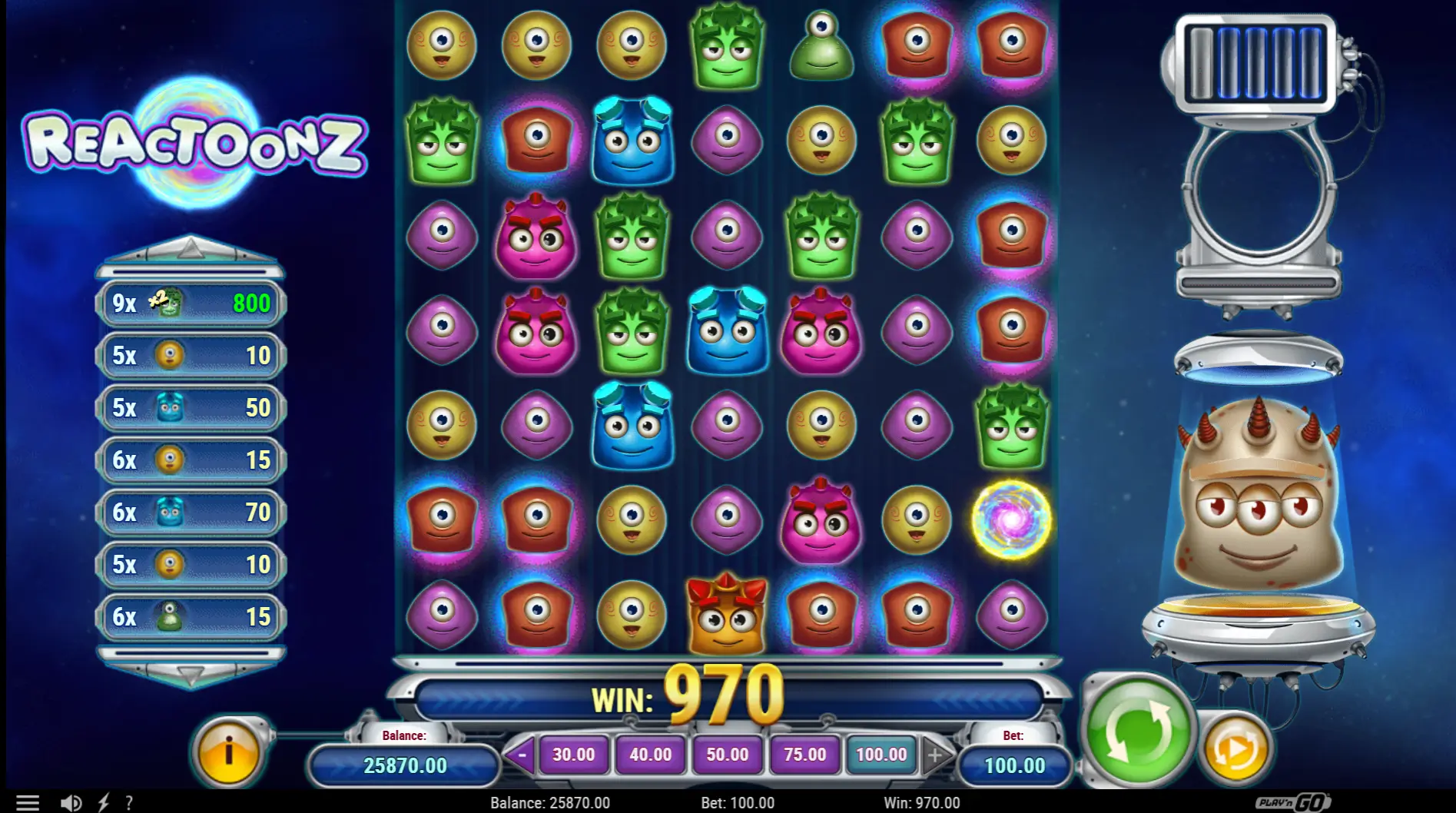
Let’s get one thing clear upfront: Reactoonz is not a slot in the traditional sense. There are no spinning reels, no paylines numbered from 1 to 25, no scatter symbols that unlock fifteen free spins while a dramatic drum roll plays. Instead, what you get is a 7×7 grid where colorful alien creatures cascade down from the top, cluster together, explode when they match, and make room for more aliens to fall in. It’s closer to Candy Crush than to Book of Dead — and that’s a compliment, not an insult.
The mechanics are called Cluster Pays: you need five or more matching symbols connected horizontally or vertically to form a win. The winning symbols then disappear, new ones drop in, and if those form another cluster — congratulations, the chain continues. This cascading sequence keeps going until no new winning clusters appear, at which point the round ends and your total accumulated winnings get paid out.
For players in Bangladesh picking this up on a Redmi Note or Samsung Galaxy A-series — which covers a large chunk of the BD player base — the game runs smooth on both Grameenphone and Banglalink 4G networks. Play’n GO built this thing mobile-first, and it shows. Load times are reasonable even on moderate connections, the grid is clean and readable on smaller screens, and the feature animations don’t lag or stutter. This matters because nobody wants their Gargantoon moment killed by a buffering screen.
Worth noting for anyone used to traditional slot formats: the adjustment period for Reactoonz is real. Your first few sessions might feel disorienting. Where are the reels? Where are the paylines? Why are these things exploding? Give it ten minutes of real play before forming an opinion. The mechanics make intuitive sense once you’ve watched a few cascade chains play out, and after that initial learning curve the game becomes genuinely readable. The feature names flash on screen whenever they trigger, which helps enormously during your first encounters with the Quantum system.
The Numbers You Actually Need
RTP: 96.51% (top-end configuration) Volatility: High Grid: 7×7 Minimum Bet: ৳20 (approximately ০.২০ EUR equivalent) Maximum Bet: ৳8,500+ (approximately €100) Max Win: 4,750x your stake Release Date: October 2017 Provider: Play’n GO
One critical note on that RTP figure. The certified top-end RTP is 96.51%, which sits above the industry average of around 96%. But — and this is the part that often gets buried in reviews — Play’n GO offers multiple RTP tiers to operators. Some casinos run Reactoonz at configurations as low as 84.51%. That’s a massive gap, and it affects your real-money returns in ways that aren’t visible on the surface. Before depositing to play Reactoonz anywhere, check the game’s info tab once it loads. The RTP should be listed there. If you see anything below 95%, consider playing elsewhere. On platforms available to Bangladeshi players like Nagad88, where Reactoonz is listed with cluster-based mechanics and a ~96% RTP configuration, the game is reportedly running at or near the standard tier — but always verify this in-session.
The high volatility classification is accurate and worth taking seriously. This is not a grind-for-steady-returns machine. Sessions can go deeply negative before a big chain reaction swings things back. You’ll hit long cold spells where the meters barely move and the grid feels like it’s working against you. Then suddenly four Quantum features queue up in one round and the whole screen lights up. That variance is both the appeal and the danger of Reactoonz.
The Symbol Lineup
All paying symbols in Reactoonz are aliens. No fruit, no cards, no generic gems — just extraterrestrials organized by number of eyes.
Low-pay symbols (one-eyed aliens): Four varieties in yellow, dark green, brown, and purple. A five-symbol cluster pays 0.1x your stake. A maximum cluster of 15 or more pays 3x.
High-pay symbols (two-eyed aliens with horns): Four varieties in blue, orange, light green, and pink. The pink alien is the top payer — a five-symbol cluster pays 1x stake, and 15 or more pays 750x. Yes, 750x from a single symbol type in one cluster. That’s the dream scenario.
Wild symbol: The Vortex Orb — a swirling energy ball that substitutes for all regular symbols. These don’t appear on their own initially; they’re generated by the game’s feature system.
Gargantoon: A three-eyed alien boss who acts as an oversized wild during his feature. More on him below.
The Feature System: Where Things Get Interesting
Reactoonz earns its reputation from its interconnected feature ecosystem. The game essentially has four layers of mechanics that build on each other, and understanding how they interact is what separates players who know what they’re doing from players who are just watching pretty animations.
Fluctuating Symbol
At the start of every spin, one random one-eyed (low-pay) alien type is designated as the Fluctuating symbol. It gets a glowing marker. If that marked alien participates in a winning cluster, two Vortex Wild symbols are left behind on the grid after the cluster explodes. These wilds can then contribute to subsequent cascades in the same round. It’s a passive bonus that fires reasonably often and can meaningfully extend chain reactions.
Giantoonz
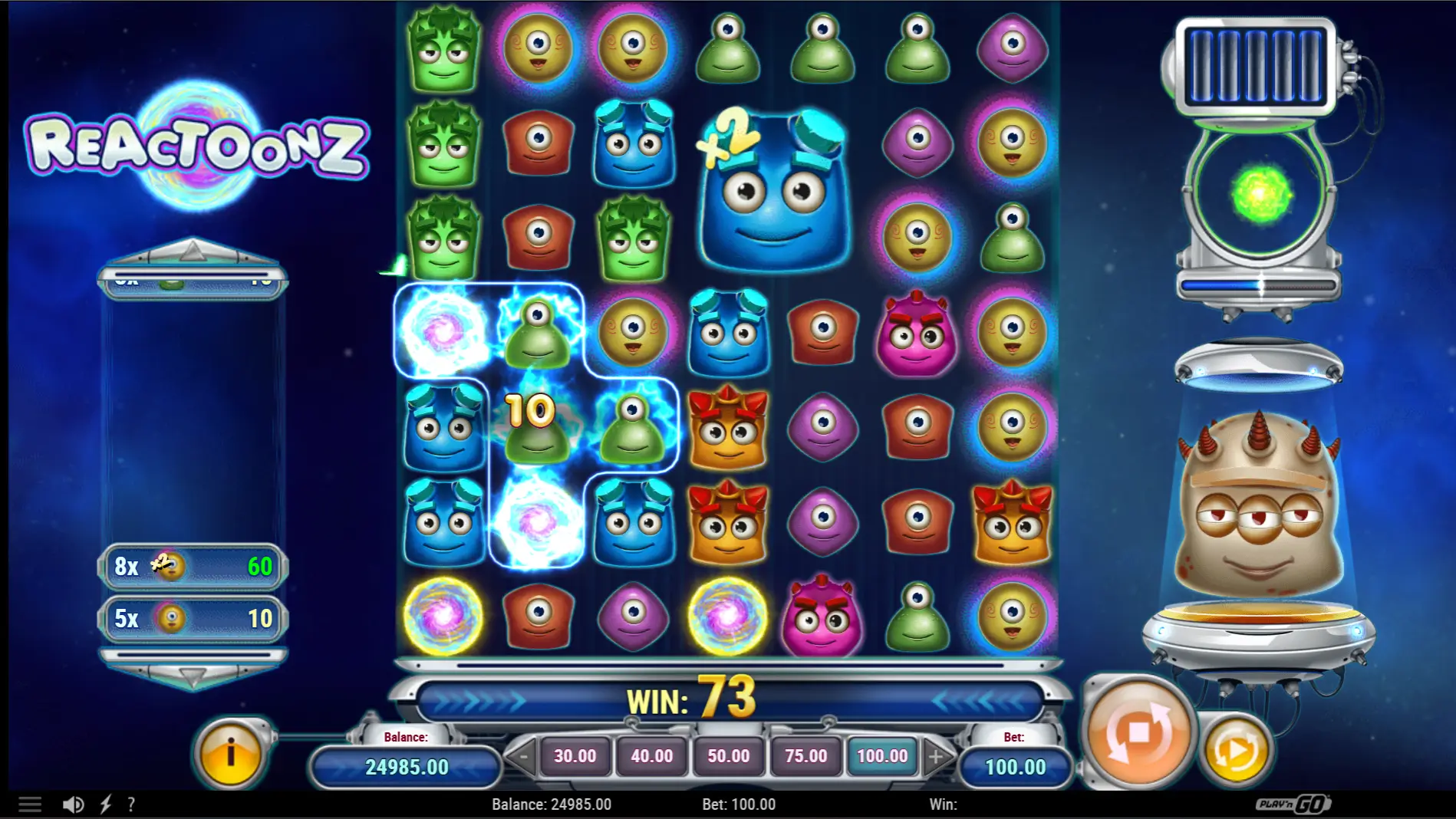
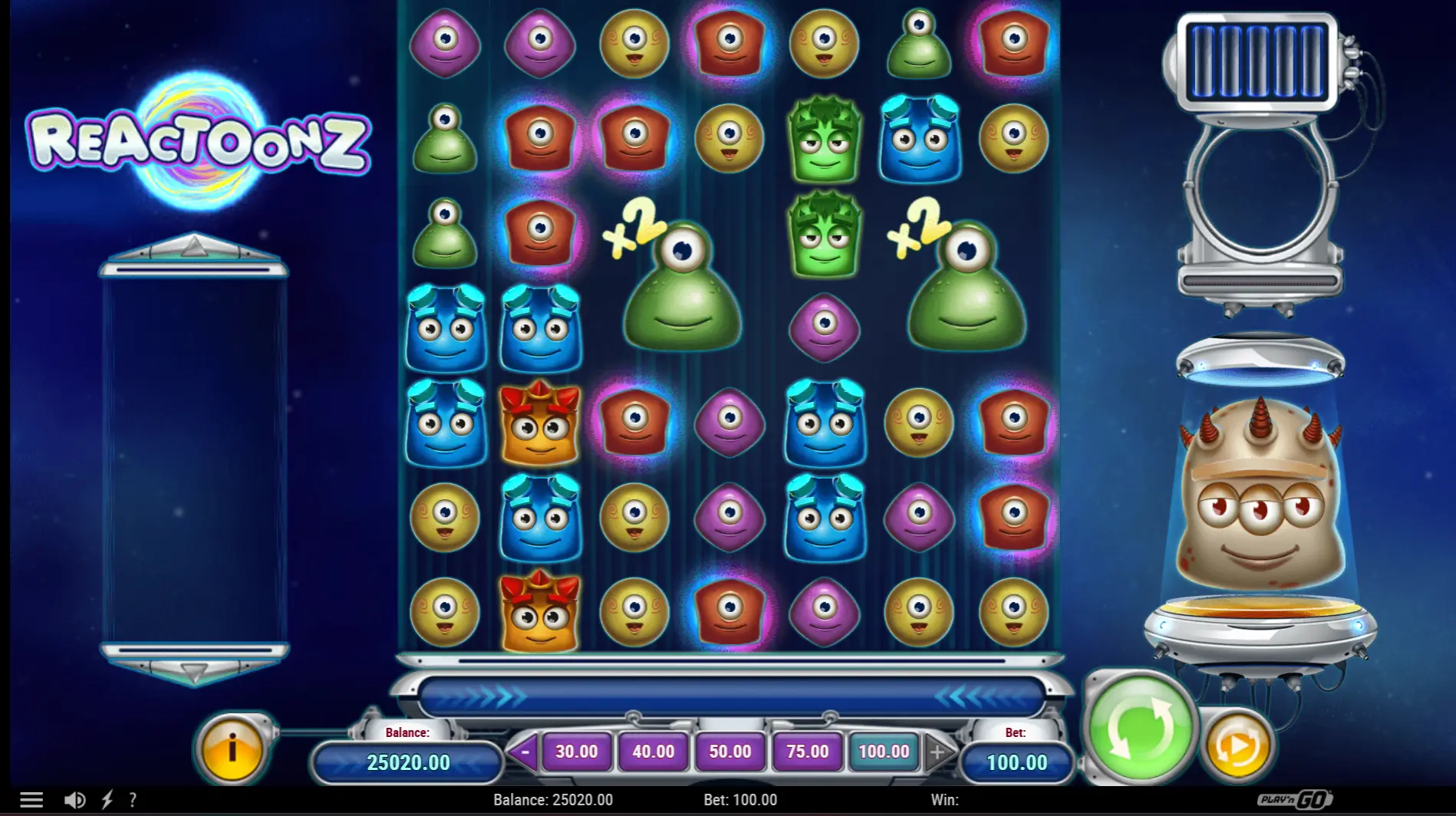
When four identical symbols land adjacent to each other in a 2×2 square formation, they automatically fuse into a single Giantoonz — an oversized symbol occupying four grid positions. Any winning cluster that includes a Giantoonz has its payout doubled. This is one of the more satisfying mechanics when it triggers; there’s something deeply satisfying about watching four little aliens merge into one big alien and then explode in a winning combo for 2x the normal value.
Quantum Leap Charge Meters
This is the heart of the feature system. Five charge meters are displayed to the right of the grid. Every winning cluster during a spin (regardless of symbol type or cluster size) contributes to filling these meters sequentially. When a meter fills completely, one of four Quantum Features is added to a queue. These features activate after the current cascade chain ends.
The four Quantum Features are:
Implosion (orange): Converts three to six random grid symbols into Vortex Wilds, then destroys all symbols adjacent to those newly created wilds. The destruction removes symbols from the grid, triggering another cascade drop. This can clear significant portions of the grid and set up monster follow-up wins.
Alteration (green): Selects one random one-eyed alien type. Every instance of that symbol on the grid transforms into a different (randomly chosen) one-eyed symbol. This reshuffles the grid in potentially favorable ways — if the game picks the most populated symbol to transform, you can end up with a massive cluster of the new type.
Demolition (blue): Destroys all one-eyed alien symbols currently on the grid. In a grid where low-pay symbols dominate, this can wipe a large chunk of the board clean, forcing high-pay symbols to fill the resulting gaps. One of the more brutally useful features when conditions are right.
Incision (red): Places a Vortex Wild in the center of the grid, then draws two diagonal lines across the entire grid, both showing the same randomly selected alien type. If that symbol is a high-pay alien and the diagonals connect with existing clusters, the result can be substantial.
Importantly, features queue up. If multiple meters fill during a single spin sequence, all corresponding features are lined up and activated in order after the chains conclude. Watching three or four features trigger back-to-back is exactly as explosive as it sounds.
The Gargantoon Feature
The fifth and final meter charges to unlock the Gargantoon Feature — the slot’s climax moment. Gargantoon (the three-eyed alien visible on the right side of the screen, apparently napping between sessions) stomps onto the grid as a massive 3×3 Wild symbol, covering nine grid positions and substituting for all regular symbols.
Here’s the mechanical sequence: after all wins involving the 3×3 Gargantoon are paid out, the cascade drops new symbols. Gargantoon doesn’t disappear — instead, he splits into two 2×2 wild symbols. After another cascade, those two 2×2 wilds split again into nine individual 1×1 wild symbols scattered across the grid. That final scatter of nine wilds across a 7×7 board is where the game’s biggest wins tend to come from, particularly if the remaining alien symbols can form large clusters around all those wilds.
Instability (Random Feature)
There’s one more wrinkle: Instability. On any spin where no winning cluster forms at all, there’s a chance that Instability triggers and drops four to eight Vortex Wilds randomly onto the grid. This is the game’s consolation mechanism — it can turn a dead spin into something salvageable. It doesn’t fire often, but when it does on a packed grid of high-pay symbols, it can kickstart an unexpected chain.
What It Feels Like to Actually Play
Honest assessment from multiple extended sessions: Reactoonz is one of the more tilting slots in existence, and also one of the most rewarding when it connects. Both of those things are equally true.
The charge meters are the psychological core of the experience. You spend spin after spin watching them fill, sometimes creeping into the fourth or fifth bar — and then a stretch of low-cluster spins drains the accumulated charge before any features queue. This cycle of building and losing meter progress is genuinely frustrating in a way that few slots replicate. The game is designed to keep you engaged through anticipation, and it succeeds almost too well.
When the Gargantoon feature fires during a spin where the Quantum Leap has already queued two or three features beforehand, the resulting sequence is spectacular. Features cascade into each other, wilds multiply, grids fill with pink and orange aliens, and the payout counter starts stacking in ways that feel disconnected from the modest bet size you started with. That’s when you understand why this game still has a dedicated following in 2026.
One thing community tracking data consistently shows: Reactoonz’s real-world RTP measured over 3.2 million tracked spins sits around 96.98% SRP — actually slightly above the listed 96.51%. This suggests the game performs at or near its stated math model in practice, which isn’t always the case with high-volatility titles where short-term variance can create systematic underpayment impressions. The hit rate — how often you land any winning cluster — tends to run relatively frequently during active rounds, but many of those wins are small single cascades rather than chain reactions. The big money comes from the chain events, and those are genuinely infrequent. A session of 200-300 spins might have one or two genuinely impressive sequences and a lot of middling filler in between.
The absence of a free spins feature is the most commonly cited complaint about Reactoonz, and it’s a fair one. Most high-volatility slots offer a bonus round — a protected space where the big wins are concentrated and where you can benchmark your session. Reactoonz has no such thing. Every spin plays from the base game. The Gargantoon sequence is effectively the bonus climax, but it plays out in the regular game without the distinct psychological boundary of an actual “bonus mode.” For players who like that structure, this design choice will feel like something missing. For players who find free spins rounds formulaic and repetitive, it’s a non-issue — the Quantum feature queuing system creates enough narrative arc within single spins to compensate.
For Bangladeshi players specifically: the base bet structure translates well to BDT stakes. Minimum bet of ৳20 per spin is accessible even for casual sessions on a modest bankroll. At ৳100 per spin — a common mid-range bet for BD players — a 4,750x max win would return ৳475,000. That’s a theoretical ceiling, of course, but the realistic win range during Gargantoon sequences tends to run anywhere from 50x to 300x depending on the grid conditions when the feature fires.
Graphics, Sound, and Presentation
Play’n GO built Reactoonz with a distinct visual personality that still holds up. The dark space background, the bobbing animated aliens, the snoozing Gargantoon — it has a coherent aesthetic identity that most slots don’t manage. The art direction leans into cartoon nostalgia without becoming childish; it’s the visual equivalent of a Saturday morning sci-fi show pitched slightly too clever for its time slot.
Sound design is understated and effective. The ambient track starts quiet and builds tempo as the action heats up. Feature transitions have satisfying audio cues. When symbols fuse into a Giantoonz, there’s a distinctive crunch that becomes genuinely satisfying after a few sessions. Nothing about the audio is overbearing or designed to manipulate — it just supports the gameplay without getting in the way.
One visual note: the Quantum Leap meters on the right side of the screen have clear, readable fill animations that communicate progress without requiring you to pause and inspect numbers. This is better UI design than most competitors manage, and it matters during fast cascading sequences where you’re tracking multiple events simultaneously.
On mobile — Redmi Note 11/12/13 series, Samsung Galaxy A34/A54, whatever your daily driver in Dhaka or Chittagong — the layout adapts cleanly. The grid doesn’t shrink awkwardly, the meters remain visible, and the bet controls are appropriately sized for touch input. Portrait and landscape both work, though landscape gives you a bit more visual breathing room.
How Does It Stack Up in 2026?
Play’n GO launched Reactoonz 2 in 2020, then Gargantoonz, Gigantoonz, Dr Toonz, and most recently Reactoonz 100 in October 2025. Reactoonz 100 is particularly relevant context: it introduces a progressive win multiplier (up to 100x), boosts max win potential to 10,000x, but removes the Giantoonz mechanic and cranks volatility to the provider’s maximum 10/10 rating. The top symbol cluster value also drops from 750x to 100x, compensated by the multiplier system.
So where does the original Reactoonz sit after all those sequels?
It sits in a comfortable, well-worn position as the most balanced entry in the series. The volatility is high but navigable. The max win at 4,750x is substantial without being a unicorn-chasing exercise. The feature interactions are complex enough to reward understanding but not so convoluted that new players are lost. Reactoonz 2 brought higher win potential (5,083x) but a somewhat messier feature set. Reactoonz 100 is basically the original on hard mode — more max win, more multiplier potential, more brutal dry spells. For players who want to understand the Toonz series and enjoy the mechanics without getting obliterated by extreme variance every session, the original remains the right starting point.
The game also benefits from Play’n GO’s continued reputation as a reliable, well-regulated provider. They’ve picked up Software Supplier of the Year and Game Studio of the Year awards in both 2023 and 2024 from major industry bodies. These aren’t marketing footnotes — they reflect genuine technical and design quality that shows up in how the games are built and how consistently their math models behave.
One historical note worth understanding: the original Reactoonz was itself a sequel to Energoonz (released December 2013), which used a 5×5 grid with a medium volatility profile and a running win multiplier. Play’n GO took that concept, enlarged it to 7×7, stripped out the free spins, replaced the simple multiplier with the much more elaborate Quantum Leap system, and tuned the volatility up significantly. The result was a game that played completely differently from its predecessor despite sharing the alien cast. That iterative design approach — keep the characters, rebuild the mechanics — is a Play’n GO signature, and it explains why Reactoonz 100 (which revisits the original formula again with yet another new mechanical layer) feels like a natural evolution rather than a cash grab.
The Toonz series in full as of early 2026: Energoonz (2013, 5×5, medium volatility, 96.69% RTP), Reactoonz (2017, 7×7, high volatility, 96.51% RTP, 4,570x max win), Reactoonz 2 (2020, 7×7, high volatility, 96.2% RTP, 5,083x max win), Gargantoonz (7×7, 96.2% RTP, 7,000x max win), Gigantoonz, Dr Toonz (6 reels, 4,096 ways, 2021), and Reactoonz 100 (October 2025, 7×7, extreme volatility, 96.2% RTP, 10,000x max win). Each entry exists because the original still draws players in — the series wouldn’t have expanded this far on the strength of mediocre source material.
Responsible Gambling Note
Reactoonz is a high-volatility game. That means extended losing streaks are a normal part of its mathematical design, not a malfunction. Before playing for real money, set a session budget you’re comfortable losing entirely. The charge meter mechanic is particularly psychologically sticky — it’s designed to make you feel like you’re always “almost there,” which can encourage chasing behavior. Be aware of this design element and treat it as entertainment information rather than a signal to increase your bet.
The game supports auto-spin up to 100 rounds, which can drain a bankroll faster than manual play. If you use autoplay, set loss limits where the feature allows. Some platforms accessible to Bangladeshi players offer configurable auto-spin stops at specific loss thresholds — use them.
For longer sessions, the absence of a bonus-round structure means there’s no natural “session endpoint” the game creates for you. Set your own time and money limits before starting. If you’re depositing via bKash or Nagad, the transaction history in your mobile financial app is a useful record of session spend that many bank accounts wouldn’t give you as cleanly.
If you’re in Bangladesh and feel gambling is becoming a problem, GamCare (gamcare.org.uk) provides free counseling and resources accessible internationally via their online service. Seeking support is a sensible decision, not a weakness.
Final Verdict
Reactoonz by Play’n GO is one of the genuinely good slots — the kind where the mechanics actually justify the reputation. The cluster pays system rewards understanding, the cascading feature interactions create genuine tension, and the Gargantoon sequence delivers the kind of payoff that high-volatility games owe their players. The RTP at 96.51% top-end is solid, the mobile performance is excellent, and seven years after release the game still gets picked up by new players who can’t find anything that scratches the same itch.
The core strength is design coherence. Every mechanical element in Reactoonz connects to every other element in a way that’s unusual in the slot world, where features are often bolted on independently for novelty value. The Fluctuating symbol produces wilds. Those wilds enable bigger clusters. Bigger clusters fill the Quantum meters faster. The Quantum features create new conditions for even larger clusters. The Giantoonz mechanic applies multipliers to the clusters that form in those conditions. And all of it feeds toward the Gargantoon climax where the grid is briefly dominated by wilds from corner to corner. That’s a complete mechanical loop — stimulus to response to bigger stimulus — and Play’n GO built it tight enough that it hasn’t dated badly even with a half-dozen sequels in the catalogue.
The downsides remain real: no free spins, the Gargantoon feature is genuinely hard to reach consistently, the cold spells test patience in ways most slots don’t, and the RTP floor at certain casinos (as low as 84.51%) is a legitimate concern worth checking before you deposit. The Gargantoon’s tendency to land in the worst possible grid position, blocking potential cluster formations rather than enabling them, is an occupational hazard that every Reactoonz veteran has experienced and cursed. These aren’t fatal flaws, but they’re not nothing either.
For Bangladeshi players, the game is accessible at multiple platforms accepting bKash and Nagad deposits, runs well on mid-range Android hardware across Dhaka, Chittagong, Sylhet and beyond, and offers a betting range that works from casual ৳20 spins up to serious ৳8,500+ sessions. The BD online gaming market reached approximately $1.7 billion in estimated GGR in 2024, and Play’n GO titles — Reactoonz prominently among them — form part of the core library at platforms serving this market. The infrastructure exists. The game is there. Whether it’s worth your time comes down to whether high-volatility cluster mechanics appeal to you.
If you want to understand what made Play’n GO one of the consistently decorated providers in the industry over the past decade, start with this game. It’s not the flashiest entry in their catalogue, and it’s not the newest. It is, arguably, the most well-crafted slot they’ve ever made.
Rating: 8.5/10
Gamble responsibly. This game is for entertainment purposes. All RTP figures reflect Play’n GO’s certified configurations — individual casino operator settings may vary. Always verify in-game RTP before depositing.