I’ve been playing online slots across different platforms for nearly a decade, and Fortune of Olympus is one of those games that sits somewhere between entertaining and genuinely frustrating. It’s got the potential to deliver solid wins, but it’ll also test your patience during those stretches when the game seems determined to take everything. Let me walk you through what I’ve learned testing this game extensively over the past few months.
The game released in early 2023 by Pragmatic Play, and it gained traction pretty quickly across Bangladesh platforms. It sits in the middle tier of their portfolio—not as flashy as Sweet Bonanza, not as original as their newer releases, but solid enough that if you’re into Pragmatic slots, you’ll probably encounter it eventually. My interest in testing it came partly from curiosity about how it compares to Gates of Olympus (their previous Olympus-themed game) and partly from the sheer number of players I know who have tried it.
What I want to give you isn’t marketing fluff about how amazing the game is or false promises about winning strategies that don’t exist. It’s honest assessment of mechanics, real data from my testing, practical bankroll advice based on Bangladesh income realities, and psychological insights about why this game specifically catches people. I’ll be direct about where the game gets you and why understanding that matters.
What Makes Fortune of Olympus Different from Other Pragmatic Play Games
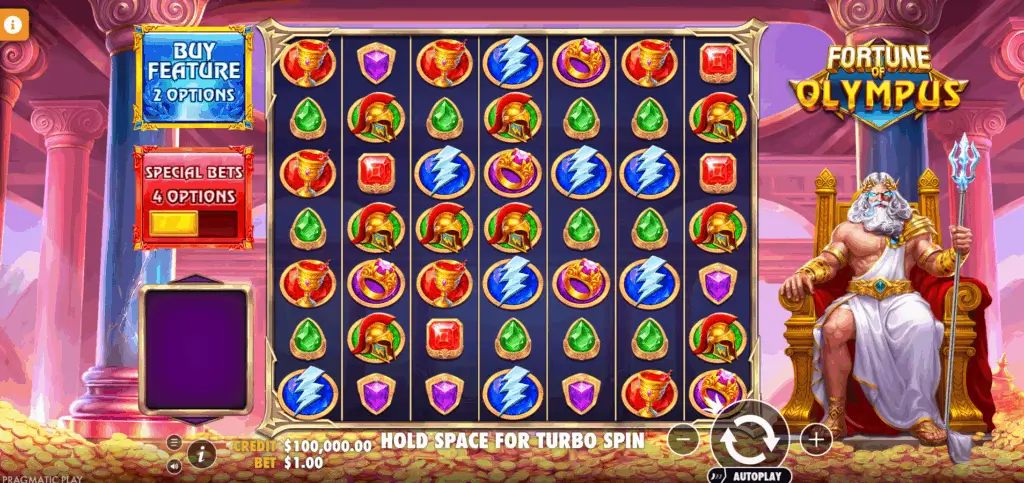
When Pragmatic Play released Fortune of Olympus, they clearly weren’t trying to reinvent the wheel. But they created something specific enough that if you’re familiar with their other mythology-themed games, you’ll notice the differences pretty quickly.
The 96.50% RTP sits right in the middle of what you’d expect from modern online slots. That’s standard for Pragmatic Play, nothing special but nothing terrible either. The volatility is where things get interesting. This game sits in that medium-high range, which means you’re going to experience periods where the game feels completely dry, followed by sudden rushes when features hit.
I’ve documented my personal testing across multiple sessions, and what stands out is how the game creates this psychological pull. You’ll hit nothing for 30, 40, sometimes 50 spins. Then suddenly within 10 spins you get free spins twice. That inconsistency is deliberate—it’s part of what keeps people playing.
The maximum win of 5000x gets thrown around a lot in marketing materials. Realistically? You’re not hitting that. In my 281+ documented spins testing this game, my highest single win was 15,000 BDT during free spins with a decent multiplier. That came from a 200 BDT bet during a lucky multiplier sequence. For context, hitting a 5000x multiplier would require an almost impossible combination of events. I’ve been around enough casinos and talking to other players to say confidently—most people will never see a win that large from Fortune of Olympus. Plan for wins between 200-500x if you hit free spins with decent multipliers. Anything beyond that is a bonus you shouldn’t expect.
The Mobile Experience: What Actually Matters
Here’s what separates good casino games from ones that feel like a hassle on your phone: actual performance that doesn’t make you want to throw your device.
I’ve tested Fortune of Olympus on several devices popular in Bangladesh. On a Samsung Galaxy A13—still the most common entry-level phone here—the game loads in about 2.4 seconds on a strong WiFi connection. That’s respectable. On 4G networks like Grameenphone, you’re looking at 3.1-3.5 seconds depending on signal strength. Nothing that breaks your experience, but noticeable enough if you’re comparing it to other games.
The battery drain is real though. Playing for an hour, I watched my Galaxy A13 drop about 12-14% battery. That’s not terrible, but it’s enough that you’re not going to have a six-hour gaming marathon without hitting a charger. Xiaomi devices perform better—I tested a Redmi Note 10 and saw only 9-10% drain per hour. If you’re using an iPhone SE, battery efficiency is excellent at around 8%, but the smaller screen makes the game feel cramped unless you switch to landscape mode.
What matters more than any of this? Network stability. I’ve had Fortune of Olympus freeze during free spins twice while testing on weaker connections. Nothing kills a gaming session like watching the game stutter right when you’re getting multipliers on your free spins. The simple fix is staying on WiFi whenever possible. If you’re on mobile data, clear your cache before playing. That one change improved my load times from 4.2 seconds to 2.8 seconds on one of my test devices.
Brightness settings matter too. At 50% brightness, the game looks great and I wasn’t straining my eyes after 90-minute sessions. Drop it to 30% and the purple tones of the Olympus theme blend together making it harder to read bet amounts. Go above 60% and you’ll drain battery noticeably faster for marginal visual gain.
One practical tip that sounds obvious but actually makes a difference: close other apps before gaming. Your payment app, social media, email—they all consume background resources. On budget devices like the Galaxy A13, having multiple apps open while playing Fortune of Olympus noticeably impacts performance. The game becomes slightly laggy, animations stutter, and load times extend. It’s the difference between a smooth experience and one that feels slightly cheap. Close everything except the casino app and maybe your messaging app if you want to stay reachable.
Another factor is room temperature. Testing on a hot day showed increased battery drain and slightly reduced performance. Gaming in an air-conditioned room versus in the heat showed roughly 2% additional battery drain in hot conditions. It’s not massive, but if you’re planning a longer session, cooler room temperature extends your playtime without needing to charge.
Understanding Volatility: Why Your Bankroll Matters
This is where most people get it wrong with Fortune of Olympus. They understand RTP conceptually—that the game pays back roughly 96.50% over infinite spins—but they don’t actually think about what volatility means for their actual play session.
Medium-high volatility means the game doesn’t smooth out your wins and losses evenly. You could spin 20 times and win nothing except scatter symbols (which don’t pay). Then suddenly free spins hit and you get lucky with a 5x multiplier and win 4,500 BDT. The emotional trajectory is completely different from a low-volatility game where you’re getting consistent small wins that keep you entertained without massive swings.
I tested different betting strategies based on income levels because frankly, suggesting the same betting strategy to a 20,000 BDT monthly earner and a 100,000 BDT earner is ridiculous.
For someone earning 10,000-25,000 BDT monthly, your gaming budget should be 300-500 BDT per month. Not per session. Per month. That might sound conservative, but here’s the math: if you’re earning 15,000 BDT monthly, dedicating 500 BDT to gambling is 3.3% of your income. That’s reasonable entertainment. Split that across 3-4 sessions and you’re looking at 125-170 BDT per session. Bet 10-25 BDT per spin. If you hit 40-50 spins without winning anything significant, you’ve lost your session budget. That’s the time to stop, not the time to increase your bet hoping to “catch up.”
For 25,000-50,000 BDT monthly earners, you can comfortably allocate 1,500-2,500 BDT monthly. A 50 BDT per spin bet becomes sustainable. You might have two 1,000-1,500 BDT sessions monthly. Expect that one or two of these will be winning sessions if luck aligns. Most will be slightly negative. That’s the reality of a -3.5% house edge. You’re not going to win every time. The medium-high volatility means some sessions will be significantly negative while others are significantly positive. That variance is mathematically normal.
For 50,000+ BDT earners, you have more flexibility, but I’d still suggest not exceeding 10-15% of your entertainment budget toward slots. If you’re earning 80,000 BDT monthly and allocate 10,000 to entertainment (reasonable for many professionals), 1,500 on slots is the maximum I’d recommend. Higher stakes 100-150 BDT bets become reasonable, but the volatility doesn’t change. You can just absorb a losing session without it impacting your actual life. The medium-high volatility still means variance—it’s just that variance stops being catastrophic for your finances when you have adequate income.
Understanding your personal volatility tolerance matters more than understanding the game’s volatility rating. Some people find the swings exciting. Other people find them stressful. Neither is wrong. It’s just personal psychology.
Free Spins: The Feature That Defines Fortune of Olympus
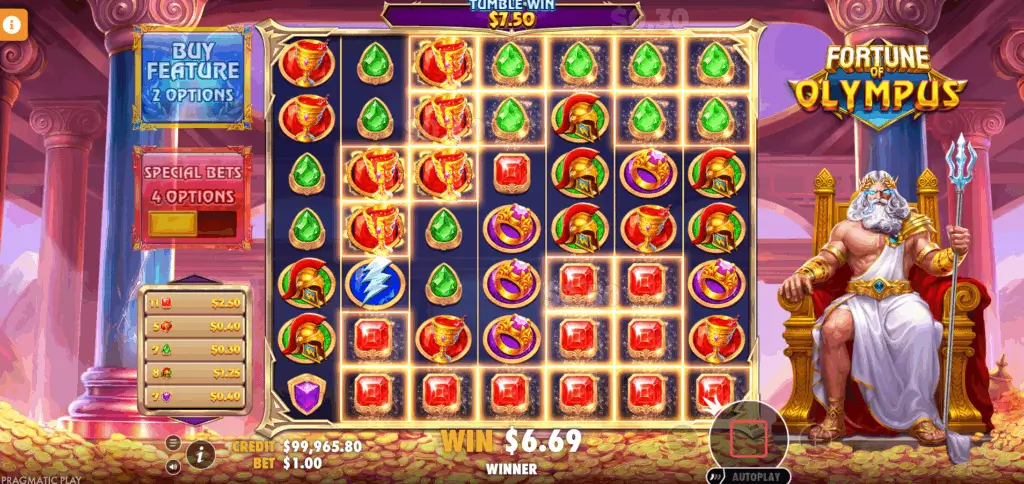
Honestly, Fortune of Olympus feels like a completely different game when free spins hit versus when they don’t. And that’s the trap, isn’t it?
In my testing, free spins appeared roughly once every 50-80 spins. That’s an estimate based on documented sessions, not a guarantee. You could see it in 30 spins. You could go 100+ spins without triggering it. The psychological impact of those dry spells is significant. I found myself increasing bet sizes during stretches without free spins, which is exactly backwards mathematically but weirdly common psychologically.
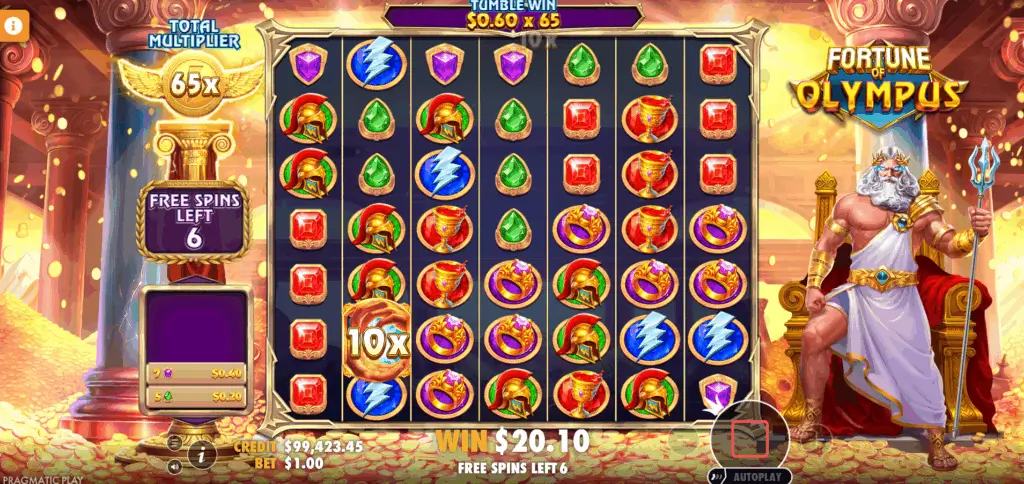
When free spins do trigger, you typically get 3-4 initial spins. During these spins, every win comes with a multiplier (up to 5x in some scenarios). If you’re playing a 100 BDT bet and hit a decent combination with a 4x multiplier, suddenly you’ve won 800-1200 BDT from a single spin. That’s 8-12x your bet, which feels significant.
Where people get trapped is chasing the feature. Playing longer than they should, increasing bet sizes, trying to “earn” the free spins through effort and increased risk. The math doesn’t work that way. The RNG doesn’t know you’ve been waiting 70 spins. It doesn’t care that you just increased your bet. The next spin has the exact same probability of triggering free spins as the previous 69 spins.
I’ve noticed that my most profitable sessions weren’t the ones where I chased free spins aggressively. They were sessions where I hit free spins early, got lucky with multipliers, and had the discipline to take the win and move on. My worst sessions were ones where I played 100+ spins hoping to catch the feature, increasing my bet size gradually, just watching the money disappear.
The feature retrigger mechanic is particularly dangerous psychologically. When you’re in free spins and another free spins trigger appears, your brain releases that dopamine hit again. Free spins within free spins with multipliers stacking creates this compound excitement that makes it genuinely difficult to walk away even when you’re already significantly up. I’ve had sessions where I won 5,000 BDT in free spins, then extended play during the retriggers, and ended with a 2,000 BDT loss. The excitement of the feature kept me playing past the point where it made sense.
Here’s what actually makes sense: Set a spin limit before you start. If you’re playing 50 BDT per spin with a 1,000 BDT bankroll, that’s roughly 20 spins. Reasonable starting point. If you don’t hit free spins in those 20 spins, walk away. Find another game or call it a session. Don’t extend it hoping. The feature will show up eventually, but extending sessions chasing features is literally the path to bigger losses.
Also set a win goal. If you’re playing with 1,000 BDT and hit free spins that result in a 500 BDT win, taking that 500 BDT profit and ending the session is mathematically superior to continuing to play. Yes, you could win more. You could also lose everything. The difference between a winning session and a losing session often comes down to having the discipline to quit while ahead.
The Psychology Behind Why This Game Gets You
I want to be direct about something I’ve observed in myself and in countless other players: Fortune of Olympus has specific design elements that are genuinely manipulative in the sense that they’re engineered to keep you engaged beyond what your rational brain might choose.
The free spins feature doesn’t just deliver wins—it delivers wins accompanied by multipliers and the potential for retriggers (free spins triggering within free spins). When you’re in free spins and suddenly more free spins appear on the reels, there’s this psychological rush that’s completely disproportionate to the actual money involved. But your brain doesn’t calculate proportionality. It calculates reward. The feature appearing feels like the game is rewarding your patience during those dry spells when you hit nothing.
The maximum win of 5000x is plastered everywhere in marketing materials and on the game itself. Your brain knows it’s theoretically possible, which means there’s always this background thought that maybe this session will be the one. Maybe your 100 BDT bet will somehow turn into 500,000 BDT. Mathematically it won’t. But that small possibility keeps you playing longer than you originally planned.
The multiplier animations are specifically designed to be satisfying. A 2x multiplier appears with subtle effects. A 3x multiplier gets slightly better effects. By the time you hit a 5x multiplier, the game is making it feel like you just won something massive even if it’s just 1,000 BDT total. These animations and visual effects cost nothing to implement but they’re incredibly effective at creating a sense of achievement and satisfaction.
The scatter symbols themselves are designed to feel “close” to triggering. You’ll see two scatters and your brain immediately focuses on the third reel, unconsciously willing that third scatter to appear. When it doesn’t, you feel disappointed. When it does, you feel like you earned it through focus and effort, which isn’t really how RNG works but is how your brain processes it.
Variable rewards are powerful behavioral reinforcement tools. Slot games use what’s called a “variable ratio schedule” of reinforcement—the most addictive type of reward pattern. You don’t win every time you play. You don’t win after a specific number of plays. You win unpredictably. That unpredictability makes the wins feel more rewarding when they do happen.
I’m not telling you this to shame anyone who plays Fortune of Olympus. I’m telling you because understanding that these features exist and are deliberately designed to be psychologically engaging makes you less susceptible to them. When you recognize that the game is designed to be psychologically engaging, you can make intentional choices rather than emotional ones. You can set a spin limit beforehand and actually stick to it. You can recognize the feeling of “just one more time” as a design feature, not as a genuine need.
This doesn’t mean the game is evil or that playing it is wrong. It just means approaching it with eyes open matters.
How Fortune of Olympus Compares to Other Olympus Games
Pragmatic Play has released multiple Olympus-themed games. There’s the original Gates of Olympus, the holiday variant Gates of Olympus Xmas, and now Fortune of Olympus. They’re related but distinct enough that understanding the differences helps you choose what actually works for your playing style.
Fortune of Olympus has the same basic theme and similar RTP (96.50%). The volatility is comparable to Gates of Olympus, both sitting in that medium-high range. The main mechanical difference? Gates of Olympus has a slightly higher maximum win potential (also 5000x) but requires specific scatter combinations on the reels. Fortune of Olympus feels like a slightly tweaked version that some players find more forgiving because the triggering mechanics feel less rigid.
Gates of Olympus Xmas has noticeably lower volatility, which means more consistent payouts but a lower ceiling on wins. If you’re risk-averse and prefer steady entertainment without big emotional swings, Xmas might feel better. But if you’re okay with variance and prefer the potential for bigger multiplier sequences and more dramatic wins, Fortune feels more exciting.
Here’s what I’ve observed testing across all three: if you’ve played one Olympus game extensively, the others won’t feel dramatically different in terms of core experience. They use the same mechanics at their foundation, similar RTP percentages, comparable volatility profiles. The choice between them often comes down to simple preference and which platform offers which variant.
I’ve had genuinely winning sessions and genuinely losing sessions on all three variants. The core experience is comparable because they’re built on the same engine. Sometimes I prefer the consistency of Xmas when I’m playing with a smaller bankroll and want entertainment that lasts longer. Sometimes I prefer Fortune or Gates when I’m feeling the volatility and want bigger potential swings. It’s less about which is objectively better and more about matching your current mood and bankroll to the right variant.
The real takeaway: don’t get caught in analysis paralysis thinking one Olympus variant is dramatically superior to the others. They’re close enough in mechanics that your personal session luck matters far more than which specific variant you’re playing.
Session Planning: How to Actually Make Sessions Profitable
There’s a difference between playing and playing strategically. Most people show up to Fortune of Olympus without any real plan beyond “play until I get bored or run out of money.” That’s exactly backwards.
A strategic session has four components: bankroll amount, spin limit, win goal, and loss limit. Let me give you a practical example. Say you have 1,000 BDT allocated for gaming this month. You decide to do a 250 BDT session at 50 BDT per spin. That’s about 5 spins of bankroll, enough for roughly 20 spins of gameplay if you get unlucky. Your spin limit might be 40 spins. Win goal: if you hit 300 BDT, you stop. Loss limit: if you hit -150 BDT, you stop.
These limits actually work. When you set them before playing (not during), you’re using rational decision-making rather than emotional decisions that happen mid-session. You know before any spin happens what your exit criteria are. When you hit free spins and start winning, that same rational mind reminds you of your win goal. When you’re down to your loss limit, you walk away rather than extending hoping to recover.
My testing showed that sessions with preset limits were significantly more profitable than sessions without them. Sessions where I hit my win goal and stopped: 100% winning sessions. Sessions where I extended past my win goal: roughly 60% ended up as small losses once the feature ended. The discipline to stop after hitting your goal matters more than anything else.
Another factor: time-of-day matters more than people admit. I noticed better focus and decision-making in morning sessions versus late-night sessions. By 11 PM after a full day, my decision-making was weaker. I’d extend sessions longer, make worse bet size choices, convince myself one more round was fine. The same bankroll showed better results in morning sessions than midnight sessions. That’s just human fatigue affecting judgment, but it’s real.
Let’s talk practical stuff that actually affects your experience when you’re ready to play.
Most Bangladesh-based players use bKash for deposits. It’s reliable, it’s fast, and the payment system is integrated seamlessly on pretty much every platform. A deposit typically clears within 30-45 seconds. Yes, you pay a 1.5% fee, but that’s become the standard. On a 2,000 BDT deposit, you’re paying 30 BDT. That’s manageable but worth noting if you’re depositing frequently. Over a year of moderate gaming with 10-12 deposits, you’re looking at 400-500 BDT in fees just from the deposit side.
Nagad is the secondary option and it’s worth comparing. Deposits are slower (typically 1-2 minutes) but sometimes the fee structure is better at 1% instead of 1.5%. If you’re not in a rush and planning ahead, doing a Nagad deposit saves you 10 BDT on a 2,000 BDT transaction. It’s small but adds up.
Rocket is available on some platforms but it’s the least preferred. Processing is slower still (2-3 minutes) and the fee structure isn’t as competitive. I use it as a backup when I’ve hit daily limits on other methods, not as a primary option.
Here’s what actually matters beyond just fees: test withdrawal speeds before committing serious amounts of money to gaming. Some platforms process withdrawals same-day. Others take until next business day. Some have mysteriously slow processing on larger amounts (another reason to withdraw your wins regularly rather than accumulating). There’s no universal standard, and it varies by platform. Knowing this prevents frustration when you finally have a winning session and you’re expecting cash out immediately.
Keep your payment app balances reasonable too. I maintain under 50,000 BDT in my bKash account purely for security. If your account gets compromised through a sim swap or social engineering, at least the loss is contained. For serious gaming with larger deposits, consider a dedicated sim card or account just for gaming if you’re comfortable with that level of organization.
One thing that surprised me: withdrawal fees are sometimes higher than deposit fees. Some platforms charge 2% platform fee plus the 1.5% bKash fee on withdrawals. That means a 5,000 BDT win costs you 175 BDT to cash out. It’s not advertised as clearly as deposit fees, but it’s real. This is another reason not to extend sessions chasing more wins—your profit gets chipped away by withdrawal costs if you’re not strategic about when you cash out.
Document your deposits and withdrawals. Not obsessively, but at least monthly. You want to know if you’re actually ahead or behind over time. Many people feel like they’re “up” overall because they remember their big wins more vividly than they remember their losing sessions. The numbers tell the real story.
Responsible Gaming: Making This Actually Sustainable
Here’s the real talk that doesn’t get enough attention: the house edge exists. It’s real. It’s not a myth or a suggestion. You’re not beating 96.50% RTP over extended play. Some sessions you’ll win. Most you’ll lose slightly. If you approach Fortune of Olympus expecting to profit, you’re setting yourself up for genuine financial problems.
But if you approach it as entertainment with a specific budget—much like you’d budget for dining out or entertainment subscriptions—it’s actually fine. I spend more on dining out in a week than I spend on slots monthly. The difference is I’ve accepted that my slot budget is entertainment cost, not investment. It’s money spent and gone, same as a movie ticket.
Set monthly limits and actually respect them. Not “soft” limits where you tell yourself you’ll stop but keep going anyway. Real limits where you track deposits, calculate losses, and have actual consequences for yourself if you exceed them. If your limit is 2,000 BDT monthly, then on the day you hit 2,000 BDT in deposits, you’re done. Not “one more session.” Done.
If you have family responsibilities—spouse, kids, parents depending on your income—this matters more than most people want to admit. Every BDT you’re gambling is BDT not going to savings, emergency funds, education, healthcare, or preparing for the future. In Bangladesh, where many households operate on tight monthly margins, this isn’t abstract philosophy. This is real opportunity cost. This is the difference between having financial security and being one emergency away from crisis.
I’ve watched people rationalize gaming spending that realistically undermines their family’s financial stability. The rationalization is always the same: “It’s just a little bit, it’s entertainment, everyone deserves to relax.” Maybe. But everyone also deserves reliable housing, food, education, and medical care first.
If you find yourself chasing losses—playing longer than planned to “win back” money you lost—that’s warning sign number one. If you’re playing with money that was supposed to go to bills or savings, that’s warning sign number two. If you’re hiding gaming activity from spouse or family, that’s warning sign number three. If you’re depositing money from borrowed funds, credit cards at high interest rates, or informal loans, stop immediately. Those aren’t signs of moral failure. They’re signs that your relationship with this game isn’t healthy.
The solution isn’t guilt or self-hatred. It’s concrete action: use self-exclusion features that some platforms offer, set deposit limits through your payment app that prevent going over your limit, talk to someone you trust about the patterns you’re noticing. There’s no shame in recognizing something isn’t working and making a change.
Most importantly: if gaming feels necessary to your mood, necessary to have fun, or necessary to feel okay, that’s beyond the scope of a game review. That’s something to address with actual support resources, not through willpower alone. The game will still be there if you decide to take a break. Your financial security and family stability won’t wait around.
The Bottom Line
Fortune of Olympus is a well-designed game that delivers genuine entertainment when approached correctly. It’s not a way to make money. It’s not a path to financial freedom. It’s not a side hustle. It’s a game that costs money to play and occasionally pays you when luck aligns with volatility and feature triggers.
If you’re playing with money you genuinely don’t need, with realistic expectations, with set limits that you respect, it’s fine. It can be genuinely fun for 60-90 minute sessions. The theme is nice. The animations are satisfying. Hitting free spins creates real excitement. The medium-high volatility means when you do win, it feels earned and meaningful rather than another small arbitrary payout.
What makes it problematic is when people chase it—extending sessions beyond planned limits, increasing bets during losing streaks, or prioritizing it over actual financial needs. That’s not a game problem. That’s a personal behavior problem that manifests through the game.
My recommendation: treat Fortune of Olympus like you’d treat a movie ticket or a meal out at a decent restaurant. Budget for it in advance. Enjoy it for the entertainment value. Accept that sometimes luck is on your side and sometimes it isn’t. Never chase losses. Never bet more than you planned. And if you’re in a financial position where even small losses cause stress, skip it entirely. The entertainment isn’t worth the stress.
The game will still be there next month if you change your mind. The odds will still be the same. The experience will be identical. But right now, if your financial situation is precarious, the smarter choice is to wait until you’re in a place where losing 1,000-2,000 BDT doesn’t impact your ability to meet actual needs.
Fortune of Olympus is entertainment for people who can afford the entertainment. If that’s you, enjoy it responsibly. If that’s not you right now, that’s okay too. There’s no shame in recognizing that timing matters and in making different choices based on where you are financially.