Sloth Game has been live since 6 May 2026, which makes it one of the newer titles in Endorphina’s catalogue rather than an established name. That matters, because a slot this new hasn’t had time to build the track record that older high-volatility games rely on to earn player trust.
It lands in a crowded space. High-volatility slots with a Hold and Win feature are everywhere right now, and most of them chase bigger numbers than this one does. Sloth Game runs on a 96.08% RTP, a high volatility rating, and a maximum win somewhere between 1,600x and 1,700x the stake, depending on which source you check. That gap alone tells you something worth sitting with before you load real money into it.
If you play from Bangladesh, none of this changes the basics you need to know: what RTP actually means for your money, whether the bonus rounds are worth chasing, and whether the numbers hold up next to what else is available. That’s what this review covers, spin by spin.
The math model: what the numbers actually mean for your money
Start with RTP, because it’s the number every review leads with and the one most players misunderstand. RTP stands for Return to Player. Sloth Game’s RTP is 96.08%, and every source checked for this review — SlotCatalog, Casino Guru’s listing network, and several independent aggregators — agrees on that figure, so there’s no conflict to flag here.
Here’s what 96.08% means in plain terms: for every 1,000 taka you spend on this game over a long stretch of play — thousands of spins, not a single session — the math predicts you get back around 960.80 taka on average. That’s a theoretical long-run number, not a promise for tonight. You could deposit 500 taka and lose it all in twenty spins, or you could turn 500 taka into several thousand on one Hold and Win round. RTP describes the casino’s edge over time, not your personal outcome on any given evening.
One reviewer framed 96.08% as sitting just under a 96.10% line some experienced players use as an informal cutoff for “good enough” RTP. That’s one aggregator’s personal benchmark, not an industry standard, and the practical difference between 96.08% and 96.10% is close to nothing over a normal session. Worth knowing the number exists, not worth losing sleep over.
Volatility is the second number that matters more than RTP for how the game actually feels to play. Sloth Game is rated high volatility, and one source scores it 5 out of 5 on that scale. In plain language: high volatility means the game holds onto your money for longer stretches between meaningful wins, and then pays out in bigger, rarer chunks when it does pay. Low volatility slots feed you small wins constantly. High volatility slots make you wait — sometimes for a long time — and then hit harder when they hit.
That trade-off has a direct consequence for how you should approach this game with a Bangladeshi bankroll. If you deposit 300 taka and play at a stake where each spin costs 10 taka, you have roughly 30 spins before you’re out — and high volatility means you can genuinely burn through all 30 without a single bonus round triggering. One aggregator lists a hit frequency of 34.48%, meaning roughly one in three spins returns something. But that source is alone in publishing the number, and it isn’t confirmed on the official Endorphina game page, so treat it as directional rather than certain. What every source agrees on: base game wins are small and infrequent, and the real money sits in the bonus rounds.
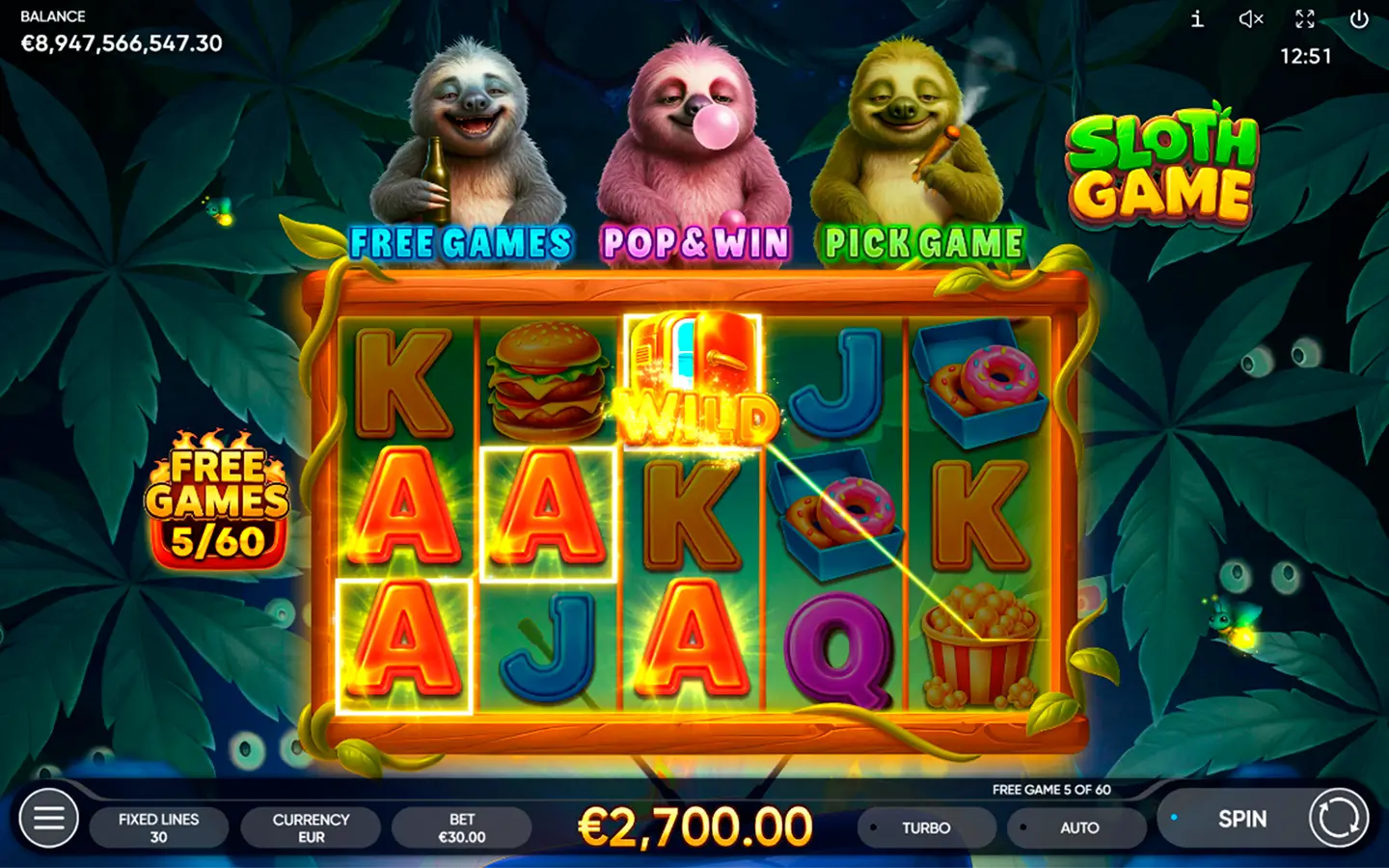
The grid itself is straightforward, which is one part of this game that doesn’t need much explaining. Sloth Game runs on 5 reels and 3 rows, with 30 fixed paylines. Fixed means all 30 lines are active on every spin — there’s no option to reduce lines to lower your cost per spin, and no Megaways-style shifting reel count. Wins form left to right across those 30 lines when matching symbols land. This is one of the simpler structures in the current slot market, and for a Tier 3 audience new to online slots, that’s genuinely useful: what you see on the paytable is what you’re playing, with no adjustable line count to configure incorrectly.
Bet range runs from roughly $0.30 to $135 per spin in the standard currency listings — in taka terms, that’s a wide enough range to play cautiously with small deposits or push stakes up if the bankroll allows it. Most BD-facing casinos convert this to a BDT equivalent automatically at your account currency, so check your specific casino’s bet range before assuming the dollar figures translate one-to-one.
Work through a realistic session at the low end of that range. A 1,000 taka deposit at a modest 25 taka stake per spin buys 40 spins before the balance is gone. With a hit frequency somewhere near one in three spins — again, that figure comes from a single source, so hold it loosely — you’d expect somewhere around 13 paying spins in that stretch, most of them small returns from the Double Burger or Popcorn Box symbols rather than anything close to a bonus trigger. High volatility means those 40 spins could just as easily produce zero bonus triggers at all. That’s not a flaw in the game; it’s what “high volatility” is telling you upfront. Budget for it rather than being surprised by it.
Then there’s the ceiling, and this is where the numbers get genuinely inconsistent. Sloth Game’s max win is listed as 1,600x the stake by SlotCatalog, Bitz.io’s game coverage, and Spindex. It’s listed as 1,700x by two other sources, including the marketing copy that accompanied the game’s launch. Neither figure is a rounding error away from the other — a 100x stake difference on the ceiling is a real discrepancy, not noise. Since Endorphina hasn’t published an official specs sheet that resolves this cleanly across all its distribution channels, the honest move is to flag both figures rather than pick one and pretend it’s certain. Either way, treat the lower figure as the safer planning number.
Put a real stake against it: at a 100 taka spin, a 1,600x max win pays 160,000 taka; at 1,700x, it pays 170,000 taka. That’s the theoretical ceiling — hit through the game’s math in an extremely rare best-case run, not something you should expect to see in a normal session, or possibly ever.
The bonus features: what actually pays, and what to expect from each
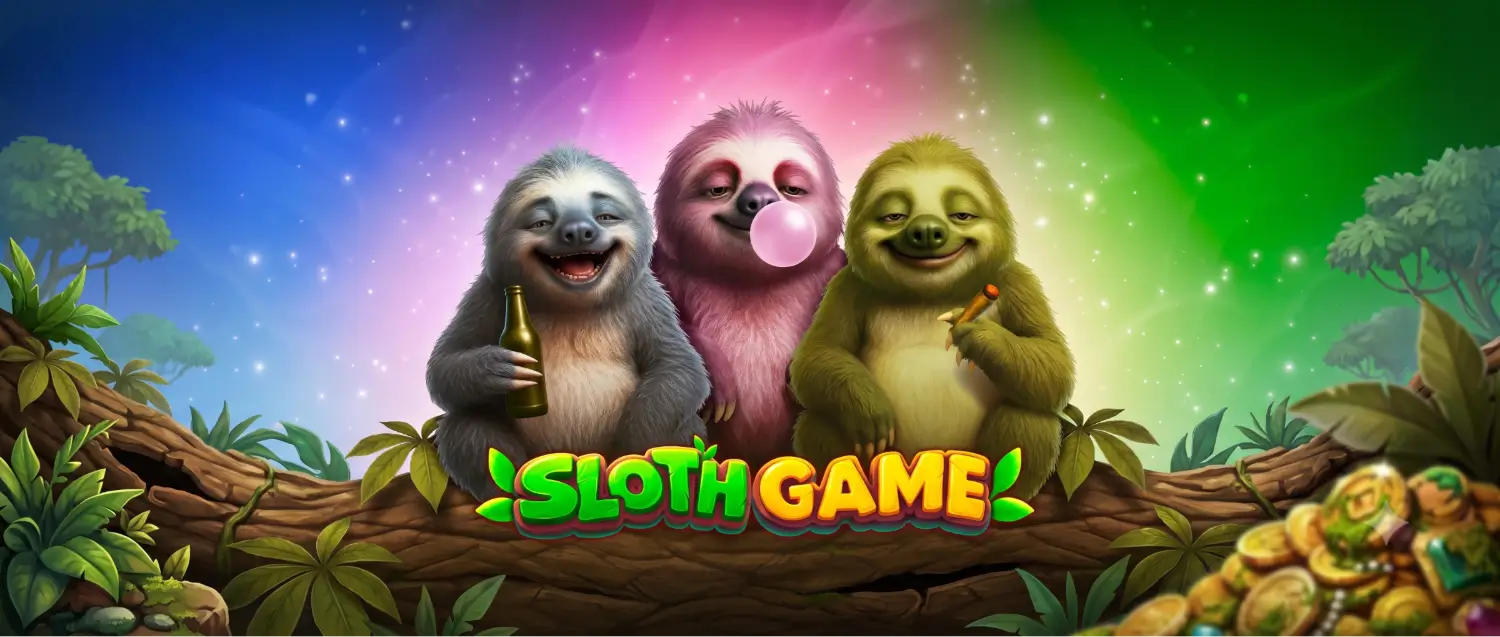
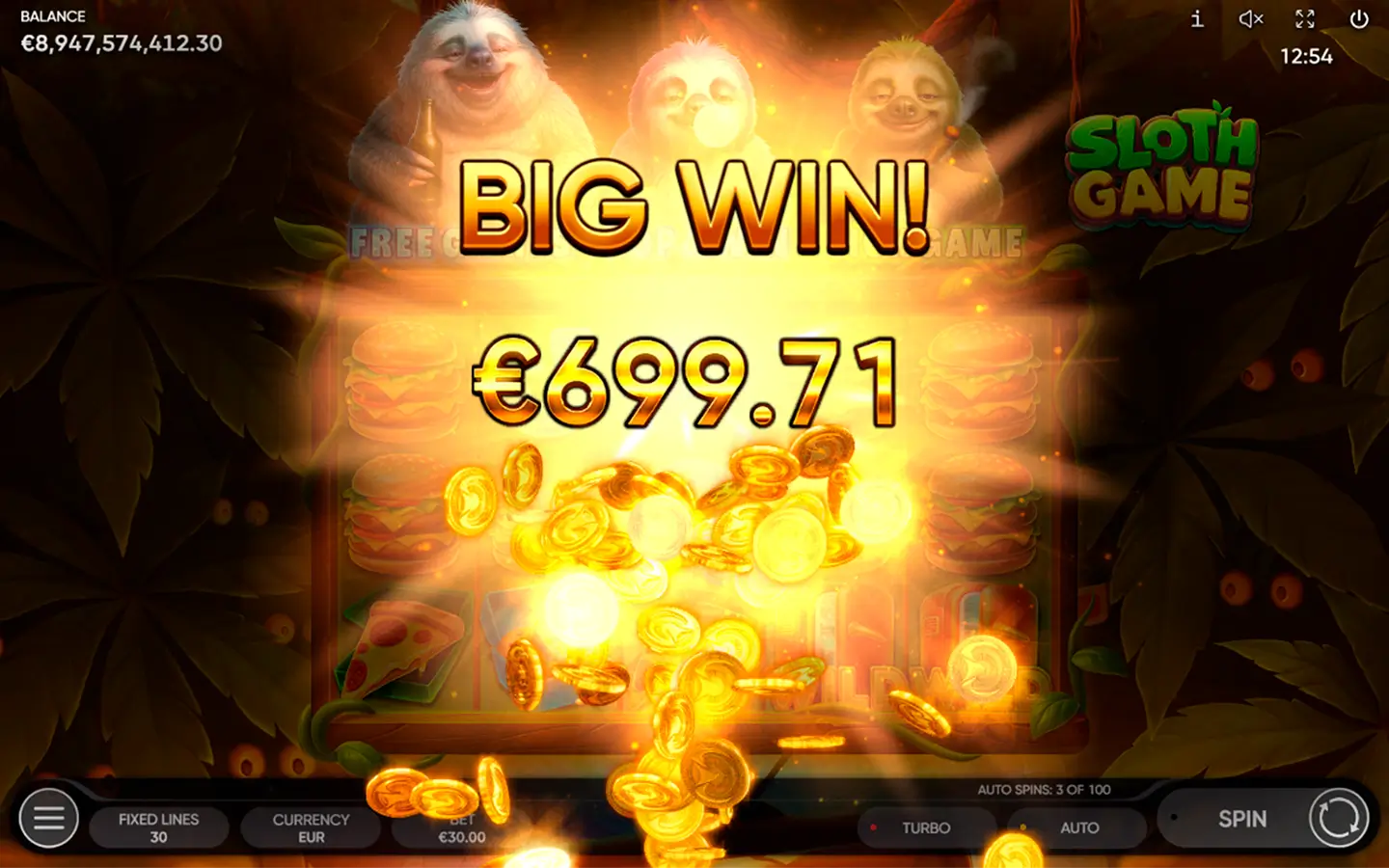
Sloth Game builds its entire identity around three sloth characters sitting above the reels, each one waiting for a specific symbol to appear so it can trigger a different bonus path. That’s a genuinely different structure from most Hold and Win slots, which usually offer one main feature and treat everything else as filler. Here, all three paths carry real weight.
The Free Games feature
The Blue Sloth activates Free Games. Land the trigger and you’re awarded 30 free spins, well above the 8-12 spins that a lot of competing slots hand out. The feature can retrigger during the round itself, extending the session further. Free Games run on the same 30-payline structure as the base game, with the same symbol set, so nothing changes mechanically — you’re just playing a longer, uninterrupted stretch without staking your own balance for each spin.
What Free Games doesn’t do is multiply your win rate dramatically on its own. It’s a volume play: more spins means more chances for the base-paying symbols to line up, and more chances for the other two bonus paths to trigger inside the feature itself. If you’re chasing a specific big number, Free Games is the slow accumulation route, not the fast one.
The Pick Me Bonus Game
The Green Sloth triggers the Pick Me Bonus Game, and this is where the single biggest payout on the entire game sits. Inside this feature, players reveal hidden rewards through a simple selection mechanic — pick an item, see what’s underneath. Somewhere in that pool of options sits the Blaze Award, which pays up to 1,000x the total bet on its own.
That’s worth sitting with for a second: 1,000x out of a maximum 1,600x-1,700x ceiling means a huge share of the game’s entire win potential is concentrated in one specific pick-game outcome, not spread across the Hold and Win jackpot tiers the way you might expect from a title marketed around Hold and Win mechanics. If you’re playing Sloth Game specifically for its biggest number, the Pick Me round — not the Hold and Win board — is where you actually want to land.
The catch, and it’s a real one: pick-and-reveal features are inherently random with no skill involved in the selection itself, and no source has published the odds of landing the Blaze Award specifically versus the other prizes in the pool. Treat the 1,000x figure as the game’s headline number, not a realistic session expectation.
Hold and Win and the jackpot tiers
The third bonus path routes through Hold and Win, triggered when bonus symbols land on the reels. Once triggered, qualifying symbols lock in place while the remaining positions respin. Each respin that lands a new bonus symbol resets the respin counter, and the round ends when no new symbols appear across a full respin cycle. Locked symbols carry cash values, and some carry jackpot labels tied to four separate tiers: Min, Mid, Max, and Ultra.
Here’s the honest limitation, and it’s one that competitor research flags directly: Endorphina hasn’t published the specific respin count, the board fill percentage needed to trigger the top jackpot, or the individual value ranges attached to Min through Ultra. That’s a meaningful gap for a feature this central to the game’s marketing. Compare that to slots where the provider publishes a full jackpot value table upfront — Sloth Game asks you to trust the mechanic without giving you the numbers to evaluate it precisely.
What is confirmed: the Hold and Win round is described as the “main event” of the game by more than one independent reviewer, and it’s the mechanic most closely associated with the game’s overall high-volatility feel. Expect this feature to trigger rarely across a normal session, and expect the payout when it does trigger to depend heavily on how many bonus symbols land during the initial trigger spin — a strong initial trigger with several bonus symbols already on the board is a materially different outcome from a minimal one.
The supporting mechanics
A few smaller systems run alongside the three main bonus paths. Open Refrigerator wilds appear on reels 2 through 5, in both the base game and Free Games, and substitute for every regular symbol except the Bonus symbol and the Token symbols. Token symbols — beer, gum, and cigar icons, each matched to one of the three sloths — appear across the reels and “fly off” when triggered, revealing whatever symbol sits underneath — which can complete a winning combination that wasn’t visible before the token cleared.
There’s also a collection system tied to an energy meter, sometimes described as the Pile Feature, where landing tokens builds toward escalating rewards over the course of a session — the sloths visibly grow bigger on screen as the meter fills, which is presentation rather than a separate payout mechanic, but it does track progress toward the bigger bonus triggers.
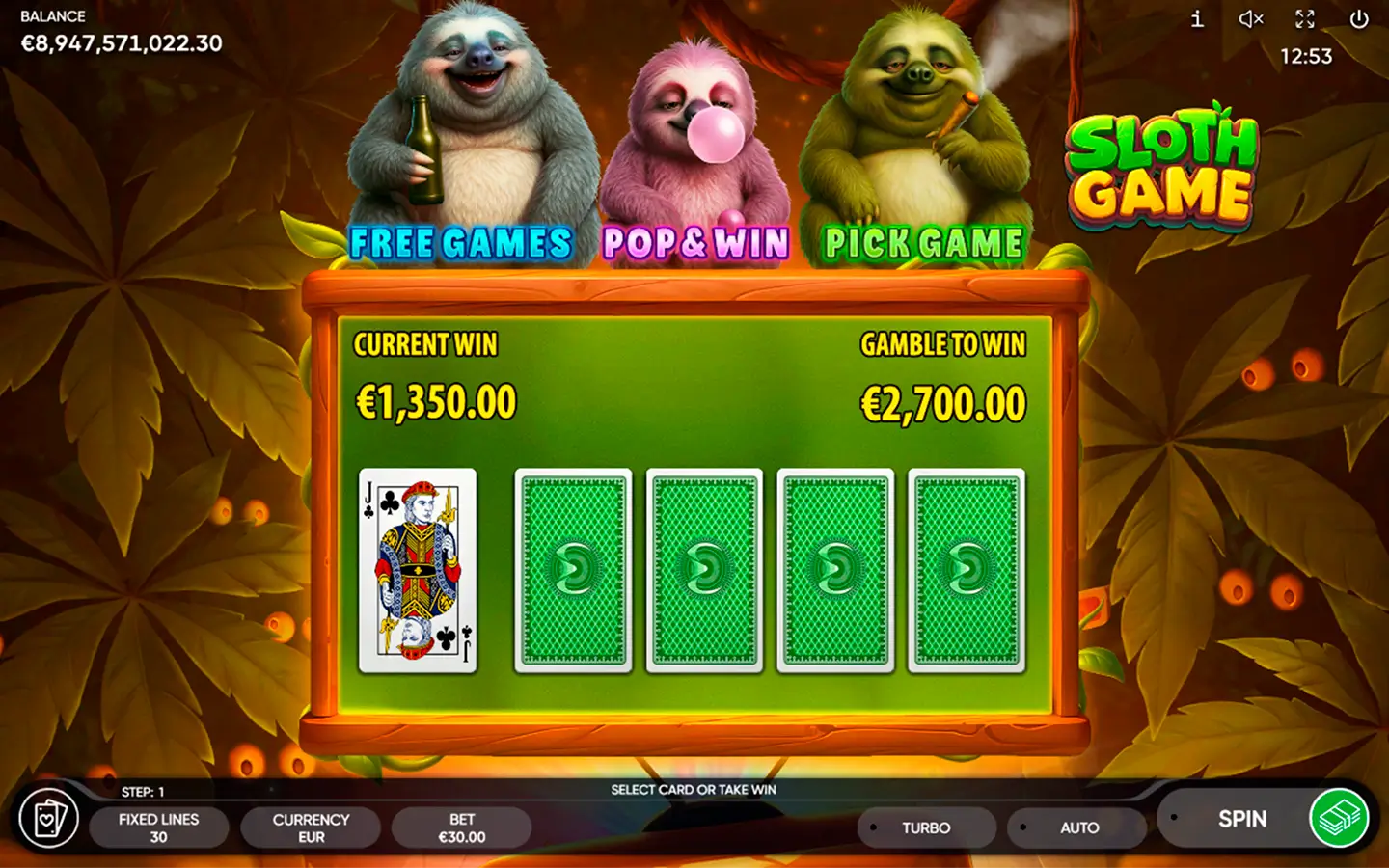
A Lucky Time Feature can activate at random during ordinary base-game spins, described as improving winning opportunities without a published mechanism for exactly how. And a standard Risk Game — Endorphina includes this across most of its catalogue — lets you gamble any win for a chance to double it, at the cost of losing it entirely if you call it wrong.
On the paytable itself: the Double Burger is the top-paying regular symbol, worth 40x the stake for five of a kind. The Popcorn Box sits second, worth 30x for five of a kind. Those are base-game numbers, and they’re modest — realistic base-game wins from partial combinations of these symbols sit well below the multiplier ceiling, generally in the 0.3x to 6x range per one player’s testing notes, which lines up with a game designed to push its real value into the bonus rounds rather than pay it out symbol by symbol.
Below the Double Burger and Popcorn Box, the paytable fills out with the beer, gum, and cigar token symbols doing double duty as both regular paying icons and the trigger mechanism for the token-collection system described above — a design choice that keeps the symbol set compact rather than stacking on a separate row of low-value card symbols the way older slots typically do. That’s a small detail, but it means every symbol on the reels is doing some kind of work toward a bonus path, rather than half of them existing purely as filler between the wilds and scatters.
The game is built in HTML5, which is standard for current releases but still worth confirming for a Bangladeshi mobile-first audience: it runs natively in a phone browser with no separate app download required, on Android and iOS alike, and the interface is designed to stay readable on smaller screens. That matters more than it sounds — a slot with a dense feature stack like this one can get visually cluttered on a 6-inch screen if it wasn’t built with mobile in mind from the start.
No buy-bonus option exists on Sloth Game. If you want to reach Free Games, Pick Me, or Hold and Win, you trigger them through ordinary base-game spins — there’s no instant-access purchase to skip the wait. For a Tier 3 bankroll working with smaller deposits, that’s the right call in practice: a buy-bonus feature on a high-volatility game tends to drain a modest balance in a handful of purchases, and Sloth Game doesn’t give you that option to fall back on.
Sloth Game in the 2026 slot market
Sloth Game launched as a single, standalone release. There’s no Power Reels version, no Megaways adaptation, and no sequel — Endorphina built this on a fixed 30-payline grid with explicitly no cluster pays or adjustable line structure, and nothing in the studio’s release schedule since May 2026 suggests an evolved version is coming. If you’re comparing this to slots where the provider ships a base version and a higher-variance Megaways spin-off within months, that comparison doesn’t apply here. What launched in May is what you’re playing now, and what you’ll be playing for the foreseeable future.
That makes the competitive comparison a straight one: how does Sloth Game’s math stack up against other high-volatility Hold and Win slots available right now, including Endorphina’s own back catalogue?
Two Endorphina titles make the clearest comparison points. King of Ghosts runs at a 96.00% RTP, medium-high volatility, and a 7,000x max win — more than four times Sloth Game’s ceiling, at a very slightly lower RTP. Cyber Wolf runs at 96.07% RTP, high volatility (the same classification as Sloth Game), and a 10,000x max win — over six times Sloth Game’s ceiling, at almost identical RTP.
That comparison isn’t flattering. Sloth Game asks players to absorb the same variance load as Cyber Wolf — long dry stretches, infrequent bonus triggers, high volatility rated at the top of the scale — for a ceiling that’s a fraction of what Cyber Wolf offers at essentially the same return rate. If maximum win potential is what draws you to high-volatility slots in the first place, Sloth Game is the weaker math model of the two, from the same studio, released around the same period.
Widen the lens beyond Endorphina and the comparison shifts, though not dramatically. Wolf Gold, from Pragmatic Play, is the slot widely credited as the one that popularised the Hold and Win mechanic back in 2017, and it’s still one of the most-played titles carrying it. Wolf Gold runs 5 reels, 25 paylines, roughly 96% RTP, medium-high volatility — a notch gentler than Sloth Game’s rating — and a max win around 2,500x. That’s a lower ceiling than Cyber Wolf, but still comfortably ahead of Sloth Game’s 1,600x-1,700x, and it comes with a milder volatility profile, meaning Wolf Gold’s dry spells tend to run shorter. For a Tier 3 bankroll trying to stretch a modest deposit, that combination — a bigger ceiling and gentler variance — makes Wolf Gold the safer high-volatility-adjacent pick between the two, even years after its release.
Where Sloth Game does separate itself is feature density. Three distinct bonus paths — Free Games, Pick Me, and Hold and Win — running alongside a token collection system and a random Lucky Time trigger is genuinely more mechanical depth than a typical Endorphina release carries. That’s worth something if what you value is variety in how a bonus round can play out, rather than chasing the single biggest number on the paytable. It won’t matter to a player who picked this game purely on the strength of its advertised win potential.
Progressive jackpots don’t exist here in the traditional sense — the Min, Mid, Max, and Ultra tiers inside Hold and Win are fixed values attached to that specific feature, not a network-wide progressive pool that grows across every casino running the game. If you’re specifically hunting for a progressive jackpot slot, this isn’t that game, regardless of how the four-tier structure is marketed.
Early performance data is thin, which is expected for a title barely three months old at the time of writing. One tracking platform lists Sloth Game around the 1,000 mark by tracked play volume among slots on its network, with a sample of roughly 9,000 tracked bets — small enough that any trend read from it should be treated as provisional, not conclusive. A newer title simply hasn’t accumulated the volume that a two-year-old slot has, and that’s a timing issue rather than a quality signal either way.
For Bangladeshi players specifically, availability runs through the usual channel: Endorphina titles circulate widely across BD-facing platforms like JeetWin, Betvisa, and Melbet, which regularly carry the studio’s newer releases in their slots sections. Given how recently Sloth Game launched, check your specific casino’s Endorphina catalogue directly rather than assuming it’s live everywhere — new titles roll out to different operators on different timelines. Wherever it does appear, the demo version runs on identical math to the real-money game, which makes it a genuinely useful way to get a feel for how long the dry spells run before committing a deposit.
So — recreational spin, high roller’s game, or dead weight in a crowded 2026 lobby? It sits closer to the middle than either extreme. The feature stack is above average for the studio and genuinely engaging to play through. The ceiling is below average for the risk level the game demands. That combination makes it a reasonable pick for players who value variety over raw win potential, and a weaker pick for anyone chasing the biggest number on the paytable.
Verdict: play it if you know what you’re getting into
Sloth Game is a well-built, feature-dense slot with an honest math model and one genuine mismatch: it demands the same patience as Endorphina’s higher-ceiling titles while paying out considerably less at the top end. The 1,600x-1,700x max win — and yes, that range itself is a flag, since Endorphina hasn’t settled the figure across its own promotional materials — is the single number that limits this game the most. Cyber Wolf, from the same studio, offers over six times that ceiling at nearly the same RTP and the same volatility rating.
Play this if you’re a player who wants mechanical variety in your bonus rounds — three distinct feature paths, a token collection system, and a gamble option — and you’re not specifically chasing a five-figure multiplier. A bankroll built for extended sessions, spread across 100+ spins with stakes sized to survive the dry stretches that high volatility guarantees, is what this game rewards. Someone testing it in demo mode first, to feel out how long those dry spells actually run before a bonus triggers, will get more out of it than someone loading real money in cold.
Skip it if the appeal of a high-volatility slot, for you, is specifically the ceiling — the chance at a life-changing multiplier from a single spin. At 1,600x-1,700x, Sloth Game isn’t that slot in 2026. King of Ghosts or Cyber Wolf, both from Endorphina’s own catalogue, offer four to six times more room at the top for a comparable or lower variance load. Sloth Game’s real strength is in the depth of how it plays, not in how big it can pay.